

On this page
Look at the date and batch code on a milk packet or a soft-drink bottle. The dots were most likely fired at the packet as it raced past on a conveyor, by a continuous inkjet printer. Inside its print head, every droplet of ink is given a measured electric charge and then bent between two charged plates, in exactly the way an electron is bent in a cathode ray tube. The charge on a droplet decides where it lands. This post works out how far a droplet bends and why the charge alone sets the height of each dot.
What is a continuous inkjet printer, and how is it different from a home printer?
A continuous inkjet (CIJ) printer pumps ink through a tiny nozzle as a steady jet. A piezoelectric crystal vibrates at a fixed frequency and breaks the jet into droplets of equal size. Linx, one maker, says its printers expel up to 120,000 droplets every second, each about half the width of a human hair, and the reference figures summarised on Wikipedia's inkjet printing page give a range of roughly 64,000 to 165,000 droplets per second, travelling at about 20 m/s.
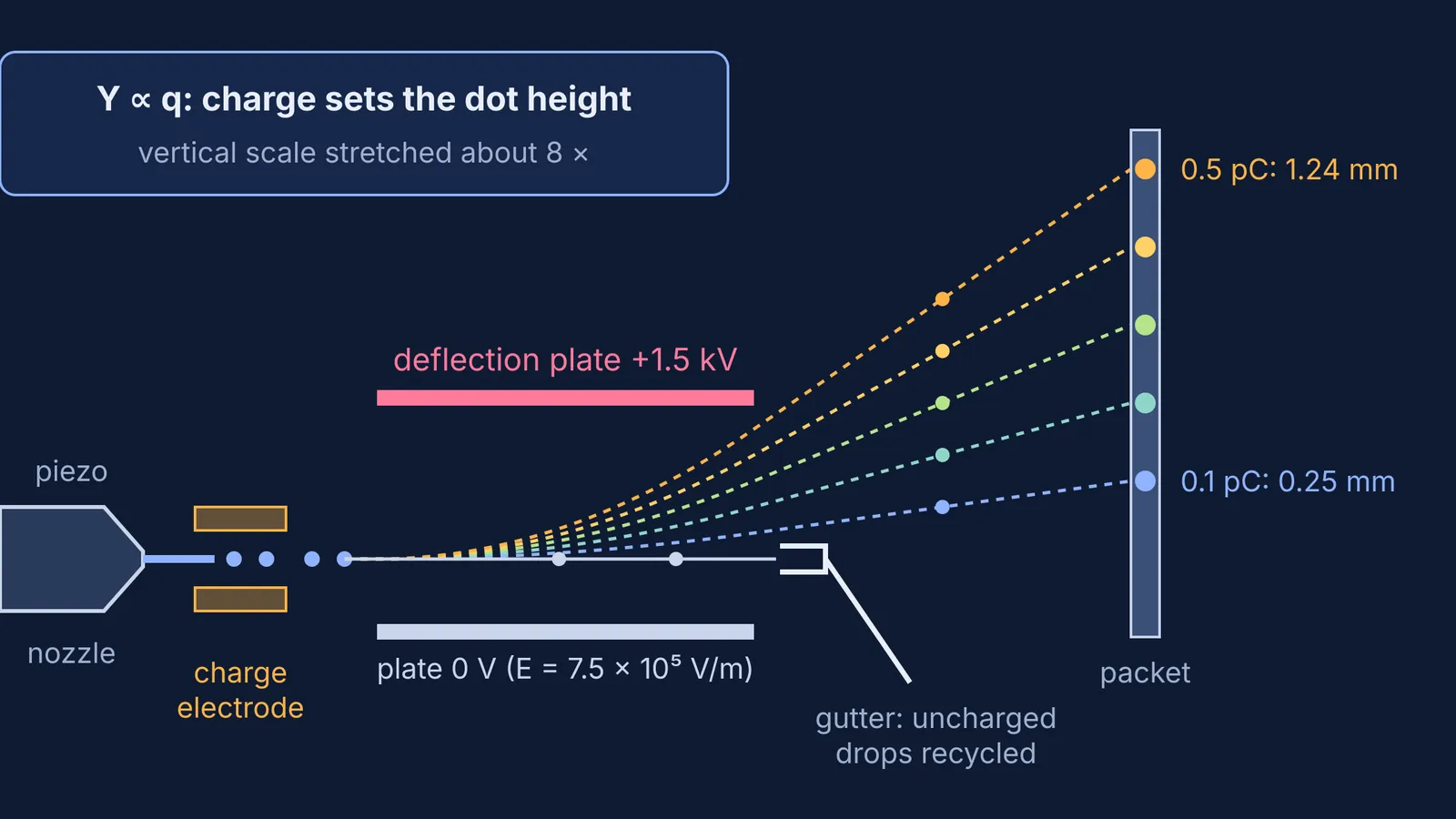
Most of those droplets are never printed. Only the ones that are charged get steered onto the product. Uncharged droplets fly straight into a small tube called the gutter and are sucked back to the ink tank for reuse.
Your home printer works differently. It is a drop-on-demand printer: a tiny heater or piezo element fires a droplet only when a dot is needed, straight at the paper. It has no charging electrode and no deflection plates. Continuous inkjet is the industrial coding type for fast, curved surfaces such as bottles, cables and packets.
How does each droplet get its electric charge?
Charging works by electrostatic induction. The ink is conducting and the jet is held at earth potential through the nozzle. The jet breaks into droplets inside a small charging electrode. When the electrode is at a positive voltage, it attracts negative charge onto the tip of the jet, and the amount of charge is proportional to the electrode voltage. At the moment a droplet pinches off, that charge is trapped on it.
The printer changes the electrode voltage for every droplet, in step with the piezo, so each leaves with its own chosen charge. Droplets meant for the gutter get none.
This is the same induction idea that lets a photocopier lay down toner using static charge, only here the charge is placed on flying liquid drops instead of on a drum.
How far does a charged droplet bend between the plates?
Between the plates there is a uniform field E acting across the droplet's path. Along the path nothing changes the speed, so the droplet moves like a projectile thrown sideways: a parabola inside the plates, then a straight line after it leaves them. The electron version is in electron deflection between charged plates. The difference is that a droplet has a mass about 10²⁰ times larger, so it needs a far larger charge and field to bend.
Two stages add up:
Inside the plates (length L). Time inside t = L/v. Sideways acceleration a = qE/m. Deflection at the exit y₁ = ½a t² = qEL²/(2mv²).
After the plates (drift distance D). The droplet leaves with sideways velocity v_y = at = qEL/(mv) and travels in a straight line for a time D/v. Extra deflection y₂ = qELD/(mv²).
Total deflection on the surface:
Y = qEL(L/2 + D)/(mv²)
A neat way to remember it: the straight line after the plates points back to the middle of the plates, as if the droplet had been kicked sideways at L/2.
Worked example: where does a 0.5 pC droplet land?
These values are illustrative; real print heads vary from maker to maker.
Droplet diameter d = 60 µm, ink density ρ = 1000 kg/m³
Speed v = 20 m/s
Plates L = 10 mm long, 2 mm apart, with 1.5 kV across them
Surface D = 10 mm beyond the end of the plates
Charge q = 0.5 pC = 5 × 10⁻¹³ C
Mass. m = ρπd³/6 = 1000 × π × (60 × 10⁻⁶)³/6 = 1.13 × 10⁻¹⁰ kg.
Field. E = V/d = 1500/0.002 = 7.5 × 10⁵ V/m.
Force. F = qE = 5 × 10⁻¹³ × 7.5 × 10⁵ = 3.75 × 10⁻⁷ N. The droplet's weight is mg = 1.11 × 10⁻⁹ N, so the electric force is about 338 times the weight.
Time between the plates. t = L/v = 0.01/20 = 5.0 × 10⁻⁴ s.
Deflection at the exit. a = F/m = 3.32 × 10³ m/s², so y₁ = ½at² = 0.41 mm.
Drift. v_y = at = 1.66 m/s, giving y₂ = v_y × D/v = 1.66 × 0.01/20 = 0.83 mm.
Total. Y = 0.41 + 0.83 = 1.24 mm. Check with the formula: Y = qEL(L/2 + D)/(mv²) = 1.24 mm. The droplet leaves the plates at about 4.7° to its original line.
Units: N m² divided by N m gives metres.
Now repeat with q = 0.1 pC. Everything is the same except q, so Y is five times smaller: 0.25 mm. Droplets with 0.1, 0.2, 0.3, 0.4 and 0.5 pC land at 0.25, 0.50, 0.75, 0.99 and 1.24 mm. That is a column of evenly spaced dots, placed by charge alone. As the packet moves, column after column builds the letters.
Why do the droplets have to be exactly the same size?
The formula depends on q/m, not on q alone. If one droplet were 10% wider, its mass would be 1.1³ = 1.33 times larger and, with the same charge, it would land 25% lower. That is why the jet is broken up by a piezo crystal at a fixed frequency instead of being left to break up on its own: forced break-up makes the droplets uniform in size and spacing.
Does gravity bend the droplets too?
Barely. The whole flight from the start of the plates to the packet is 20 mm, which takes 20 mm ÷ 20 m/s = 1.0 ms. In that time gravity pulls a droplet down by ½gt² = ½ × 9.8 × (1.0 × 10⁻³)² = 4.9 µm. That is about 250 times smaller than the electric deflection, and the same for every droplet.
If you want to see how the path changes as you vary q, E or the plate length, try the Simulation Lab. For more problems on charged particles in fields, the Fermi Problem Library has a step-by-step solver that explains the reasoning.
Quick checklist
Continuous inkjet: a constant jet broken into equal droplets by a piezo crystal; home printers are drop-on-demand.
Charge comes from induction at the charging electrode and is set droplet by droplet.
Inside the plates the path is a parabola; after them it is a straight line.
Total deflection Y = qEL(L/2 + D)/(mv²), proportional to q/m.
Worked example: 0.5 pC gives 1.24 mm, 0.1 pC gives 0.25 mm; gravity adds only 4.9 µm.
Uncharged droplets go to the gutter and are reused.


