On this page
Add a drop of phenolphthalein to 0.1 M sodium hydroxide and you get a deep pink. Leave the test tube on the bench and within about twenty minutes most of the pink has gone. This is not the fade you see at a titration end point. That one happens because carbon dioxide from the air lowers the pH below about 8.2, as explained in why phenolphthalein pink fades after the end point. Here the opposite is true: the solution stays strongly alkaline, and the indicator itself turns into a third, colourless form. The fade is slow enough to time, which makes it a standard kinetics experiment.
What are the three forms of phenolphthalein?
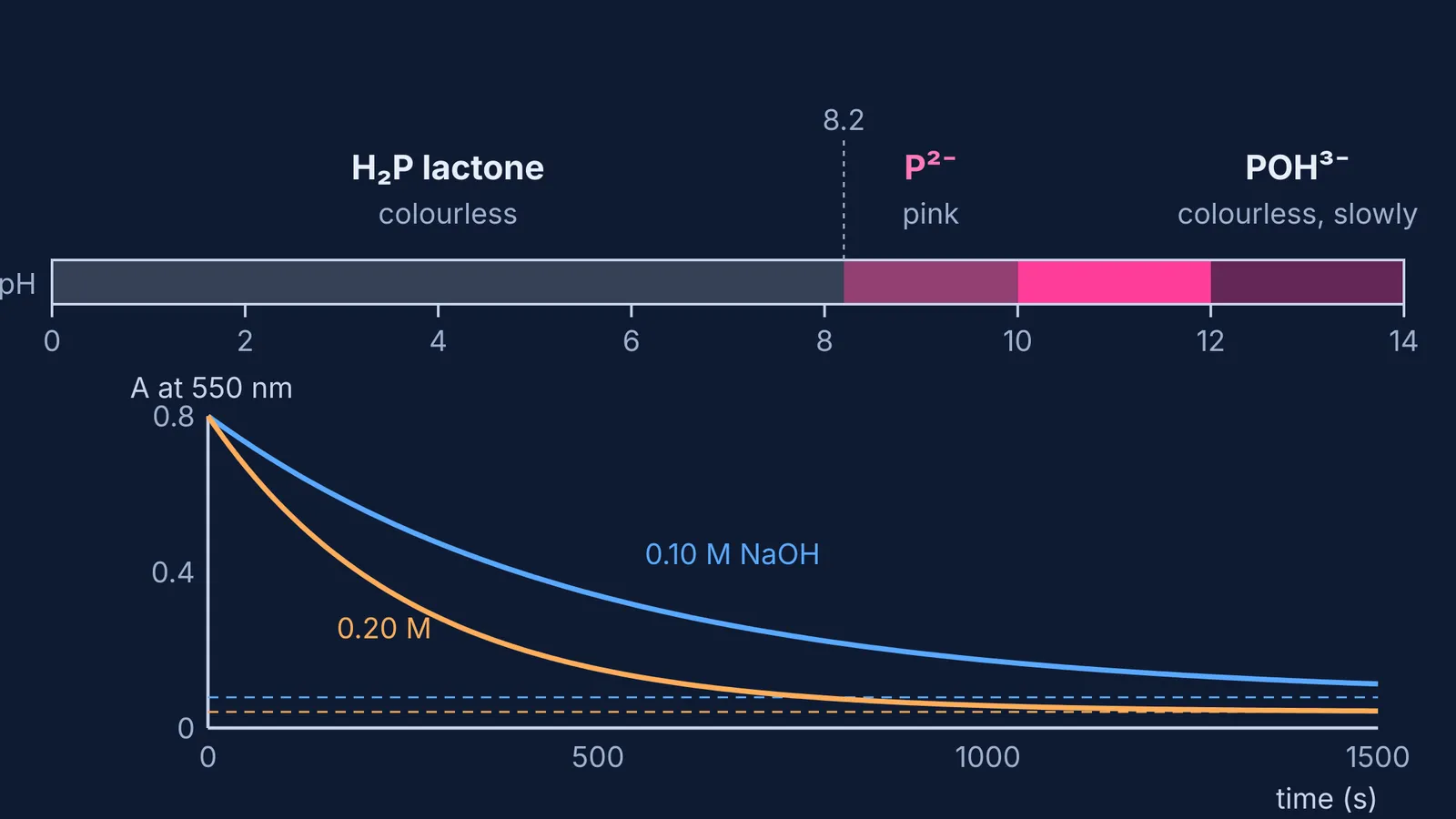
H₂P, the lactone form: colourless. This is what you have in acid and in neutral solution, up to about pH 8.2. The central carbon is sp³, so the three rings are not conjugated with each other.
P²⁻, the dianion: pink. Between about pH 8.2 and 10, the indicator loses two protons and the lactone ring opens. The central carbon becomes sp², and the π system now runs across the whole molecule. It absorbs green light near 550 nm, so you see pink to magenta.
POH³⁻, the carbinol form: colourless. In strong alkali, a hydroxide ion slowly adds to the central carbon. That carbon becomes sp³ again, the long conjugation is cut, and the colour goes.
The step that removes the colour is:
P²⁻ + OH⁻ ⇌ POH³⁻
Check the charges: −2 + (−1) = −3 on both sides. It is reversible, so a little pink is always left at equilibrium. The usual table entry, "pink above about pH 8.2", is right for everything you do in a titration, because at those hydroxide levels this third step is far too slow to notice.
Why does the pink fade slowly instead of at once?
The rate law found by experiment is:
rate = k₁[P²⁻][OH⁻] − k₋₁[POH³⁻]
The forward step needs two negative ions to meet, and they repel each other, so it is slow. Nicholson's classroom study (J. Chem. Educ. 1989, 66, 725) measured the order in OH⁻ as 1.03, so first order, and the second-order rate constant as k₁ ≈ 1.1 L mol⁻¹ min⁻¹ at 23 °C, with the ionic strength held at 0.30 M by mixing NaOH with NaCl. In seconds, that is k₁ ≈ 0.018 L mol⁻¹ s⁻¹.
Why fix the ionic strength? Because the reactants are both anions, adding any inert salt shields their repulsion and speeds the reaction up (the primary salt effect). A k₁ value only means something with the ionic strength beside it.
Why is the fading reaction pseudo first order?
In a typical run, [OH⁻] is 0.05 to 0.3 M while the indicator is around 10⁻⁵ M. The hydroxide hardly changes, so k₁[OH⁻] acts as a single constant, k′. The decay of the pink then follows a first-order law with k′ = k₁[OH⁻]. This is the same idea as ester hydrolysis in excess water, covered in pseudo first-order reactions. The reaction is really second order overall; the first-order look comes from the excess.
You follow the reaction with a colorimeter at 550 nm. By the Beer–Lambert law, absorbance is proportional to [P²⁻], so you can use absorbance in place of concentration.
Worked example: how fast does the pink fade?
Use Nicholson's k₁ = 0.018 L mol⁻¹ s⁻¹ and ignore the reverse step for now, which is fair early in the reaction.
(a) Half-life at different hydroxide concentrations. For a first-order decay, t½ = 0.693 ÷ k′, with k′ = k₁[OH⁻].
0.30 M NaOH: k′ = 0.018 × 0.30 = 5.5 × 10⁻³ s⁻¹, so t½ ≈ 126 s, about 2 minutes.
0.10 M NaOH: k′ = 1.8 × 10⁻³ s⁻¹, so t½ ≈ 380 s, about 6 minutes.
0.05 M NaOH: t½ ≈ 760 s, about 13 minutes.
Titration end point near pH 10, where [OH⁻] = 10⁻⁴ M: t½ ≈ 3.8 × 10⁵ s, about 4 days. This one is a rough extrapolation, since the ionic strength is different, but it shows why you never see this fade in a titration.
(b) Checking the order in OH⁻. Going from 0.05 M to 0.10 M halves the half-life (13 to 6 minutes). Half-life inversely proportional to [OH⁻] means the reaction is first order in OH⁻.
(c) The reversible step. These numbers are made up for practice. In 0.10 M NaOH, the absorbance starts at A₀ = 0.80 and levels off at A_eq = 0.08 instead of zero. A plot of ln(A − A_eq) against time is a straight line with slope −2.0 × 10⁻³ s⁻¹. Find k′ and k₋₁.
For a reversible first-order approach, the observed constant is the sum: k′ + k₋₁ = 2.0 × 10⁻³ s⁻¹. The derivation is in reversible first-order kinetics.
At equilibrium, k′[P²⁻] = k₋₁[POH³⁻], so the fraction left pink is k₋₁ ÷ (k′ + k₋₁) = A_eq ÷ A₀ = 0.08 ÷ 0.80 = 0.10.
So k₋₁ = 0.10 × 2.0 × 10⁻³ = 2.0 × 10⁻⁴ s⁻¹.
And k′ = 2.0 × 10⁻³ − 2.0 × 10⁻⁴ = 1.8 × 10⁻³ s⁻¹, giving k₁ = k′ ÷ [OH⁻] = 1.8 × 10⁻³ ÷ 0.10 = 0.018 L mol⁻¹ s⁻¹.
The trap is to read the slope as k′ alone. The rate of approach to equilibrium is the sum of the forward and backward constants. Notice also that more hydroxide pushes the equilibrium further towards the colourless form, so A_eq is lower in stronger alkali, not the same at every concentration.
What should you write in the exam?
Indicator questions: phenolphthalein is colourless in acid and pink in base, with a range of about 8.2 to 10. That is the expected answer. Mention the strong-alkali fade only if the question asks about it.
Kinetics questions on this reaction: rate = k₁[P²⁻][OH⁻], pseudo first order with k′ = k₁[OH⁻] when OH⁻ is in excess, and second order overall.
Reversible relaxation: k_obs = k₁[OH⁻] + k₋₁, and the equilibrium fraction of pink left is k₋₁ ÷ k_obs.
Why colourless: OH⁻ adds to the central carbon, which becomes sp³ and breaks the conjugation.
If you are trying this in the lab, use 0.1 M NaOH or weaker, wear goggles, and keep the solution off your skin.
For more practice on pseudo first-order and reversible rate problems, the Fermi Problem Library has a step-by-step solver that explains the reasoning. If you are revising indicators and kinetics for the exam, Fermi Test Prep for JEE Main and Advanced has an AI tutor to work through them with you.
Quick checklist
Three forms: H₂P colourless, P²⁻ pink, POH³⁻ colourless.
Fading step: P²⁻ + OH⁻ ⇌ POH³⁻, slow because two anions must meet.
k₁ ≈ 0.018 L mol⁻¹ s⁻¹ at 23 °C and ionic strength 0.30 M (Nicholson, 1989).
Excess OH⁻ makes it pseudo first order: t½ = 0.693 ÷ (k₁[OH⁻]).
Approach to equilibrium: k_obs = k₁[OH⁻] + k₋₁.
End-point fade (CO₂, pH falls) is a different effect from strong-alkali fade (pH stays high).