On this page
You add one last drop of sodium hydroxide, the solution in the conical flask turns a faint pink, and you write down the burette reading. A minute later the pink has gone. It is tempting to think you stopped too early and add another drop. Usually you should not. The colour faded because of the air, not because of a mistake.
Why does phenolphthalein pink fade after the end point?
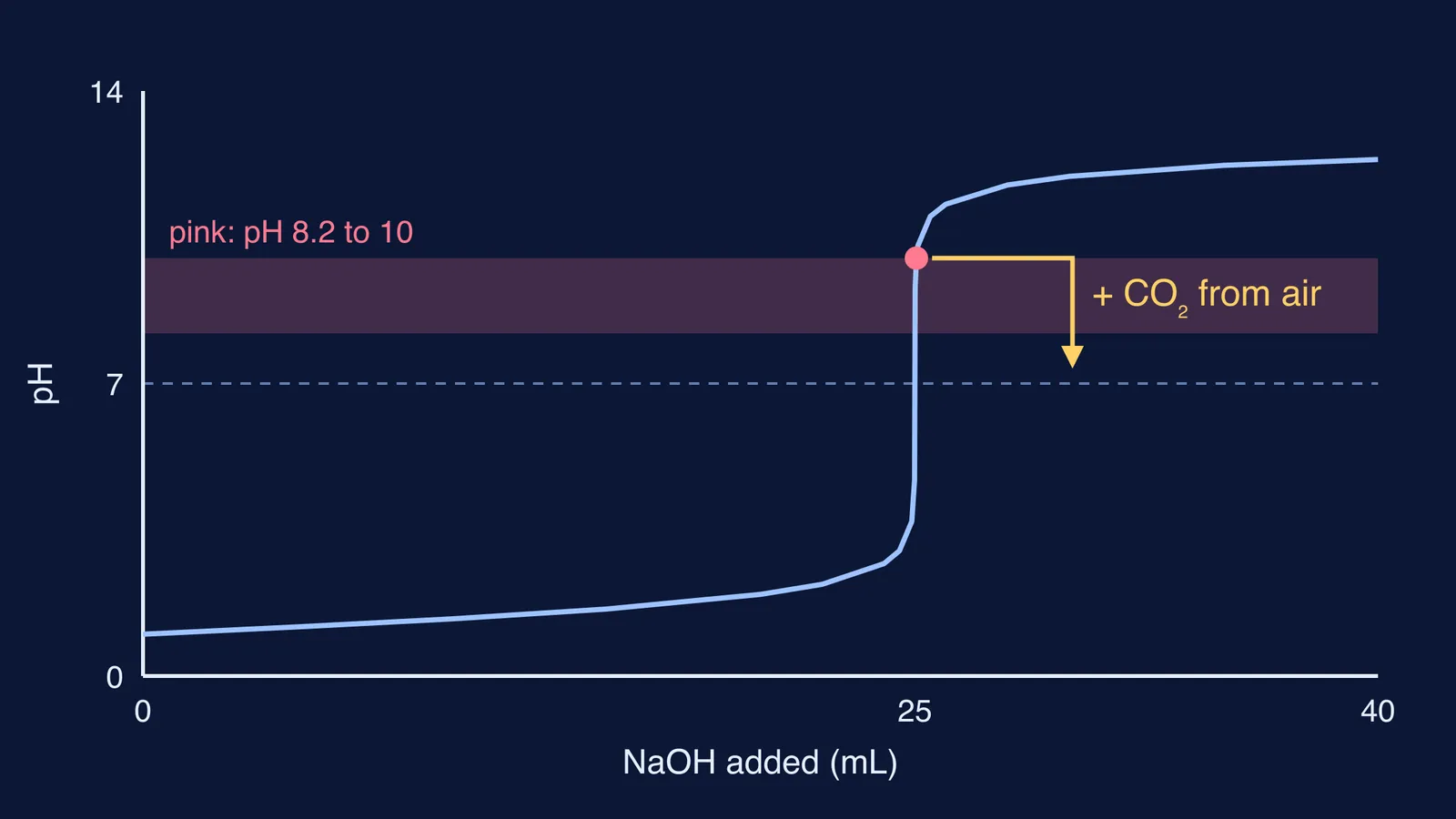
Phenolphthalein is colourless below about pH 8.2 and turns pink to red between pH 8.2 and 10, according to Chemistry LibreTexts/Acids_and_Bases/Acid_and_Base_Indicators/Acid_and_Base_Indicators). At the end point of an acid-base titration, the pink comes from a very small excess of base, often a fraction of a drop. So the pH sits just inside the pink band, and it does not take much acid to push it back out.
The air supplies that acid. The US Geological Survey explains that carbon dioxide and water react to form carbonic acid, a weak acid, which is why even clean rain has a pH of about 5.6 (USGS). The same thing happens at the open mouth of your flask, especially while you swirl it:
CO₂ from the air dissolves: CO₂ + H₂O ⇌ H₂CO₃
The carbonic acid eats up the spare hydroxide: H₂CO₃ + OH⁻ → HCO₃⁻ + H₂O
With the excess OH⁻ gone, the pH slips below about 8.2 and the indicator turns colourless again.
Water-testing labs measure dissolved CO₂ by exactly this reaction: in Hach's Method 8223, carbonic acid in a water sample is titrated with sodium hydroxide to a phenolphthalein end point at pH 8.3 (Hach Method 8223). If CO₂ can use up NaOH in their flask, it can use up the last drop of NaOH in yours.
How much carbon dioxide does it take to fade the pink?
Very little. Suppose you titrate 25.0 mL of 0.100 M HCl with 0.100 M NaOH and overshoot the equivalence point by a small drop of 0.05 mL.
Excess OH⁻ = 0.100 mol/L × 0.05 × 10⁻³ L = 5.0 × 10⁻⁶ mol
Total volume is about 50 mL, so [OH⁻] = 5.0 × 10⁻⁶ ÷ 0.050 = 1.0 × 10⁻⁴ M
pOH = 4, so pH = 10: clearly pink
To neutralise it, you need 5.0 × 10⁻⁶ mol of CO₂ (one CO₂ per OH⁻), which is about 0.22 mg
NOAA's global monitoring network put the average CO₂ in air at 426.10 ppm in July 2026 (NOAA Global Monitoring Laboratory). One litre of air at room temperature holds about 0.041 mol of gas, so it carries roughly 1.7 × 10⁻⁵ mol of CO₂. So about 0.3 L of air, a little more than a 250 mL conical flask holds, carries enough CO₂ to wipe out that drop. CO₂ dissolves slowly, so this takes time rather than happening at once, but it does happen.
Why do lab manuals say the pink must last 30 seconds?
Because there are two different reasons the pink can disappear, and the time tells you which one you are seeing. Hach's method, for example, says to add titrant until the colour changes from colourless to light pink "for a minimum of 30 seconds" (Hach Method 8223).
Pink that vanishes as you swirl means the drop made a local pink patch where it landed, but the flask as a whole is still acidic. You have not reached the end point.
Pink that holds for 30 seconds, then fades slowly means the whole solution was past the end point and CO₂ is now neutralising the small excess. That reading is your end point.
If your teacher or examiner words the rule differently, follow the instruction you are given in the lab.
What should you do at the burette?
Use this checklist in your school practical or board exam:
Near the expected volume, add NaOH one drop at a time and swirl after each drop.
When pink appears, stop and count to 30 while swirling gently.
Pink gone before 30 seconds: add one more drop and repeat.
Pink still there at 30 seconds: record the reading at once.
If it fades later, leave it. Do not add more.
Aim for the faintest pink you can see against a white tile. Deep pink means you overshot.
Carbon dioxide also affects your titrant before it ever reaches the flask, which is one reason sodium hydroxide cannot be used as a primary standard and is checked against a standard solution of oxalic acid instead. If the words "end point" and "equivalence point" still blur together, read equivalence point vs end point next.
To go back over indicators, pH and carbonic acid as connected ideas, the Fermi Concept Library gives each concept its own lesson and shows where it sits in the map. When you want to check a titration numerical line by line, the Fermi Problem Library has worked problems with a step-by-step solver that explains the reasoning rather than printing an answer.