

On this page
On a threshing floor, a farmer lifts a basket of threshed wheat overhead and pours it slowly into a breeze. The grain lands in a heap at her feet. The chaff, the papery husks around each grain, sails off and settles several metres away. This post works out, with real measured terminal speeds, how far each kind of particle drifts and why.
Why doesn't the wind blow the grain away too?
Grain is not "too heavy for the wind". The wind pushes on it too. What matters is how hard it pushes compared with the grain's weight, and for how long.
Air drag depends on the particle's speed relative to the air, not relative to the ground. A particle that has just left the basket is at rest, so a 3 m/s wind blows past it sideways at 3 m/s and drags it downwind. As it falls, it also meets air coming up from below. The drag force points along the air's motion relative to the particle, not straight up.
For particles moving fast enough through air, drag grows as the square of the relative speed. You can then describe each particle by one number, its terminal velocity v_t, the speed at which drag equals weight. That gives a neat form of the drag law:
drag = mg × (relative speed ÷ v_t)²
So the drag force divided by the mass, the acceleration it causes, is g × (relative speed ÷ v_t)². The mass has dropped out. Two particles with the same terminal speed move the same way in the same wind, whatever they weigh. If you want the comparison of linear and quadratic drag first, see terminal velocity with linear and quadratic drag.
What are the terminal velocities of wheat grain and chaff?
They have been measured in vertical wind tunnels: the air speed is raised until the particle floats. A 2020 study of two Iranian wheat cultivars by Jafari, Chegini and Khazaei, published in Acta Universitatis Agriculturae et Silviculturae Mendelianae Brunensis, reported these ranges across particle orientation and moisture content (14% and 20%, dry basis):
Grain: 7.3 to 8.9 m/s.
Rachis pieces (bits of the ear's stem): 2.2 to 4.2 m/s.
Straw pieces: 0.6 to 1.9 m/s.
Chaff: 0.35 to 0.64 m/s.
The grain's terminal speed is more than ten times the chaff's. A grain is compact and dense, so a lot of mass sits behind a small area. Chaff is a thin flake, with little mass behind a large area. Treat them as typical: they shift with variety, moisture and tumbling.
Plug in the start of the fall. The wind gives a particle at rest a sideways acceleration of g × (3 ÷ v_t)². For grain at 8 m/s that is 1.4 m/s². For chaff at 0.5 m/s it is about 350 m/s², so the chaff is moving with the wind within about a hundredth of a second.
How far does each particle drift? A worked example
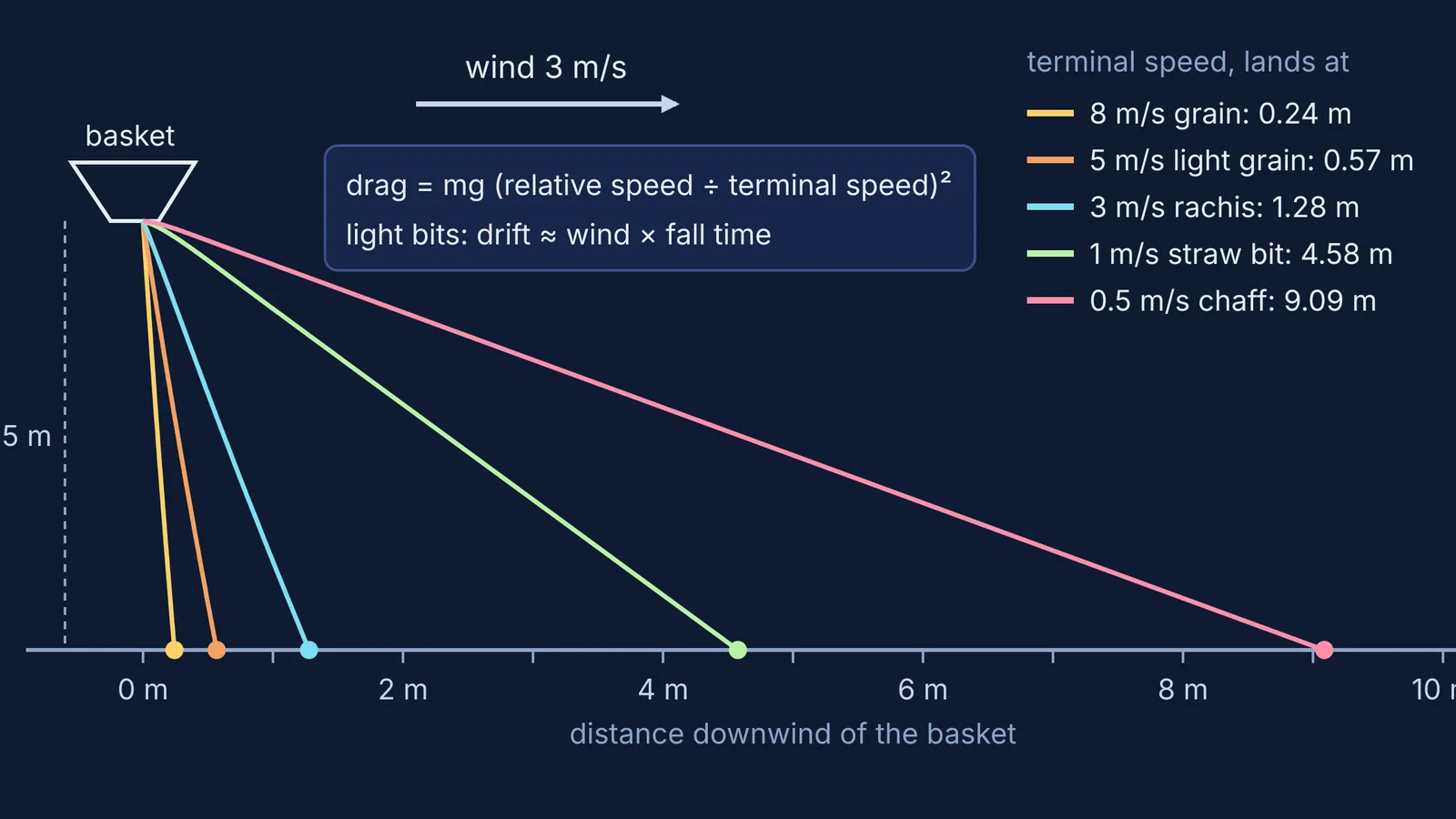
Take a drop height of 1.5 m and a steady 3 m/s wind. Use g = 9.8 m/s². We ran the motion in small time steps of 10 microseconds, using the drag law above with relative velocity, until each particle reached the ground. The 5 m/s "light grain" is an illustrative value for shrivelled grain; the others sit inside the measured ranges.
Fall time in vacuum. t = √(2h ÷ g) = √(2 × 1.5 ÷ 9.8) = 0.55 s. A grain falling this long reaches about 5.4 m/s, well below its 8 m/s terminal speed, so drag only slows it a little.
Grain, v_t = 8 m/s. The numerical run gives a fall time of 0.58 s and a landing point 0.24 m downwind. The wind pushed it for barely half a second, and with only 1.4 m/s² of sideways push to start with, it never got close to wind speed.
Light grain, v_t = 5 m/s. 0.63 s and 0.57 m.
Rachis, v_t = 3 m/s. 0.74 s and 1.28 m.
Straw piece, v_t = 1 m/s. This one reaches its terminal speed in about v_t ÷ g = 0.1 s. After that it falls at 1 m/s while moving sideways with the wind. A quick estimate: fall time ≈ 1.5 ÷ 1 + 0.1 = 1.6 s, drift ≈ 3 × 1.6 = 4.8 m. The run gives 1.60 s and 4.58 m; the estimate is a little high because the particle starts with no sideways speed.
Chaff, v_t = 0.5 m/s. It falls at 0.5 m/s for about 3 s. The run gives 3.05 s and 9.09 m.
So the floor sorts itself into bands: good grain under the basket, light grain just beyond, stalk pieces a metre or so out, and straw and chaff blown clear by several metres. For particles that reach terminal speed almost at once, you can skip the step-by-step run and use drift ≈ wind speed × (height ÷ v_t).
How is this different from sparks rising or mud settling in a river?
In why bonfire sparks fly upward, the air moves up, and an ember rises if the updraft is faster than its terminal speed.
In why rivers turn muddy brown in the monsoon, particles settle through water, and the small ones stay suspended.
Winnowing uses a sideways flow. No particle has to be held up; the wind only has to carry the slow fallers further than the fast ones. That is why a gentle breeze of a few metres a second is enough, even though it is far below the 7 to 9 m/s needed to lift a wheat grain.
Does real winnowing work exactly like this?
The pattern holds, but the numbers spread out.
Real wind is gusty, so each kind of particle lands over a range, not at one point. The bands overlap a little.
A moving basket widens each band again.
Chaff tumbles and flutters, so its effective terminal speed changes as it falls.
For the lightest flakes, drag is not purely quadratic. At these sizes and speeds the flow is in between the linear and quadratic regimes, so the simple model is an approximation.
Threshers and combine harvesters separate grain the same way, with a fan blowing through a sieve instead of a breeze. The fan's air speed has to sit between the terminal speeds of chaff and grain, which is exactly what wind-tunnel studies like the one above are used for.
If you want to see how the wind speed and drop height change the landing points, the Simulation Lab has interactive simulations for ideas that are easier to see than read.
Quick checklist
Drag depends on velocity relative to the air, not to the ground.
With quadratic drag, the acceleration is g × (relative speed ÷ v_t)², so a particle's motion is set by its terminal speed alone.
Measured terminal speeds: wheat grain about 7 to 9 m/s, chaff about 0.4 to 0.6 m/s.
Grain falls almost as in vacuum and drifts little; chaff matches the wind at once and drifts for its whole slow fall.
Light particles: drift ≈ wind speed × height ÷ terminal speed.
Gusts, tumbling and a moving basket spread the landing points into overlapping bands.


