

On this page
A river that runs clear in April can look like milky tea by August. The change is soil, and the way it gets there ties together three chapters you study separately: erosion, suspensions and sedimentation.
Why do rivers turn muddy brown during the monsoon?
The US Geological Survey puts it in one line: during a rainstorm, particles from the surrounding land are washed into the river, turning the water muddy brown (USGS Water Science School). Turbidity measures how much light material in the water scatters, in nephelometric turbidity units (NTU). At low flow, many rivers run clear, usually at less than 10 NTU, the same page says.
Three things happen in order:
Detach. Raindrops hit bare soil like small bombs, breaking up its structure and throwing particles as high as 0.6 m and as far as 1.5 m sideways (Tasmania's Department of Natural Resources and Environment). The loosened grains also block soil pores, so less water soaks in and more runs off.
Carry. Runoff sweeps the loose soil downhill into streams, and the streams feed the river.
Hold. The swollen river is fast and turbulent. Its eddies keep lifting fine grains, so they stay mixed through the water instead of sinking.
How much mud does a monsoon river carry?
Researchers at Jawaharlal Nehru University sampled the Godavari, Krishna and Cauvery and estimated that the Godavari moves about 170 million tonnes of sediment a year (Vaithiyanathan, Ramanathan and Subramanian, IAHS Publication 174, 1988). The same study found that more than 95% of sediment transport in these rivers happens within a three-month part of the monsoon. Fine sediment made up between 49% and 87% of the Godavari's annual load in their size measurements.
Is muddy river water a suspension or a colloid?
Mostly a suspension. Geologists sort grains on the Wentworth scale: sand is 62.5 µm to 2 mm, silt is 4 µm to 62.5 µm, and clay is smaller than 4 µm (USGS). Sand and silt settle out if the water is left still, which is what makes the mixture a suspension. The finest clay is much slower and can leave a jar hazy for days. Our guide to telling a true solution, colloid and suspension apart walks through the tests.
How long does river silt take to settle? A worked example
A small grain sinking through water quickly reaches a steady speed given by Stokes' law: v = (2/9)(ρp − ρf)gR²/μ, which holds when the Reynolds number is below about 1 (Stokes' law). The full derivation is in our post on terminal velocity of a sphere in a viscous fluid.
Take a quartz grain and plug in:
Grain density ρp = 2650 kg/m³, since quartz has a specific gravity of 2.65 (Quartz)
Water density ρf = 1000 kg/m³ and viscosity μ = 1 mPa·s at 20 °C (Viscosity)
g = 9.81 m/s²
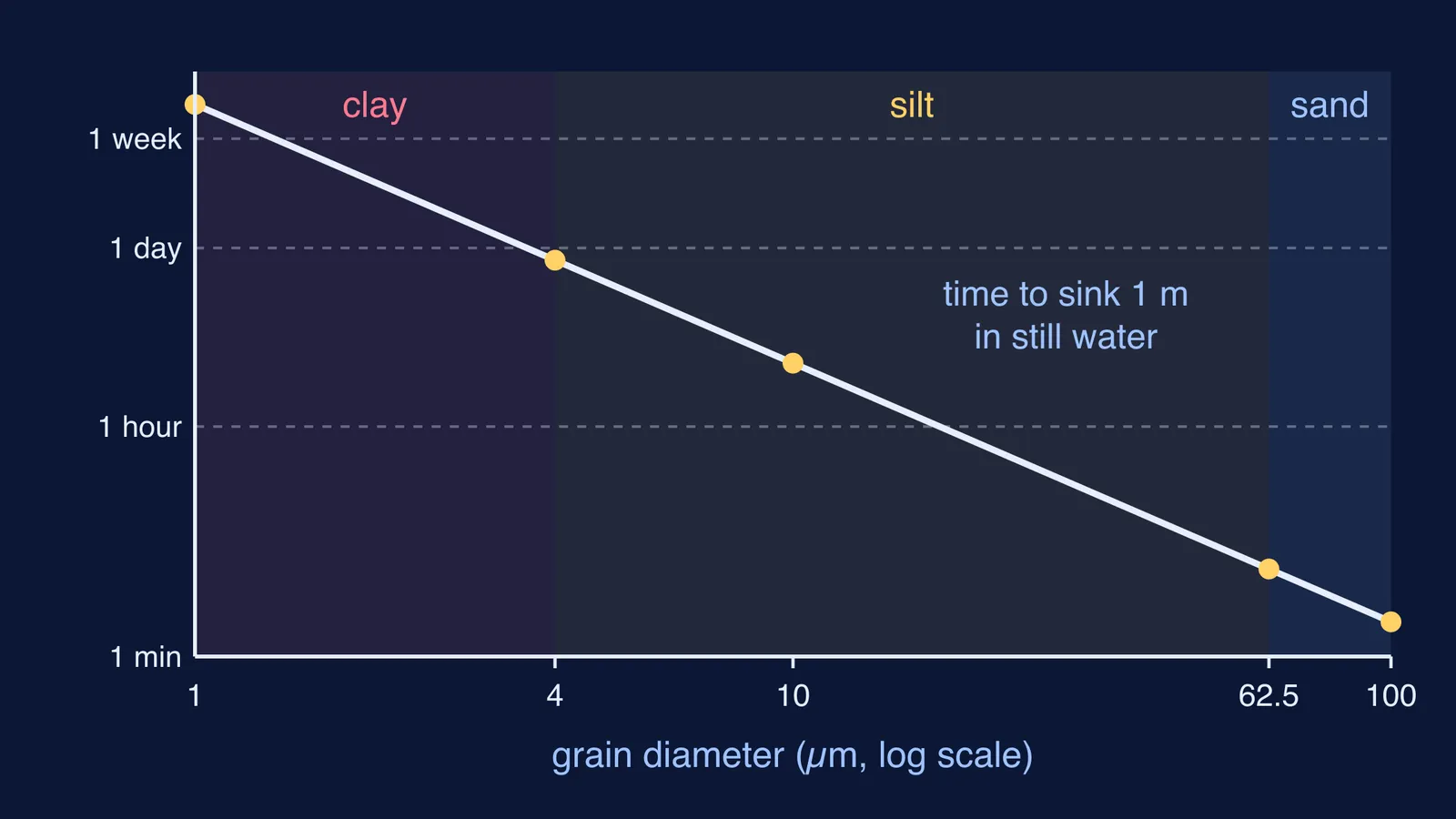
That gives v ≈ 3.6 × 10⁶ × R², with v in m/s and R in metres. Now work out the time to sink just 1 metre in still water:
Sand, 100 µm across: about 9 mm/s, so roughly 2 minutes.
Coarse silt, 50 µm: about 2.2 mm/s, so about 7 minutes.
Fine silt, 10 µm: about 0.09 mm/s, so about 3 hours.
Silt-clay boundary, 4 µm: about 19 hours.
Clay, 1 µm: about 13 days.
The R² does the work: a grain ten times narrower falls a hundred times slower. A river is metres deep and churning, so fine silt and clay ride along until the water slows, on a floodplain, behind a dam or at the delta. In sediment cores from the delta regions, the JNU team measured deposition of about 1.1 cm a year for the Krishna and 0.35 cm a year for the Cauvery (IAHS Publication 174).
To watch size, speed and settling trade off, the Fermi Simulation Lab has interactive simulations for ideas that are easier to see than to read.
Try it yourself: the two-jar settling test
Stir a spoon of garden soil into each of two clear jars of water.
Leave one still. Keep swirling the other for a minute.
In the still jar, grit drops within a minute, silt over the next hour or so, and the top can stay hazy into the next day, as the numbers above predict.
The swirled jar stays evenly brown while you stir, like a turbulent river.
Next day, add a pinch of alum to the hazy jar and watch the haze clump and sink. Our post on how alum clears muddy water explains why.
If a Stokes' law numerical keeps going wrong at the unit conversion, the Fermi Problem Library has worked problems with a step-by-step solver that explains the reasoning rather than printing an answer.
Next time a river runs brown, you are watching hillsides on the move, one slow-sinking grain at a time.


