

On this page
Here are 13 new questions on Morphology of Flowering Plants, Chapter 5 of NCERT Class 11 Biology (Reprint 2026-27): six statement-based items, four match-the-list items and three single-correct MCQs. Every answer carries a one-line NCERT reason. The NMC syllabus for NEET (UG) 2026 places these topics in Biology Unit 2, Structural Organisation in Animals and Plants.
New to the chapter? Begin with our NEET preparation guide for this chapter.
Can you judge these morphology statements?
How to attack: most statements here tie a term to a place or a plant. Test that tie in each statement separately, then read the codes. A correct definition with a borrowed example is still false.
Codes for Q1 to Q5:
(1) Both statements are correct
(2) Both statements are incorrect
(3) Statement I is correct, Statement II is incorrect
(4) Statement I is incorrect, Statement II is correct
Q1. Statement I: A few millimetres above the root cap, small thin-walled cells divide repeatedly. Statement II: Root hairs grow from epidermal cells of the region of elongation.
Answer: (3). NCERT places root hairs in the region of maturation.
Q2. Statement I: Grass, Monstera and the banyan tree have roots that arise from parts other than the radicle. Statement II: NCERT counts making plant growth regulators among the main jobs of the root system.
Answer: (1). Both are in section 5.1; such roots are adventitious.
Q3. Statement I: The stem grows from the radicle of the embryo in a germinating seed. Statement II: In some leguminous plants the leaf base swells to form a pulvinus.
Answer: (4). The stem develops from the plumule, not the radicle.
Q4. Statement I: Lotus and rose have fused carpels, so their gynoecium is syncarpous. Statement II: The Argemone ovary stays one-chambered because no septum ever forms in it.
Answer: (2). Lotus and rose are apocarpous, and in Argemone a false septum makes the ovary two-chambered.
Q5. Statement I: Most monocot seeds are endospermic, but orchid seeds are not. Statement II: The micropyle of a dicot seed is a small pore lying just above the hilum.
Answer: (1). Both come from section 5.7.
For a "which are correct" item, give each lettered line a verdict first; one certain line often rules out two codes.
Q6. Which statements about Solanaceae are correct, per NCERT?
A. Leaves are alternate, simple and exstipulate, with reticulate venation.
B. Potato is an underground stem.
C. The fruit is a drupe.
D. Seeds are many and endospermous.
(1) A, B and D only
(2) A and C only
(3) B, C and D only
(4) A, B, C and D
Answer: (1). NCERT gives the Solanaceae fruit as a berry or capsule, not a drupe.
Which morphology pairs go together in List-I and List-II?
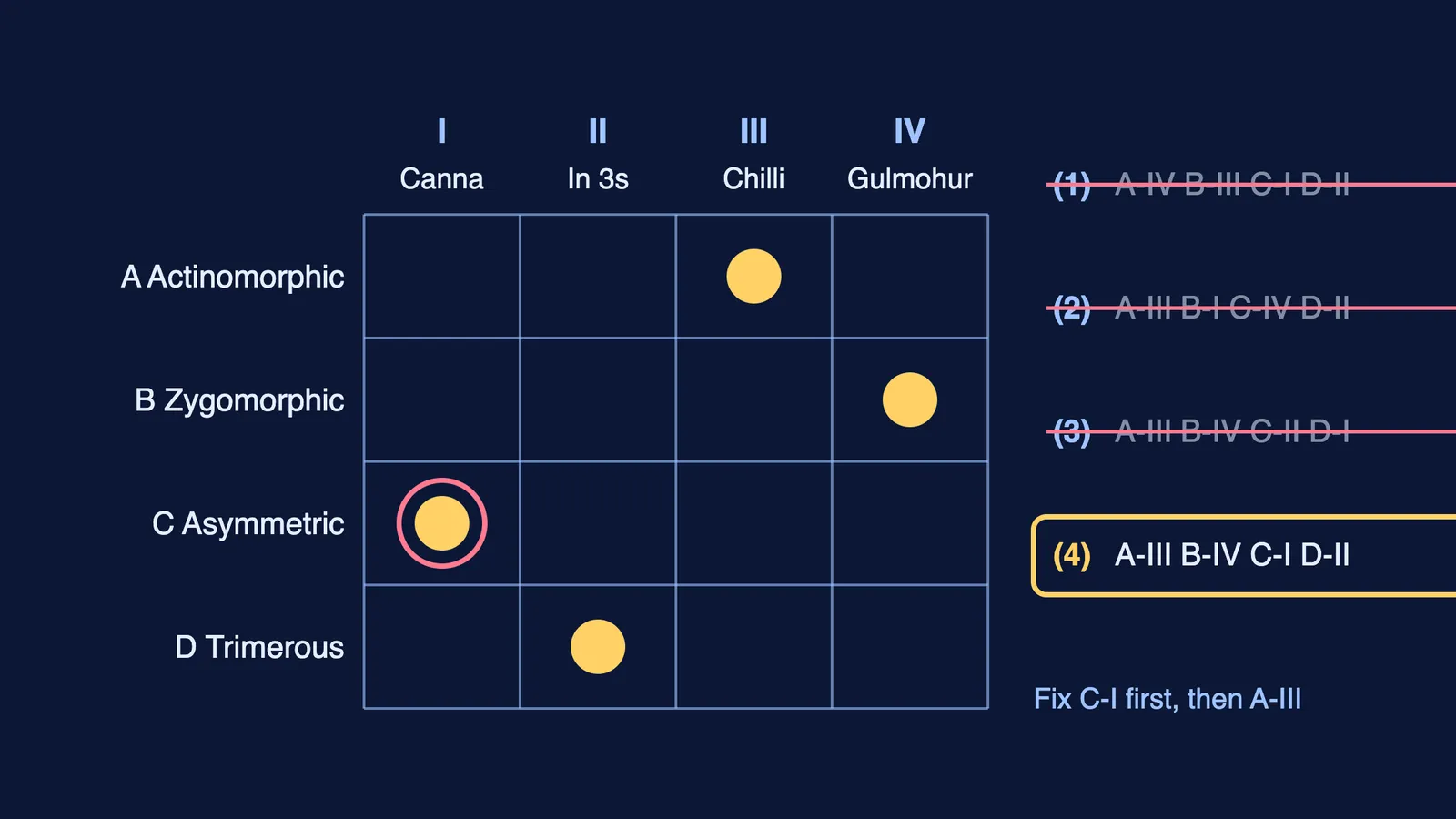
How to attack: fix the row with the most unusual partner, such as canna or staminode, keep only the codes that agree, then compare those on the row where they differ. The diagram above does this for Q9.
Q7. Match the stamen term with its meaning.
List-I: (A) Polyadelphous (B) Epiphyllous (C) Staminode (D) Polyandrous
List-II: (I) Stamens attached to the perianth (II) Stamens that stay free (III) Stamens united into more than two bundles (IV) A sterile stamen
(1) A-III, B-II, C-IV, D-I
(2) A-III, B-I, C-IV, D-II
(3) A-I, B-III, C-IV, D-II
(4) A-IV, B-I, C-III, D-II
Answer: (2). These are the definitions in NCERT section 5.5.1.3.
Q8. Match the part with its description.
List-I: (A) Tegmen (B) Aleurone layer (C) Hilum (D) Epicarp of mango
List-II: (I) Thin outer layer of the fruit wall (II) Inner layer of the seed coat (III) Proteinous layer around the endosperm (IV) Scar where the seed joined the fruit
(1) A-II, B-IV, C-III, D-I
(2) A-I, B-III, C-IV, D-II
(3) A-II, B-III, C-IV, D-I
(4) A-IV, B-III, C-II, D-I
Answer: (3). See NCERT sections 5.6 and 5.7.
Q9. Match the floral term with its example or meaning.
List-I: (A) Actinomorphic (B) Zygomorphic (C) Asymmetric (D) Trimerous
List-II: (I) Canna (II) Floral appendages in multiples of three (III) Chilli (IV) Gulmohur
(1) A-IV, B-III, C-I, D-II
(2) A-III, B-I, C-IV, D-II
(3) A-III, B-IV, C-II, D-I
(4) A-III, B-IV, C-I, D-II
Answer: (4). Section 5.5 gives chilli as actinomorphic, gulmohur as zygomorphic and canna as asymmetric.
Q10. Match the plant with the feature NCERT illustrates with it.
List-I: (A) Silk cotton (B) Salvia (C) Lady's finger (D) Datura
List-II: (I) Radially symmetrical flower (II) Palmately compound leaf (III) Twisted aestivation (IV) Filaments of unequal length in one flower
(1) A-IV, B-II, C-III, D-I
(2) A-II, B-IV, C-III, D-I
(3) A-II, B-III, C-IV, D-I
(4) A-I, B-IV, C-III, D-II
Answer: (2). These are NCERT's examples in sections 5.3.2 and 5.5.
Which single-correct MCQs test the rest of the chapter?
How to attack: read the options as four short claims; the wrong ones usually describe another whorl or another plant.
Q11. When a shoot apical meristem changes into a floral meristem:
(1) Internodes elongate quickly
(2) The axis condenses and floral parts arise laterally at successive nodes
(3) The apex goes on producing leaves
(4) The resulting flower is always part of a cluster
Answer: (2). NCERT adds that such a flower is always solitary.
Q12. NCERT lists which Solanaceae plant as a source of medicine?
(1) Petunia
(2) Tobacco
(3) Ashwagandha
(4) Chilli
Answer: (3). Petunia is ornamental, tobacco fumigatory and chilli a spice. This is a study summary, not medical advice.
Q13. In a floral diagram, which whorl is drawn at the centre?
(1) Calyx
(2) Corolla
(3) Androecium
(4) Gynoecium
Answer: (4). NCERT draws the whorls in sequence, calyx outermost.
What should you do after the set?
Attempt all 13 with the answers covered.
For each miss, name the broken link: term to plant, part to region, or symbol to meaning.
Write it correctly with its NCERT section, and retry after three days.
Then try our solved morphology practice questions for NEET and the morphology assertion-reason set.
Which morphology terms still blur together for you? Fermi's AI tutor works out what you already know and builds a plan for the session.


