

On this page
If you drop water onto a clean glass sheet, it spreads out into a flat puddle, wetting the surface completely. But if rain falls on a lotus leaf, it forms near-perfect spheres that dart across the surface at the slightest breeze, leaving the leaf completely dry and spotless.
This phenomenon, known as the Lotus Effect, is a classic example of superhydrophobicity. It relies on a delicate balance between the water's own cohesion and the microscopic physical structure of the leaf.
What makes a surface superhydrophobic?
To understand why water beads, we measure the static contact angle—the angle where the edge of the liquid meets the solid surface.
Water molecules are highly cohesive; they prefer to stick to each other due to strong hydrogen bonding. When a droplet touches a surface, it is caught in a tug-of-war between this internal cohesion and its adhesion to the solid material. Cohesion pulls the droplet into a sphere to minimise surface area, while adhesion pulls it flat against the solid.
If adhesion wins, the contact angle is less than 90°, and the liquid spreads (a hydrophilic surface). If cohesion wins, the angle is between 90° and 150°, and the water beads up (a hydrophobic surface). But when the contact angle exceeds 150°, the surface is classified as superhydrophobic Langmuir 2014. On a natural lotus leaf (*Nelumbo nucifera*), the contact angle reaches 161°, and the sliding angle—the tilt required for the drop to roll—is less than 5° Langmuir 2014.
If you are studying fluid mechanics, the Fermi Simulation Lab provides interactive simulations for ideas easier to see than read.
Why does water roll off a lotus leaf?
In 1997, botanists Wilhelm Barthlott and Christoph Neinhuis demonstrated that the Lotus Effect requires a dual mechanism: chemistry and texture Planta 1997.
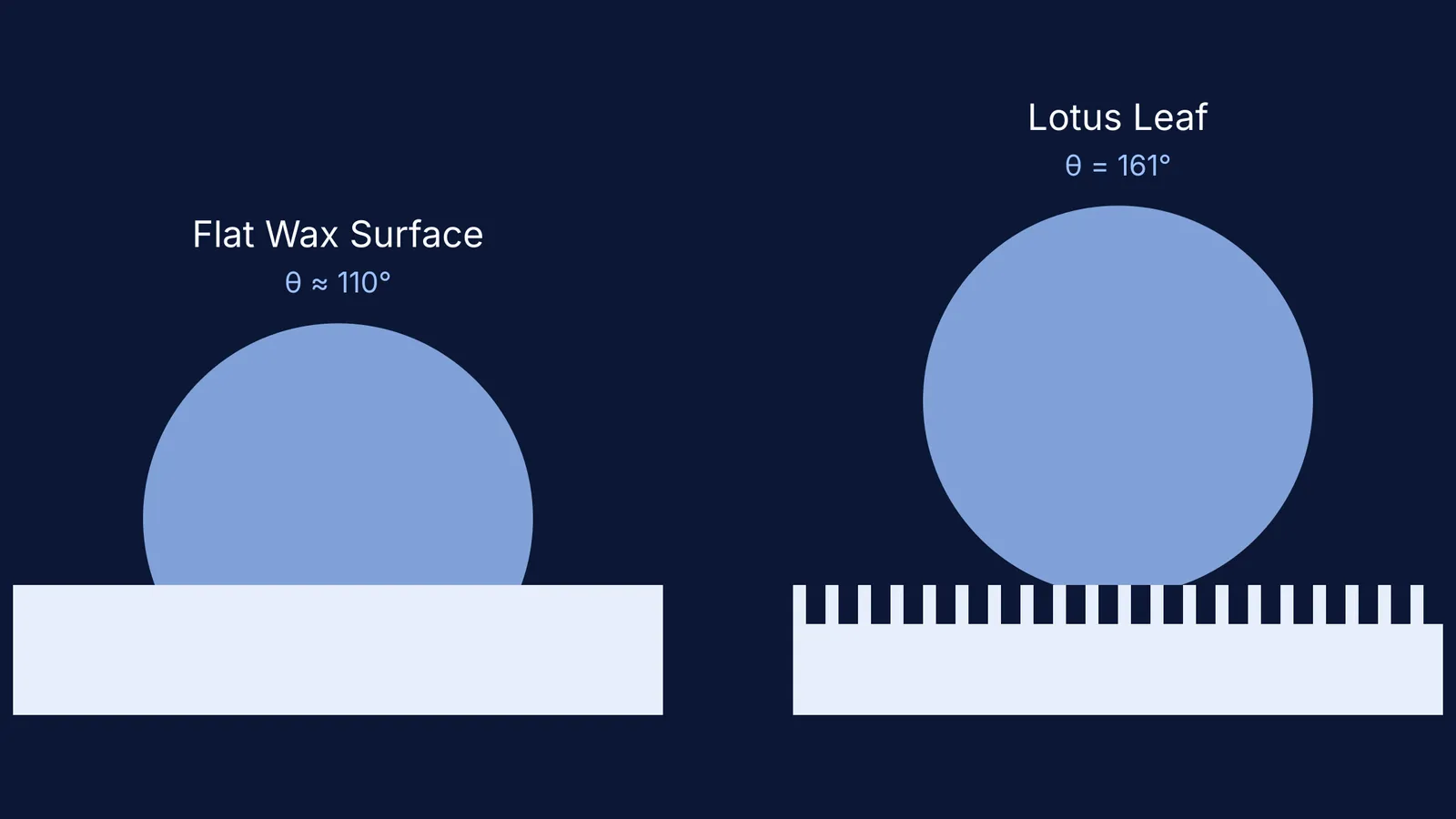
First, the leaf's epidermis secretes epicuticular waxes, which have naturally low surface energy and chemically repel water. However, smooth wax alone can only push the contact angle to about 110° Planta 1997.
To reach 161°, the leaf employs hierarchical roughness. Under a microscope, the surface is covered in tiny papillae (bumps) measuring 10 to 20 micrometres high Planta 1997. Zooming in further, each bump is densely coated in nanoscopic wax crystals.
Because of this extreme texture, water cannot penetrate the gaps. Instead, the droplet sits on the very tips of the papillae, trapping a layer of air underneath. This is known as the Cassie-Baxter state. Since air is highly hydrophobic, the actual contact area between the liquid and the solid leaf is reduced to less than 3% Planta 1997. The water essentially rests on a cushion of air.
How does the self-cleaning mechanism work?
Because the contact area is so small, adhesion between the water and the lotus leaf is exceptionally low.
When a water droplet encounters a speck of dirt on the leaf, the dirt particle adheres to the water much more strongly than it does to the tiny tips of the leaf's bumps. As the droplet rolls—rather than slides—across the leaf, it absorbs the dust and carries it away, leaving the plant perfectly clean and capable of unimpeded photosynthesis.
Understanding the physics of water and surfaces is a staple of learning science, from mastering the forces of why a diya wick draws up oil: the physics of capillary action to exploring why oil and water do not mix.
How do you answer Lotus Effect questions in exams?
If you are asked to classify a surface or explain the Lotus Effect in a physics or chemistry exam, use this decision table to frame your answer:
Hydrophilic: Contact angle < 90°. Adhesion dominates cohesion. Water spreads out to maximise contact with the surface (e.g., clean glass or bare metal).
Hydrophobic: Contact angle 90° to 150°. Cohesion dominates over adhesion. Water forms a stable dome or hemisphere (e.g., flat Teflon or smooth wax).
Superhydrophobic: Contact angle > 150° and sliding angle < 10°. Water forms a near-perfect sphere and rolls easily. This state requires both low surface energy (such as wax) and hierarchical roughness (creating the Cassie-Baxter air cushion).


