

On this page
A burning diya is one of the most familiar sights in an Indian home, but it is also a quiet demonstration of fluid mechanics. The cotton wick acts as a pump, lifting oil upward against gravity without any moving parts. This phenomenon is called capillary action, and it is the same mechanism that allows tall trees to draw water from their roots to their leaves.
How does a diya wick pull oil upwards?
Because a cotton wick is not a solid thread, it behaves like a twisted bundle of individual fibres. The microscopic gaps between these fibres act as tiny, hollow tubes. When you dip the wick into the oil, two competing forces go to work.
First, adhesion pulls the oil molecules towards the surface of the cotton fibres. Because cotton is porous and vegetable oil wets it very effectively, the oil creeps up the inner walls of these microscopic channels. Second, cohesion—the attraction of the oil molecules to each other—creates surface tension. As the leading edge of the oil climbs the cotton, this surface tension acts like an elastic skin, pulling the rest of the liquid column up behind it. The balance between these molecular forces dictates how fluid behaves on a small scale.
Why do narrower wicks work better?
If you look at the mechanics closely, the size of the gaps between the cotton fibres is crucial. The capillary rise is inversely proportional to the radius of these gaps. This mathematical relationship means that if you halve the radius of the microscopic channels within the cotton, the liquid will climb twice as high, a principle derived directly from Jurin's law.
This inverse relationship explains why tightly spun cotton threads are so effective as wicks. Loose fibres create larger gaps, which cannot support a tall column of liquid because the downward weight of the oil quickly overwhelms the upward pull of the surface tension. By twisting the fibres tightly, the effective radius of the channels is reduced, allowing the wick to draw oil much higher. However, there is a practical limit. If the gaps become too small, the friction between the thick oil and the walls of the cotton fibres increases, slowing down the flow rate and potentially starving the flame of fuel.
How high can the oil rise?
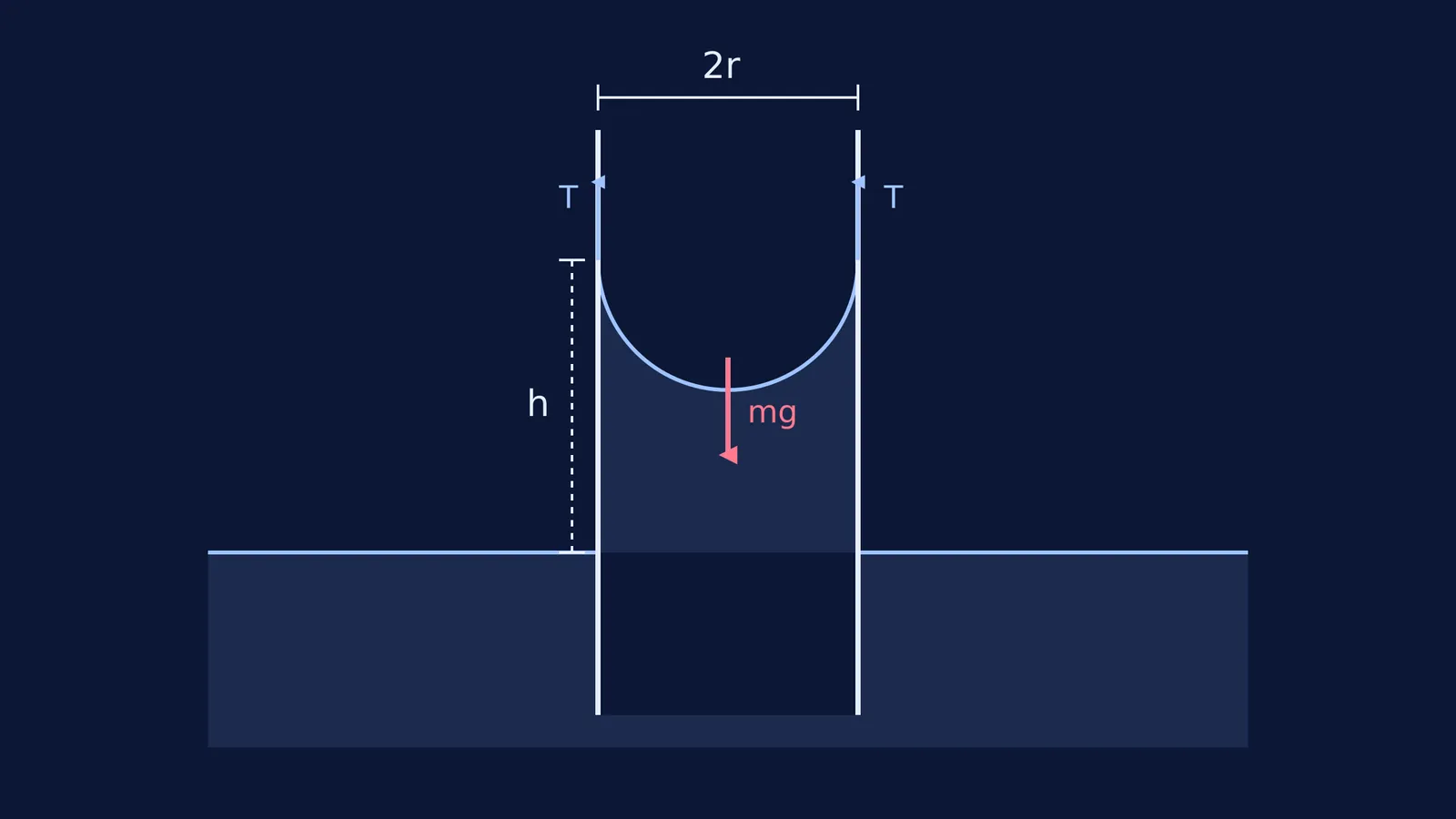
The physics of this upward climb is formally described by Jurin's law. The height the liquid reaches depends on the precise balance between the upward pull of the surface tension and the downward weight of the liquid column.
The formula is h = 2γ cos(θ) / ρgr, where γ is the surface tension, θ is the contact angle, ρ is the liquid's density, g is gravity, and r is the radius of the tube. According to a 2017 study in the International Journal of Food Properties, the surface tension of common vegetable oils like peanut oil is roughly 31 mN/m (0.031 N/m) at room temperature. Because oil wets cotton almost perfectly, the contact angle θ is near zero, making cos(θ) ≈ 1.
A worked example of Jurin's law
Let's see the math in action for a typical diya to calculate the maximum capillary rise (h).
Surface tension (γ): 0.031 N/m
Density of oil (ρ): roughly 910 kg/m³ (as documented in the same study)
Gravity (g): 9.8 m/s²
Gap radius (r): for our model, we assume a microscopic pore size of 50 micrometres (50 × 10⁻⁶ m), which is typical for porous materials relying on capillary action.
Plugging these values into the Jurin's law equation gives:
h = (2 × 0.031 × 1) / (910 × 9.8 × 50 × 10⁻⁶)
h = 0.062 / 0.4459 ≈ 0.139 m
In this theoretical model, the oil can climb nearly 14 centimetres. This vertical reach is more than enough to supply fuel to the tip of a standard diya wick in a typical small lamp.
How can you master fluid mechanics?
Fluid mechanics is full of invisible forces balancing against each other, just like the surface tension and gravity in a wick. If you are preparing for exams like the JEE or NEET, mastering these force balances is absolutely critical for scoring well. The same underlying principles of equating opposing pressures and forces apply whether you are examining a liquid column here, or solving problems with two immiscible liquids in a manometer.
Similarly, understanding how microscopic adhesion works can help clarify macroscopic phenomena across different topics in physics, such as when calculating the angle of repose and friction.
When exploring mechanics, the Fermi Simulation Lab offers interactive simulations for the ideas that are easier to see than to read. You can adjust parameters like tube radius or liquid density in a virtual environment to watch how the physics plays out in real time, making abstract laws concrete.


