

On this page
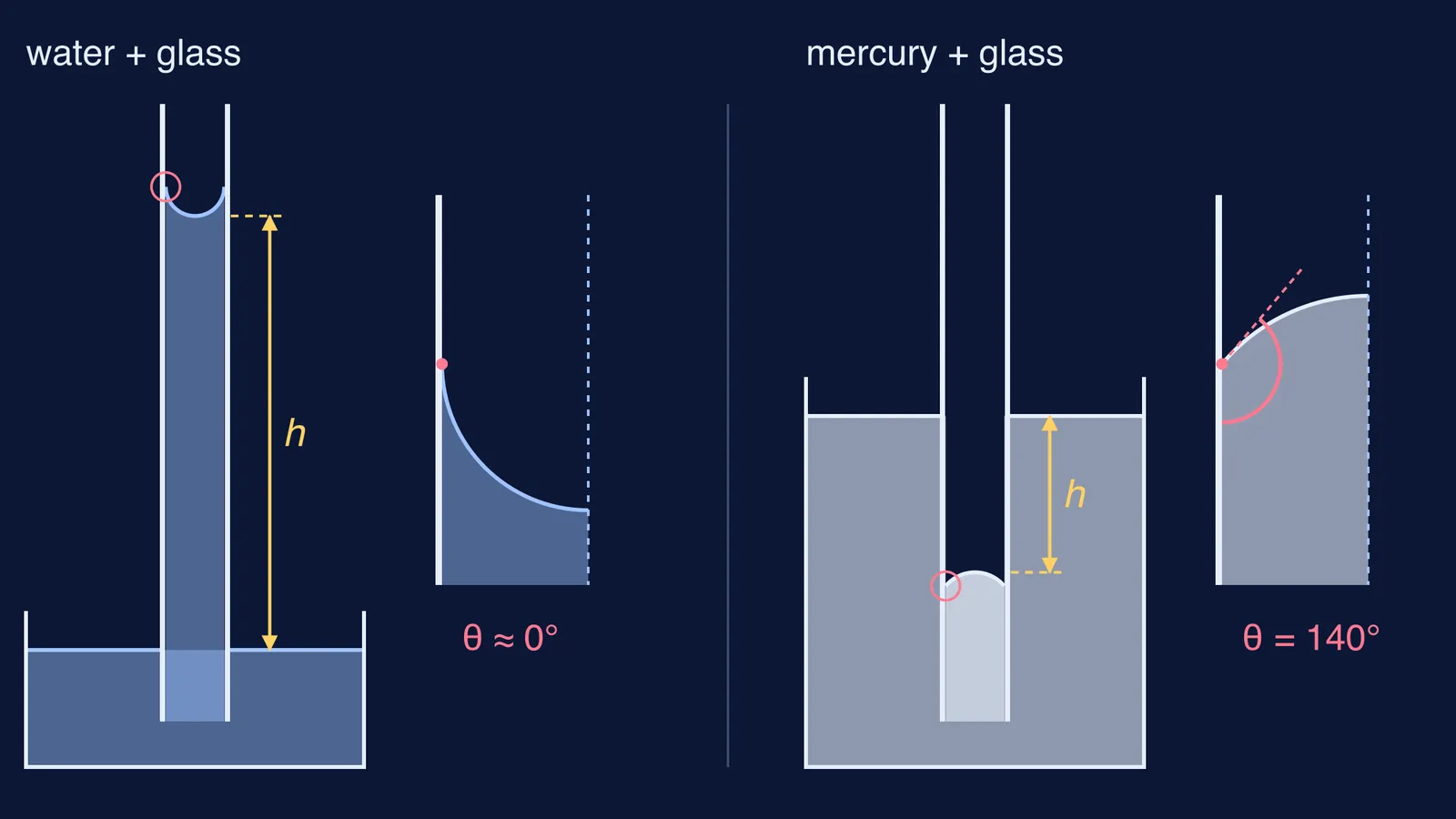
Dip a thin glass tube in water and the surface curls up at the walls while the column climbs. Dip it in mercury and the surface domes upward while the column sits below the outside level. One quantity explains both: the angle of contact. Exercise 9.2 of the NCERT Class 11 Physics chapter on fluids asks you to explain why mercury's angle of contact with glass is obtuse while water's is acute.
What is the angle of contact?
NCERT defines the angle of contact as "the angle between tangent to the liquid surface at the point of contact and solid surface inside the liquid" (NCERT Class 11 Physics, Chapter 9).
"Inside the liquid" matters: at the point where liquid, glass and air meet, measure from the wall below the surface round to the surface's tangent.
Typical values from OpenStax College Physics 2e:
Water on glass: 0°
Water on silver: 90°
Water on paraffin wax: 107°
Mercury on glass: 140°
Below 90°, the liquid wets the solid. Above 90°, it does not.
Why is the mercury meniscus convex?
Two pulls compete at the wall: cohesion, the attraction of liquid molecules for each other, and adhesion, their attraction to the solid. For an obtuse angle, NCERT says the liquid's molecules "are attracted strongly to themselves and weakly to those of solid, it costs a lot of energy to create a liquid-solid surface, and liquid then does not wet the solid" (NCERT, Section 9.6.3).
Mercury's pull on itself is strong. NCERT's Table 9.3 gives the surface tension of mercury at 20 °C as 0.4355 N/m and of water as 0.0727 N/m, about six times smaller (NCERT, Table 9.3).
NCERT balances the three surface tensions (liquid-air, solid-liquid, solid-air) at the contact line (Eq. 9.22), which rearranges to cos θ = (S(sa) − S(sl))/S(la). When the mercury-glass interface costs more energy than bare glass in air, cos θ is negative and θ is above 90°.
To leave the wall at 140°, mercury's surface slopes down toward the glass and rises to a dome in the middle: a convex meniscus. Water at 0° climbs the wall and sags in the middle: a concave one.
How does the angle of contact decide capillary rise or fall?
For a tube of radius a, NCERT derives the capillary rise as h = 2S cos θ/(ρga), where S is surface tension and ρ is density (NCERT, Eq. 9.29). Everything on the right is positive except cos θ, so the angle alone decides whether the liquid goes up or down.
NCERT's own example has water rising 2.98 cm in a tube of radius 0.05 cm. For mercury, the textbook notes that when the meniscus is convex, cos θ is negative and "the liquid will be lower in the capillary" (NCERT, Section 9.6.5).
How far do water and mercury move in a 1 mm tube?
Take a glass tube of inner radius a = 1.00 mm and g = 9.8 m/s². For water use NCERT's S = 0.0727 N/m, θ = 0° and ρ = 1.00 × 10³ kg/m³. For mercury use S = 0.465 N/m and θ = 140° from OpenStax, and ρ = 13.6 × 10³ kg/m³ from NCERT Table 9.1.
Water: h = 2 × 0.0727 × 1 / (1000 × 9.8 × 0.001) = 0.0148 m. It rises about 14.8 mm.
Mercury: cos 140° = −0.766, so h = 2 × 0.465 × (−0.766) / (13 600 × 9.8 × 0.001) = −0.712/133.3 = −0.00535 m. It sits about 5.3 mm below the outside level.
Mercury has the stronger surface tension yet moves less, because it is 13.6 times denser than water. If your exam gives a different surface tension (NCERT's 0.4355 N/m gives about 5.0 mm), use the number in the question.
If you keep slipping on the sign or on radius versus diameter, the Fermi Problem Library has worked problems with a step-by-step solver that explains the reasoning rather than printing an answer.
How do you answer "why is mercury's meniscus convex" in an exam?
Define: the angle of contact is the angle between the solid surface and the tangent to the liquid surface, measured inside the liquid.
Compare: mercury's cohesion is much stronger than its adhesion to glass, so θ is obtuse, about 140°.
Shape: to meet the wall at an obtuse angle, the surface dips at the edges and bulges in the middle, so the meniscus is convex.
Consequence: cos θ is negative, so h = 2S cos θ/(ρga) is negative and mercury falls in a capillary.
Common slips to avoid:
Putting the diameter in for a, which is the radius.
Writing "mercury has high surface tension, so it falls". Surface tension sets how big the effect is; the angle sets its direction.
Forgetting that additives change θ. NCERT notes that soaps and detergents are wetting agents that make the angle small, while waterproofing agents make it large (NCERT, Section 9.6.3).
If the links between surface tension, excess pressure and capillary rise still feel loose, the Fermi Concept Library gives each concept in physics its own lesson and its place in the map.


