

On this page
Drop a teak offcut in a bucket and it bobs. Drop a block of lignum vitae and it goes straight to the bottom. Both are wood, made of the same kind of cell walls. The difference is how much air those walls trap, and you can predict the result with one division.
Why does most wood float?
An object floats when it is less dense than the liquid it sits in. Density is mass divided by volume, and the USDA Wood Handbook, chapter 4 takes the density of water as 1.000 g/cm³, or 1,000 kg/m³.
The solid material wood is made of is actually denser than water. A 2018 hemp study by Jiang and colleagues in Royal Society Open Science, citing earlier measurements, puts the cell-wall density of wood species at 1.46 to 1.53 g/cm³. A lump of pure cell wall would sink.
Real wood floats because it is mostly hollow. Each cell is a tube with an empty space in the middle, and in dry wood that space holds air. The thinner the walls and the wider the holes, the lighter the wood.
According to the Wood Handbook, the oven-dry density of most species falls between about 320 and 720 kg/m³. That is well under 1,000, so most wood floats.
Which woods sink in water?
The same Wood Handbook chapter says the full range runs from about 160 kg/m³ for balsa to more than 1,040 kg/m³ for some imported woods. Those are the sinkers. Their cells have thick walls and narrow holes, so there is little room for air.
Lignum vitae (*Guaiacum*): the Wood Handbook, chapter 2 calls it one of the heaviest and hardest woods on the market. Its resins and other extra substances can make up to a quarter of the heartwood's air-dried weight. The Wood Database lists an average dried weight of 1,260 kg/m³.
Desert ironwood (*Olneya tesota*): about 1,210 kg/m³ dried, per the Wood Database.
Gaboon ebony (*Diospyros crassiflora*): about 955 kg/m³ on average, per the Wood Database. That is just under water, so an average piece floats very low, and a denser-than-average piece may sink.
Density also varies inside one trade name. The Wood Handbook, chapter 2 gives air-dried manbarklak as 768 to 1,185 kg/m³, so one plank might float while another sinks.
How much of a floating log stays underwater?
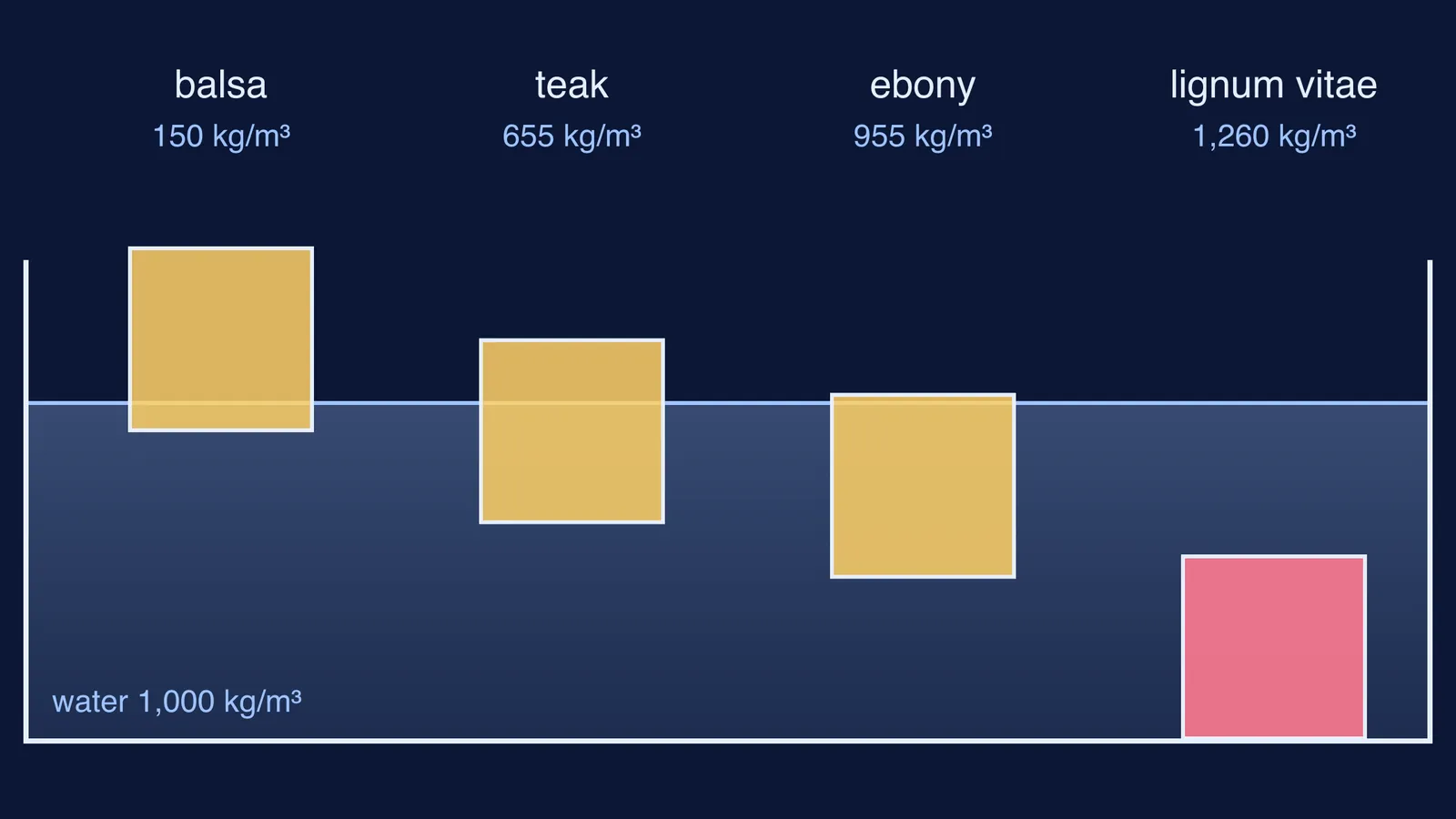
For a floating object, the fraction underwater equals its density divided by the liquid's density. This is the law of floatation, explained step by step in our post on the conditions for floating. Here it is with average dried weights from the Wood Database:
Balsa, 150 kg/m³: 150 ÷ 1,000 = 0.15, so about 15% sits below the waterline.
Teak, 655 kg/m³: about 66% underwater.
Gaboon ebony, 955 kg/m³: about 96% underwater, almost awash.
Lignum vitae, 1,260 kg/m³: the ratio is above 1, so it sinks.
Icebergs follow the same rule, which is why most of the ice is hidden. Our iceberg fraction explainer works through it.
That last point is why steel, at 7.8 g/cm³ according to the Wood Handbook, can still float as a hull. Our post on how steel ships float shows the arithmetic.
Can wood that floats today sink later?
Yes. If water slowly replaces the air in the cells, the log gets heavier without getting bigger. Here is a worked example using the numbers above.
Take dry wood at 500 kg/m³. The cell walls are about 1,500 kg/m³ (Jiang and colleagues), so walls fill 500 ÷ 1,500, about one third of the volume.
The other two thirds is empty space. Fill it with water and you add about 667 kg per cubic metre.
New density: 500 + 667 = about 1,167 kg/m³. That is more than water, so a fully soaked log sinks.
The Wood Handbook's density tables show the same trend: wood with a specific gravity of 0.50 reaches 1,000 kg/m³ at 100% moisture content. Real logs take a long time to soak through, so this happens slowly.
How can you test this at home?
You need a kitchen scale, a ruler, a bucket and three or four wood scraps. Ask a carpenter for offcuts; teak, sal or plywood all work.
Weigh each piece in grams.
Measure length, width and height in centimetres and multiply for the volume.
Divide mass by volume. Write down your prediction: float or sink, and what fraction underwater.
Float each piece and mark the waterline with a pencil. Compare the wet height with your prediction.
Leave one piece in the water overnight and weigh it again.
If your prediction is off, check the volume first; a small error in one side changes the answer a lot. For ideas that are easier to see than to read, try the interactive simulations in the Fermi Simulation Lab. If density and buoyancy still feel shaky, the Fermi Concept Library has a lesson on each idea and shows where it fits in the map.


