On this page
Toast that slides off a plate and over the edge of a table seems to land butter-side down far too often. It is not bad luck. A slice nudged slowly off the edge tips over the edge, picks up spin while it pivots there, and then falls with that spin. On an ordinary table there is time for only about half a turn. This is Class 11 rotation: torque about a pivot, moment of inertia, friction and free fall, all in one breakfast.
Why does toast start spinning as it leaves the table?
Push a slice slowly towards the edge. Once its centre of mass is a small distance δ past the edge, its weight has a torque about the edge and the slice starts to tip, pivoting on the table's edge like a hinged rod. For a hinged rod falling about its end, see the angular speed and hinge force of a falling hinged rod; toast differs because the pivot is close to the centre, not at the end.
Model the slice as a thin uniform plate of length a and mass m, tilted at angle θ below the horizontal.
Torque about the edge: mgδ cos θ.
Moment of inertia about the edge: I = m(a²/12 + δ²), by the parallel axis theorem.
Angular speed after tipping through θ: the centre drops by δ sin θ, so energy conservation gives ω² = 2gδ sin θ/(a²/12 + δ²).
Because δ is small, the torque is small and the slice turns slowly at first. But it keeps the angular speed it has gained when it leaves the edge, and nothing in the air can remove it. For the same release at the end of a rod, the torque on a rod held horizontally at one end gives α = 3g/2L; here the slow start matters more than the angular acceleration.
When does the toast slip off the edge?
While it pivots, friction at the edge holds the slice in place. As the tilt grows, the friction needed goes up and the normal force goes down, so at some angle the slice slips and falls free. Write Newton's second law for the centre of mass, which moves on a circle of radius δ about the edge:
Along the slice (towards the edge): friction f must supply the downhill pull of gravity plus the centripetal force, f = mg sin θ + mω²δ.
Across the slice: the normal force N supports what the angular acceleration does not, N = mg cos θ × (a²/12)/(a²/12 + δ²).
Slip condition: f = μN. Substituting ω² from above and simplifying gives tan θ = μ(a²/12)/(a²/12 + 3δ²).
This is the same "which limit is reached first" thinking as deciding whether a block topples or slides, applied to a body that is already rotating.
Worked example: a slice off a 75 cm table
Take illustrative values: a slice a = 10 cm long, centre δ = 5 mm past the edge when it starts to tip, friction coefficient μ = 0.5 between toast and table edge, table height H = 0.75 m, g = 9.8 m/s².
a²/12 = 0.10² ÷ 12 = 8.33 × 10⁻⁴ m².
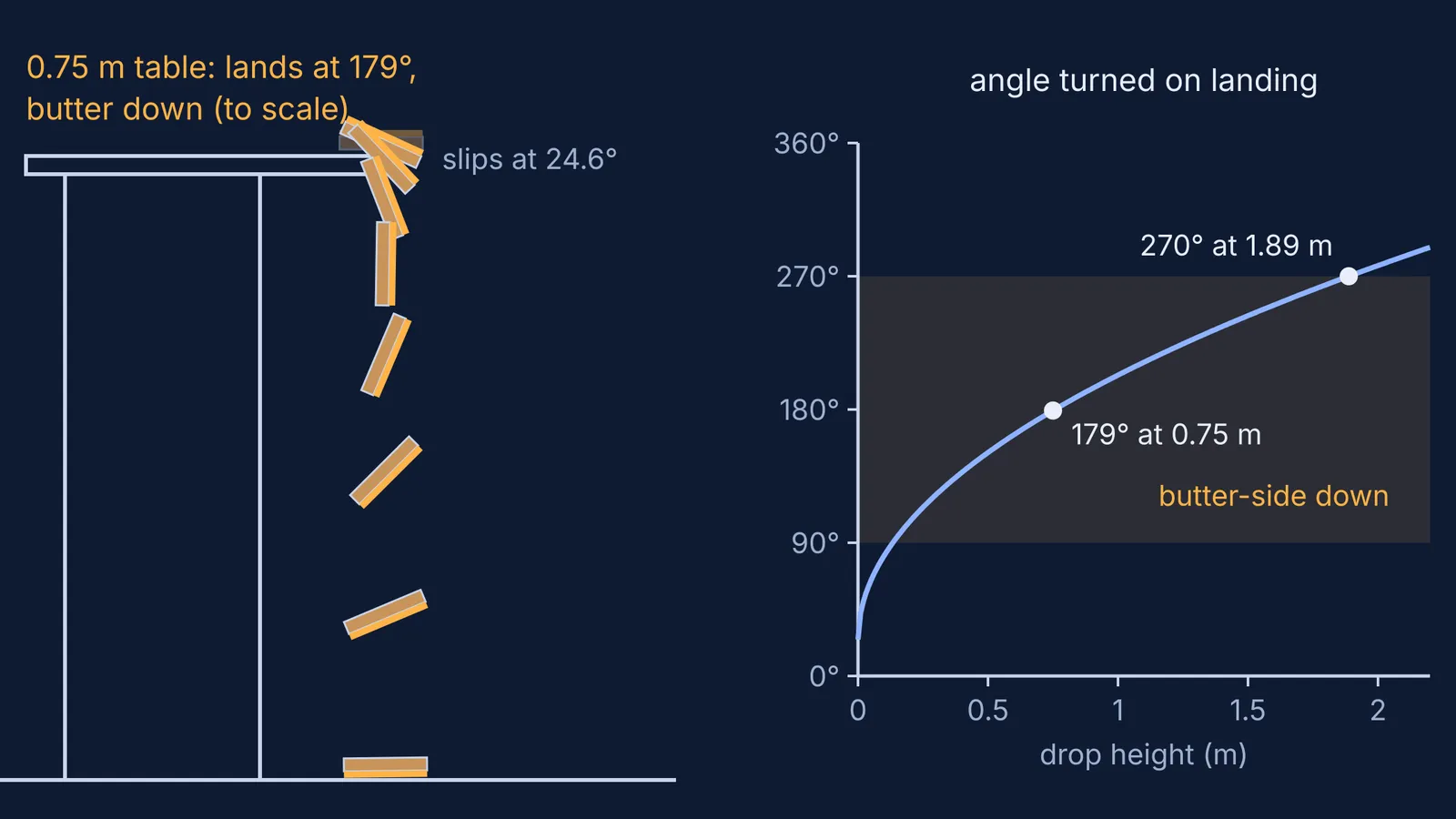
Slip angle: tan θ = 0.5 × 8.33 × 10⁻⁴ ÷ (8.33 × 10⁻⁴ + 3 × 0.005²) = 0.458, so θ = 24.6°.
Angular speed at slip: ω² = 2 × 9.8 × 0.005 × sin 24.6° ÷ (8.33 × 10⁻⁴ + 2.5 × 10⁻⁵) = 47.6 s⁻², so ω = 6.90 rad/s, about 1.1 turns per second. Units: (m/s² × m)/m² = s⁻².
Fall time: t = √(2H/g) = √(2 × 0.75 ÷ 9.8) = 0.391 s. The centre has dropped only 2 mm during tipping, so the whole 0.75 m is free fall.
Angle turned in the air: ωt = 6.90 × 0.391 = 2.70 rad = 155°.
Angle on landing: 24.6° + 155° = 179°. The slice is upside down: butter on the floor.
Anything between 90° and 270° lands butter-down. Change δ and the answer moves, but not by enough: with δ = 2 mm the slice lands at 128°, and with δ = 10 mm at 211°. Both are butter-down.
The Simulation Lab has interactive simulations for ideas like this that are easier to see than read, such as how spin and fall time combine into a landing angle.
How high would the table need to be?
To land butter-up, the slice must either turn less than 90° or more than 270°.
Less than 90°: (90° − 24.6°) = 1.14 rad, which takes 1.14 ÷ 6.90 = 0.165 s, a fall of only 13 cm. That is lower than any table.
More than 270°: (270° − 24.6°) = 4.28 rad, which takes 0.621 s, a fall of 1.89 m. That is a table taller than most adults.
With δ = 2 mm the slice spins more slowly and would need a 4.3 m fall to reach 270°; with δ = 10 mm it would need 1.3 m. Every ordinary table height falls in the butter-down window for this kind of slow tip.
Does the butter make toast fall butter-side down?
No. Butter is a thin, light layer, so it barely moves the centre of mass, and an unbuttered slice tips and spins in the same way. What decides the result is the ratio of table height to slice size, which sets how much of a turn fits into the fall.
Robert Matthews analysed this in "Tumbling toast, Murphy's Law and the fundamental constants" (European Journal of Physics, 1995) and showed that toast does have a built-in tendency to land butter-side down for a wide range of conditions, a result he traced, half in jest, to the values of the fundamental constants. A fuller study, "A closer look at tumbling toast" by Bacon, Heald and James (American Journal of Physics, 2001), filmed a toast-sized board and found that its spin is predicted accurately only if slipping on the edge is included. For their 10.2 cm board on a 76 cm table, it landed butter-side down for overhangs of about 0 to 0.8 cm and 2.7 to 5.1 cm. So the simple model above gives the right idea, but a real slice's landing side depends on details like δ and the slip.
Toast knocked off quickly is different: it flies clear of the edge with little time to pivot, so it gains little spin and can land either way. To learn the parallel axis theorem behind I = m(a²/12 + δ²), the Concept Library covers every concept in physics.
Quick checklist
Toast tips about the table edge once its centre is past the edge.
I about the edge = m(a²/12 + δ²); ω² = 2gδ sin θ/(a²/12 + δ²).
It slips when tan θ = μ(a²/12)/(a²/12 + 3δ²).
Landing angle = slip angle + ω√(2H/g); 90° to 270° means butter-down.
A 75 cm table gives about half a turn; reaching 270° needs a fall of about 1.9 m in this example.
The butter's weight is not the cause.