On this page
An oil or gas well is a narrow hole, often several kilometres deep, and while it is being drilled it is kept full of a thick, heavy liquid called drilling mud. The mud cools the drill bit and carries rock chips up, but its most important job is simple Class 11 fluids: its weight presses on the rock at the bottom. Too little pressure and gas or oil flows into the hole. Too much and the rock splits open. This post works through both limits with p = ρgh, then follows a gas bubble up the well with Boyle's law.
Why must the mud press on the rock at all?
Rock deep underground is not solid all the way through. Sandstone has tiny pores filled with water, oil or gas, and that fluid is under pressure, called the pore pressure. If the pressure in the well is lower than the pore pressure in a permeable layer, the fluid flows into the well. The drilling industry calls this unplanned inflow a kick. The IADC Lexicon, which collects definitions from API standards, describes a kick as an influx of formation liquids or gas into the wellbore that, without corrective measures, can result in a blowout.
The mud stops this by being heavy. A column of mud of density ρ and depth h presses on the bottom with p = ρgh, the same rule as in pressure at depth and gauge pressure problems. Drillers tune ρ by adding a dense powdered mineral, usually barite. The US Geological Survey's barite review notes that API specifications called for a minimum specific gravity of 4.20 until 2010, when a 4.10 grade was added.
Why can't the mud simply be as heavy as possible?
Because rock has a breaking point too. Push the well pressure above the fracture pressure of the weakest layer and the rock cracks open. Mud then drains away into the cracks, which is called lost circulation. The University of Texas PETEX textbook Practical Well Control gives an example formation at 5,000 ft that fractures at 3,640 psi, a fracture gradient of 0.728 psi/ft, about 16.5 kPa/m.
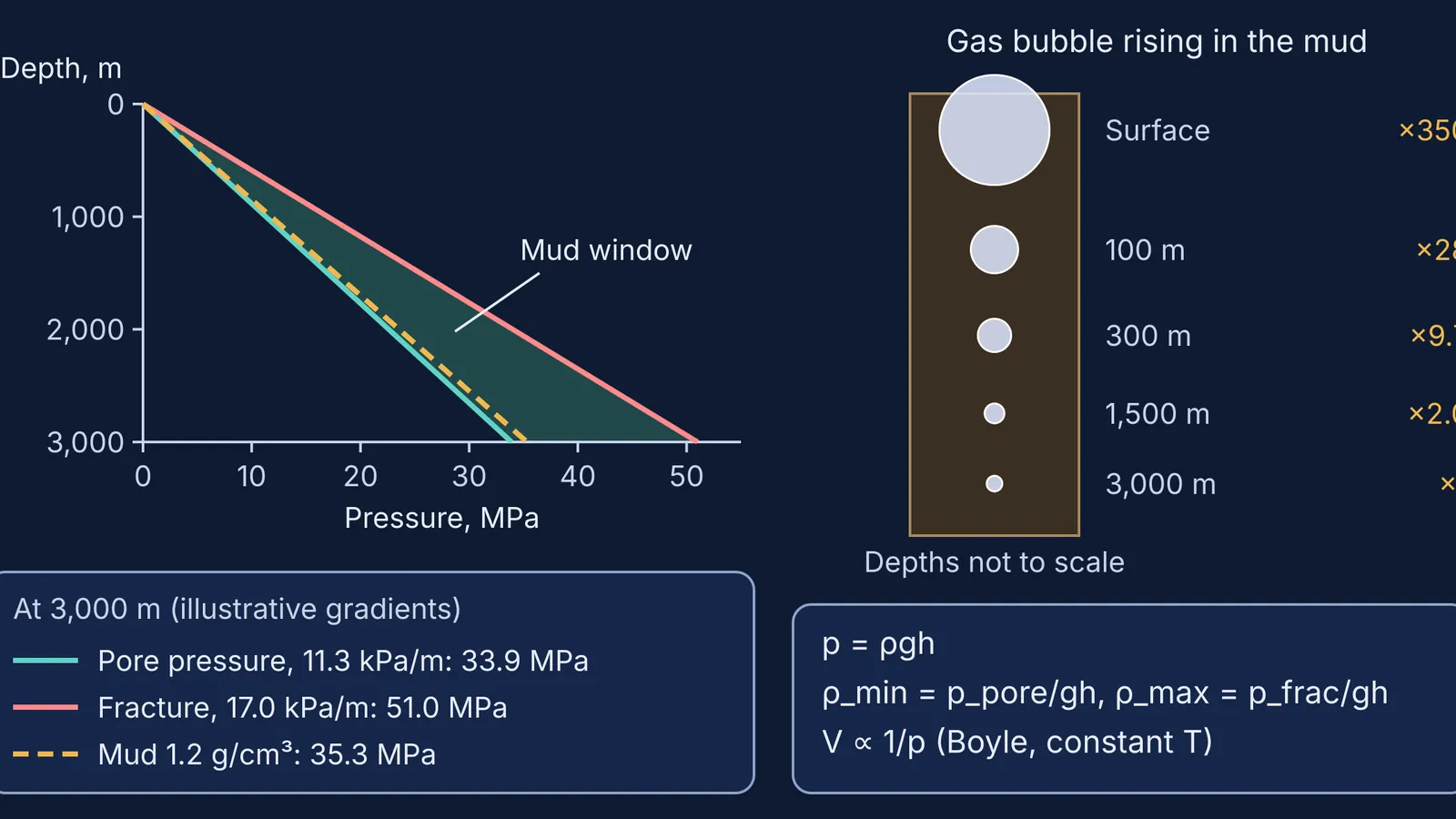
So there is a window. The mud must be heavy enough to beat the pore pressure and light enough to stay below the fracture pressure. Both pressures grow with depth, so it is easiest to quote them as gradients in kPa per metre.
How heavy must the mud be at 3,000 m?
Take an illustrative well 3,000 m deep, with a pore-pressure gradient of 11.3 kPa/m and a fracture gradient of 17.0 kPa/m. Real values vary from field to field; for comparison, the same textbook puts the gradient of seawater at about 0.45 psi/ft, or 10.2 kPa/m, so 11.3 kPa/m is a mildly overpressured layer. Use g = 9.81 m/s².
Pore pressure: p_pore = 11.3 kPa/m × 3,000 m = 33.9 MPa.
Lightest mud that balances it: ρ_min = p_pore/gh = 33.9 × 10⁶/(9.81 × 3,000) = 1,152 kg/m³, or 1.152 g/cm³.
With a margin of 1.5 MPa: ρ = 35.4 × 10⁶/(9.81 × 3,000) = 1.203 g/cm³.
Fracture pressure: p_frac = 17.0 kPa/m × 3,000 m = 51.0 MPa.
Heaviest mud allowed: ρ_max = 51.0 × 10⁶/(9.81 × 3,000) = 1.733 g/cm³.
Check a 1.2 g/cm³ mud: p = 1,200 × 9.81 × 3,000 = 35.3 MPa. That is 1.4 MPa above the pore pressure and 15.7 MPa below the fracture pressure.
Units check: Pa ÷ (m/s² × m) = (kg m⁻¹ s⁻²)/(m² s⁻²) = kg/m³. Good.
The industry usually quotes mud weight in pounds per US gallon (ppg). Since 1 g/cm³ ≈ 8.345 ppg, 1.2 g/cm³ mud is about 10.0 ppg. How much barite does it take? Mixing water (1.00 g/cm³) with barite (4.20 g/cm³) to get 1.20 g/cm³ needs a volume fraction f with 1.00(1 − f) + 4.20f = 1.20, so f = 0.0625: about 263 kg of barite per cubic metre of mud, ignoring the other solids real muds contain.
What happens if some mud is lost into the rock?
Now suppose the well passes a weak layer and 200 m of the mud column drains away into it, so the mud level in the hole drops.
Pressure lost: Δp = ρgΔh = 1,200 × 9.81 × 200 = 2.35 MPa.
New bottom pressure: 35.3 − 2.35 = 33.0 MPa.
Compare: 33.0 MPa is 0.94 MPa below the 33.9 MPa pore pressure. The balance has flipped, and gas or oil can enter at the bottom.
So the two limits are linked: mud heavy enough to crack a weak layer can end up letting fluid in.
Why does a gas bubble grow so much on the way up?
Gas that slips in at the bottom is under the full mud pressure. As it rises, the mud above it gets shorter and the pressure on it falls, so it expands. Treat it with Boyle's law at constant temperature, pV = constant, using absolute pressures (add 0.101 MPa of atmosphere to ρgh). The bubble starts at 35.3 + 0.1 = 35.4 MPa.
At 1,500 m: p = 1,200 × 9.81 × 1,500 + 0.101 MPa = 17.76 MPa. V/V₀ = 35.42/17.76 = 1.99, so the bubble has only doubled after rising halfway.
At 300 m: p = 3.63 MPa, V/V₀ = 9.7.
At 100 m: p = 1.28 MPa, V/V₀ = 27.7.
At the surface: p = 0.101 MPa, V/V₀ = 350.
Most of the growth happens in the last few hundred metres, the same idea as the air bubble rising from a lake bottom, but with a factor of 350 instead of 2. The PETEX textbook notes that gas nearing the surface expands rapidly, which suddenly increases the flow of mud out of the well. A rise in the mud tanks at the surface is therefore an early sign that gas has entered far below.
The 350 is an estimate. The bottom of a 3,000 m well is hot, perhaps 100 °C, and if the gas also cools to 30 °C on the way up, the combined gas law gives 350 × 303/373 ≈ 284. Gas at 35 MPa is also far from ideal, and gas can dissolve in the mud and come out of solution near the top.
If you want more practice with ρgh and Boyle's law problems like these, the Fermi Problem Library has a step-by-step solver that explains the reasoning at each stage.
What does this have to do with blowouts?
A blowout is a kick that is not brought under control, so oil and gas flow out of the well. The 2010 accident in the Gulf of Mexico, and the clean-up that followed, are covered in lessons from Deepwater Horizon. The mud weight is chosen to keep the pressure balance described above.
Quick checklist
Mud pressure at the bottom is ρgh, using vertical depth.
It must exceed the pore pressure (or fluid enters) and stay below the fracture pressure (or the rock cracks).
ρ_min = p_pore/gh and ρ_max = p_frac/gh give the mud window.
Losing 200 m of a 1.2 g/cm³ column drops the bottom pressure by 2.35 MPa.
In Boyle's law use absolute pressure; a gas bubble grows about 350 times from 3,000 m to the surface, mostly near the top.
1 g/cm³ ≈ 8.345 ppg.