On this page
On 20 April 2010, an explosion on the Deepwater Horizon drilling rig in the Gulf of Mexico killed 11 workers and sank the rig, according to NOAA's Office of Response and Restoration. Oil poured from the Macondo well on the seabed until a capping stack stopped it on 15 July 2010. By then about 134 million gallons had spilled into the Gulf.
What happened at Deepwater Horizon?
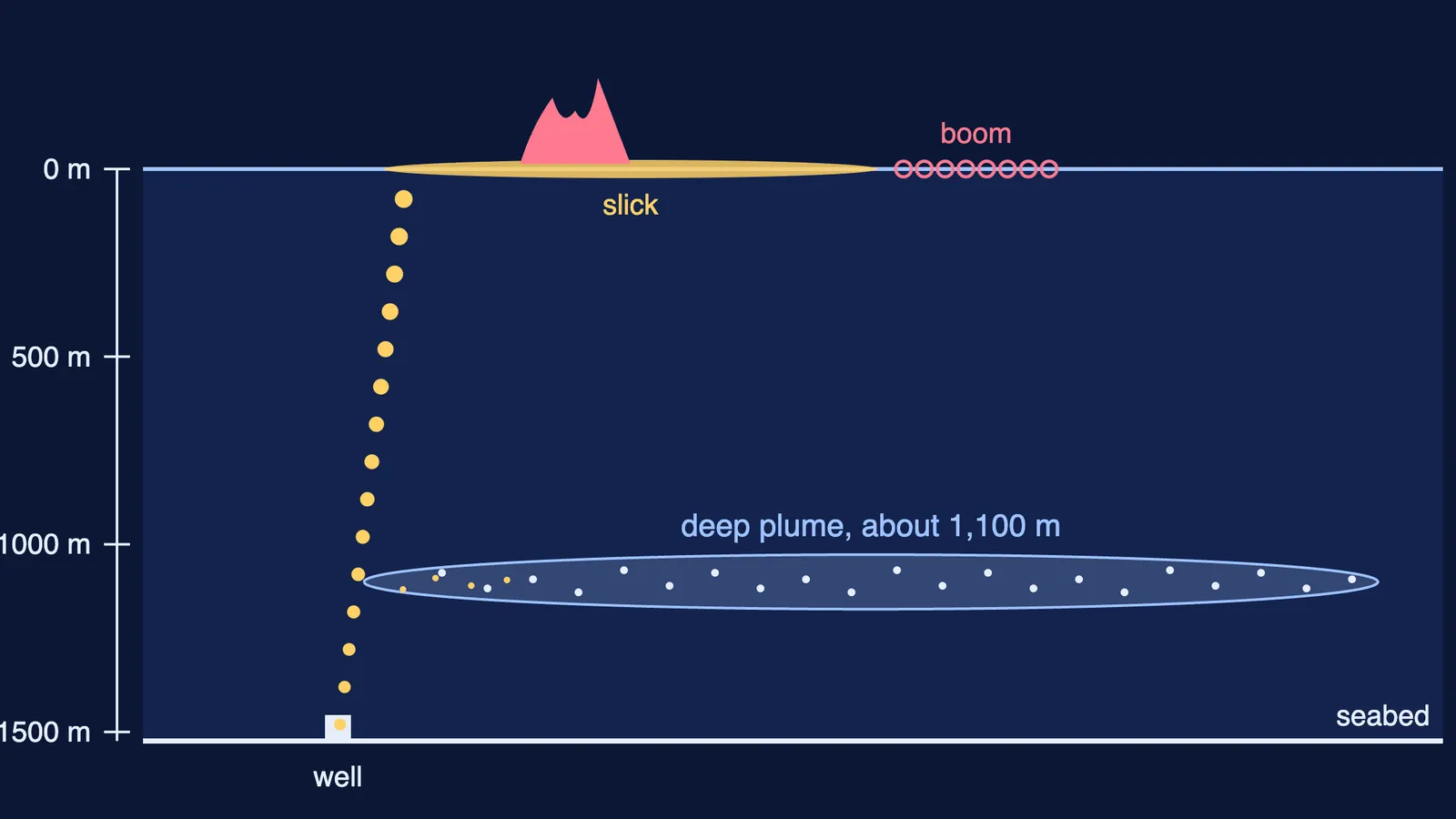
A blowout is an uncontrolled release of oil and gas from a well after the equipment meant to hold back its pressure fails. This leak was not at the surface: the oil was spewing from 5,000 feet, about 1,500 m, below the water, says a NOAA oil spill tutorial. Oil flowed for 87 days, and the US Environmental Protection Agency calls it the largest spill in the history of marine oil drilling.
Depth changed the problem. Oil and gas burst out under pressure and broke into droplets of many sizes. Big droplets rose to the surface; tiny ones rose so slowly that currents carried them sideways. Using an autonomous underwater vehicle, a Woods Hole team tracked a continuous plume of oil more than 35 km long at about 1,100 m depth (Camilli et al., Science, 2010).
Why does oil float and spread on water?
Two ideas from your chemistry and physics lessons explain it.
Like dissolves like. Water molecules are polar and hold on to each other through hydrogen bonds. Crude oil is mostly non-polar hydrocarbons, so water pushes it out instead of dissolving it.
Density. Most crude oil is less dense than seawater, so it sits on top. Because most oils float, NOAA says, surface animals such as seabirds and sea otters are among the worst affected.
Once on top, the oil spreads into an ever-thinner film that wind and currents stretch into long slicks.
How are oil spills cleaned up?
NOAA's guide to spill cleanup lists the main tools. Here they are with the totals the US government reported in its 2 August 2010 response update.
Booms. Booms are long, floating barriers used to contain or prevent the spread of spilled oil. Crews laid more than 3.29 million feet of containment boom and 8.1 million feet of sorbent boom, which soaks oil up.
Skimmers. Boats fitted with floating skimmers lift thin layers of oil off the surface. By 2 August, responders had recovered more than 34.7 million gallons of an oil-water mix.
Controlled burns. In situ burning means setting fire to fresh oil while it is still floating. There were 411 controlled burns, removing more than 11.14 million gallons of oil from the open water.
Dispersants. These chemicals disperse oil into the water column, so much less stays at the surface (NOAA). About 1.84 million gallons were used: 1.07 million on the surface and 771,000 sub-sea.
Microbes. Nutrients may be added to help microbes break oil down, NOAA's cleanup tutorial says. In the deep Gulf, oil-eating microbes were already there.
That is NOAA's description of how dispersants work, and it is the same surfactant chemistry behind soap micelles, explained in our post on CMC and Kraft temperature.
Can bacteria really eat oil?
Yes. Terry Hazen of Lawrence Berkeley National Laboratory and colleagues found that the deep plume had stimulated native gamma-Proteobacteria closely related to known petroleum degraders, and their measurements showed faster-than-expected breakdown of hydrocarbons at 5°C (Hazen et al., Science, 2010). They concluded the plume could potentially be cleaned up by these microbes without substantial oxygen drawdown. That matters because microbes that feed on pollution use up dissolved oxygen; our post on BOD and dissolved oxygen shows why.
The Woods Hole team, in the same issue of Science, reported that its plume persisted for months without substantial biodegradation. The journal's editors noted that the studies found different oxygen levels in the plumes, which may reflect where the samples were taken or how old the plumes were.
Work it out: what share did each tool handle?
Use NOAA's 134 million gallon total and the figures in the August 2010 response update.
Burning. 11.14 million ÷ 134 million ≈ 0.083, so burns removed roughly 8% of the oil spilled.
Dispersant dose. 1.84 million ÷ 134 million ≈ 0.014, about 1 gallon of dispersant for every 73 gallons of oil.
The trap. Do not divide 34.7 million by 134 million. That figure is an oil-water mix, so these numbers cannot tell you how much oil was skimmed.
The caveat. The response totals date from 2 August 2010, so the shares are estimates.
If ratio problems like these trip you up, the Fermi Problem Library has worked problems with a step-by-step solver that explains the reasoning rather than printing an answer. For ideas that are easier to see than to read, try the interactive simulations in the Fermi Simulation Lab.