On this page
Most students learn the rule as one line: micelles form only above the CMC and above the Kraft temperature. The line is easy to memorise and easy to get wrong in an assertion-reason question, because it hides why there are two conditions and how they depend on each other. This post builds the idea from the molecule up, then works through one real soap, sodium stearate, with numbers you can check.
What are the CMC and Kraft temperature?
A soap molecule such as sodium stearate (C18H35NaO2, molar mass 306.5 g/mol, per PubChem) has a long hydrocarbon tail that avoids water and an ionic head that likes it. At low concentration these ions sit in solution one by one. Push the concentration up and, at some point, they start clustering into micelles: balls with the tails pointing inward and the heads facing the water, as described in the association colloids experiment of the IIIT Hyderabad Virtual Lab.
Critical micelle concentration (CMC): the concentration above which surfactant molecules start clustering into micelles; the virtual lab puts typical values at about 10⁻⁴ to 10⁻³ mol/L (IIIT Hyderabad Virtual Lab), though some surfactants sit higher.
Kraft temperature (Krafft point): the minimum temperature at which a surfactant will form micelles (Raiguel, Avdibegović and Binnemans, Green Chemistry, 2025).
You will see the word spelt both ways. Research papers use "Krafft"; Indian course material, including the virtual lab above, often writes "Kraft". They mean the same thing.
Why does soap need both conditions to form micelles?
The CMC is a concentration threshold, but a concentration only counts if the soap is actually dissolved. Below its Krafft point, a soap does not dissolve enough to reach its CMC. The Green Chemistry paper puts it plainly: below their Krafft point, the soaps behave as poorly soluble salts. Whatever soap you add beyond that small solubility just stays as solid.
Above the Kraft temperature, the solubility of ionic surfactants rises sharply, and the virtual lab explains why: the nonpolar chains "melt" at this temperature (IIIT Hyderabad Virtual Lab). Once the soap can dissolve past the CMC, the extra molecules go into micelles instead of a crystal.
So the two conditions are not a random pair to memorise. Temperature decides whether enough soap can dissolve; concentration decides whether what has dissolved is enough to cluster.
Worked example: will sodium stearate form micelles in your beaker?
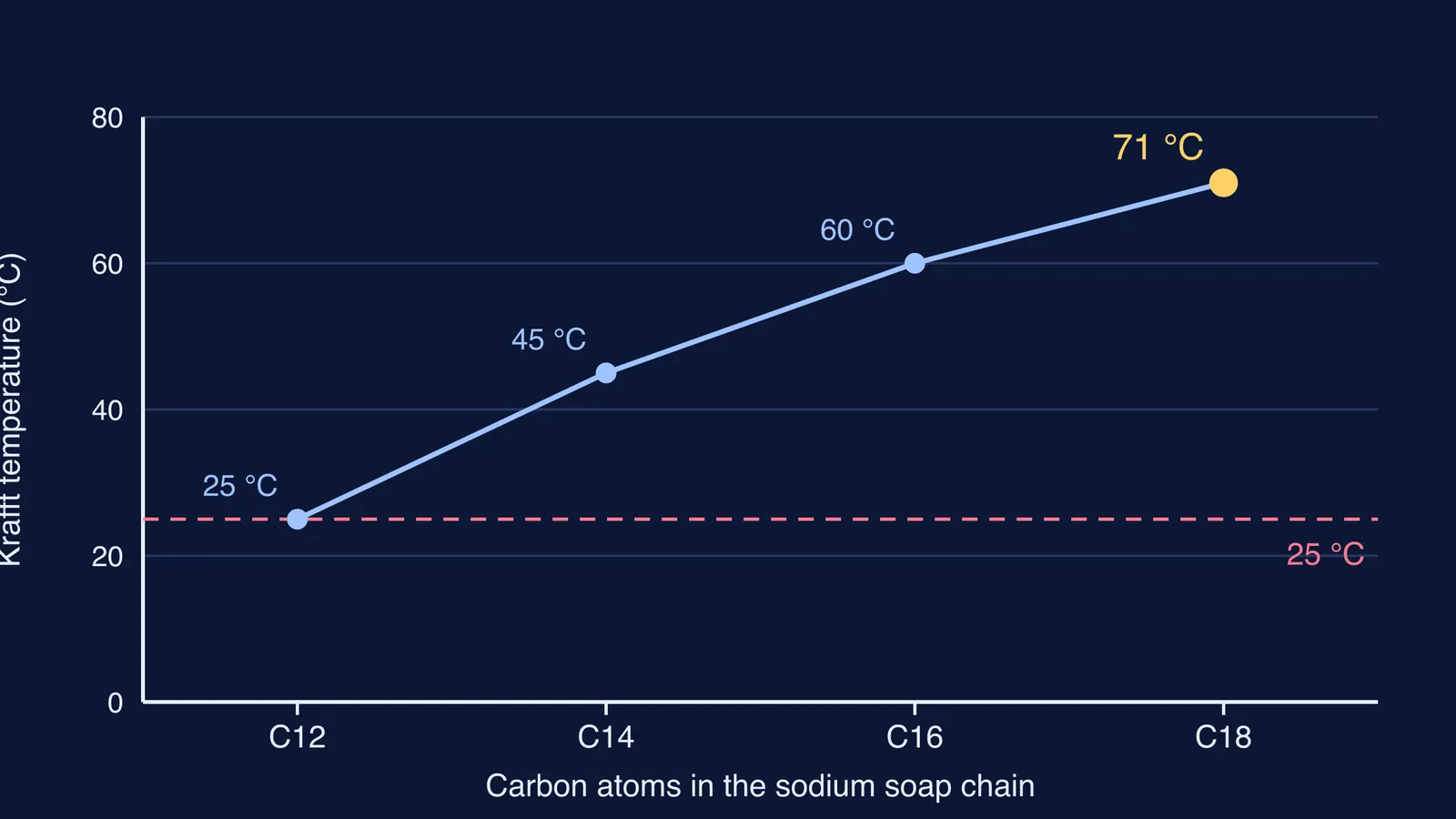
Chain length matters: the longer the tail, the higher the Kraft temperature. The same paper lists the Krafft points of sodium soaps as 25 °C for laurate (C12), 45 °C for myristate (C14), 60 °C for palmitate (C16) and 71 °C for stearate (C18) (Raiguel et al., 2025, Table 1).
Now take 1.0 g of sodium stearate in 500 mL of water.
Moles: 1.0 g ÷ 306.5 g/mol (PubChem) =3.3 × 10⁻³ mol.
Nominal concentration: 3.3 × 10⁻³ mol ÷ 0.500 L = 6.5 × 10⁻³ mol/L.
Compare with the CMC: 6.5 × 10⁻³ mol/L is above the typical 10⁻⁴ to 10⁻³ mol/L range (IIIT Hyderabad Virtual Lab), so concentration is not the problem.
At 25 °C: this is well below the 71 °C Krafft point. Most of the soap stays undissolved as a poorly soluble salt, the dissolved amount never reaches the CMC, and there are no micelles.
At 80 °C: this is above 71 °C. The soap can now dissolve past the CMC, and the excess forms micelles.
The same mass of soap gives two different answers, and only temperature changed. Run the numbers for sodium laurate and you get a different picture: its Krafft point of 25 °C sits right at room temperature.
If the step from grams to mol/L is where you slip, the Fermi Problem Library has worked problems with a step-by-step solver that explains the reasoning rather than printing an answer.
How do exam questions test CMC and Kraft temperature?
Questions on association colloids usually turn on the pair of conditions rather than on exact values. Before you mark an option, run this check:
Is the concentration above the CMC? If no, there are only single ions, at any temperature.
Is the temperature above the Kraft temperature? If no, extra soap stays solid, at any concentration.
Both yes? Micelles form, and only the soap above the CMC goes into them.
Does the option say micelles form "at" or "below" one of these thresholds? That is usually the trap.
Does the option compare soaps? A longer chain means a higher Kraft temperature.
If colloids still feel like a list of disconnected terms, the Fermi Concept Library gives each concept its own lesson and its place in the map, so you can see where micelles sit next to related ideas such as solubility. Then try the sodium laurate version of the worked example yourself.