On this page
Every few years a car that runs on air makes the news. Fill a tank with compressed air, let the air push pistons, and drive away with nothing but cold air coming out of the exhaust. It sounds clean and cheap, yet you cannot buy one. The reason is not a missing invention. It is the first law of thermodynamics, and you can work it out with the isothermal-work formula from Class 11.
How does a compressed-air car work?
A strong tank, usually wound from carbon fibre, holds air at very high pressure. The air is let into an air motor, where it expands and pushes a piston or a vane, much as steam does in a steam engine. The expanded air leaves at atmospheric pressure. To refuel, a compressor, usually electric, pumps the tank back up.
So the tank is a store of energy, like a battery. The questions are how much energy it can hold and what has to happen for the car to get that energy out.
How much work can a tank of compressed air do?
The most work comes from a slow expansion at constant temperature, an isothermal process. In that case the gas does work
W_gas = p₁V₁ ln(p₁/p₀)
as it expands from the tank pressure p₁ to atmospheric pressure p₀. But not all of this is useful. As the air expands to its final volume V₂ = p₁V₁/p₀, it has to push the atmosphere out of the way, which costs p₀(V₂ − V₁) = p₁V₁ − p₀V₁. Subtract that and the useful work is
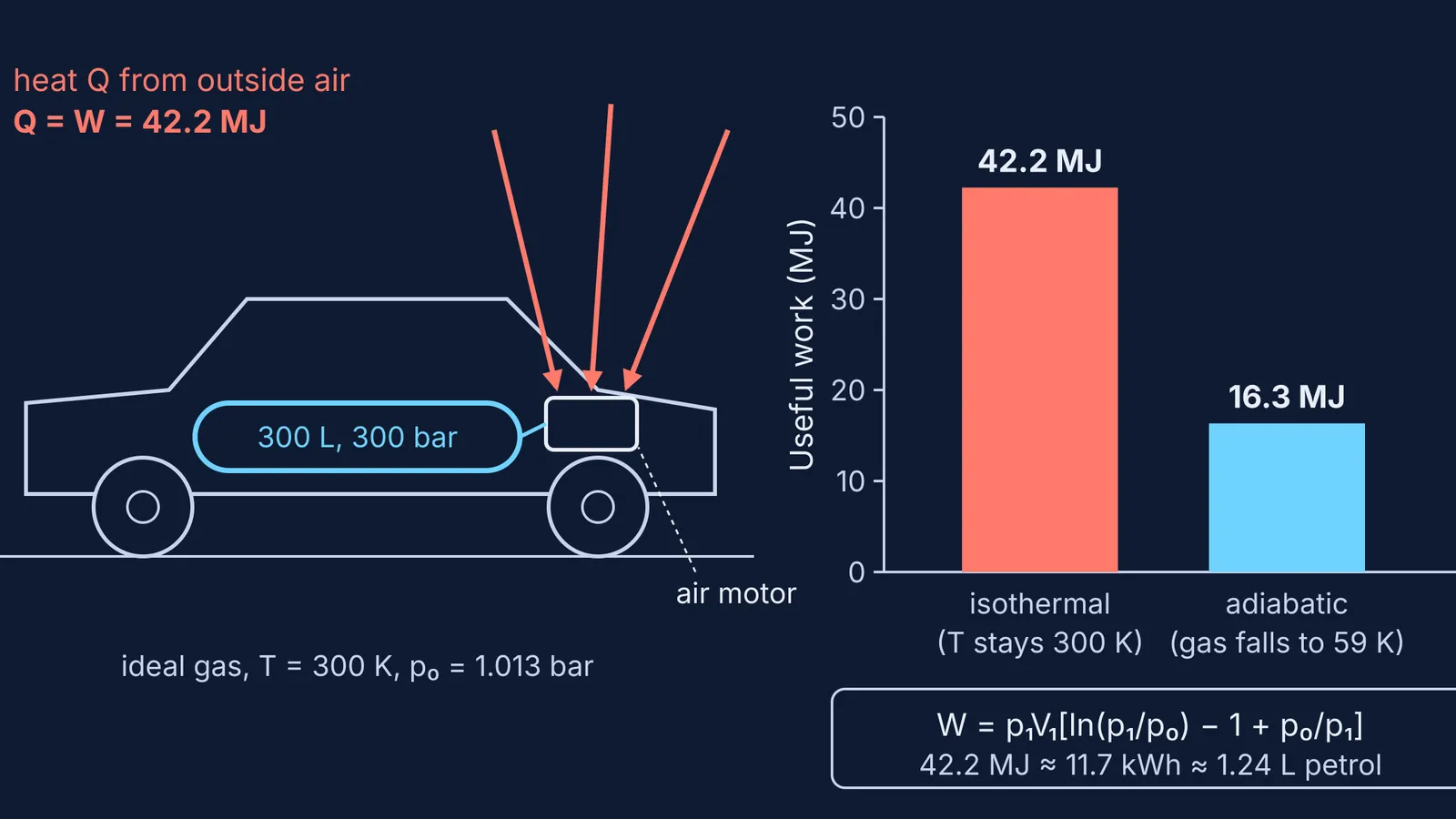
W = p₁V₁[ln(p₁/p₀) − 1 + p₀/p₁]
This is the most any engine, however clever, can get from the tank at room temperature.
Worked example: a 300-litre tank at 300 bar
Take a 300 L tank filled to 300 bar at 27 °C (300 K). These are round illustrative values, about the size and pressure discussed for air cars, not the specification of a particular vehicle. Treat the air as an ideal gas; at 300 bar real air departs noticeably from ideal behaviour, so the answers are approximate.
p₁V₁. 300 × 10⁵ Pa × 0.300 m³ = 9.00 MJ.
Pressure ratio. p₁/p₀ = 300/1.013 = 296.1, and ln(296.1) = 5.691.
Gross isothermal work. 9.00 × 5.691 = 51.2 MJ.
Minus the atmosphere's share. p₁V₁ − p₀V₁ = 9.00 − 0.03 = 8.97 MJ.
Useful work. W = 51.2 − 8.97 = 42.2 MJ = 11.7 kWh.
Mass of air. m = p₁V₁/(RT) = 9.00 × 10⁶/(287 × 300) = 104.5 kg. Released, it would fill about 89 m³ at atmospheric pressure.
How much is 42.2 MJ? Petrol holds about 34 MJ per litre (tables vary slightly), so the full tank stores the chemical energy of about 1.24 L of petrol. Another way to see it: about 39 Wh per litre of tank.
For comparison, a battery pack storing the same 11.7 kWh at an illustrative 150 Wh/kg would weigh about 78 kg. The air alone in the tank, 104.5 kg on the ideal-gas estimate, already weighs more, before you count the heavy tank that holds it.
Why must the car draw in 42 MJ of heat?
This is the part most air-car pitches leave out. For an ideal gas at constant temperature, the internal energy does not change: ΔU = 0. The first law, Q = ΔU + W, then says Q = W. Every joule of work the air does must come in as heat from outside. This is the result explained in why heat supplied equals work done in an isothermal process.
So to get the full 42.2 MJ, the air motor has to pull 42.2 MJ of heat out of the surrounding air through its metal fins. If you use the tank up in one hour, that is
42.2 × 10⁶ J/3,600 s = 11.7 kW
of heat flowing in, about as much as five or six 2 kW room heaters give out. Moving that much heat across a small temperature difference needs a large, heavy heat exchanger.
What happens if the air expands too fast to take in heat?
Then the expansion is closer to adiabatic: no heat comes in, so the work comes out of the gas's own internal energy and the gas cools. For air with γ = 1.4,
T₂ = T₁(p₀/p₁)^((γ − 1)/γ) = 300 × (1/296.1)^0.2857 = 59 K
That is −214 °C. Real air would start to liquefy before getting there, so take this as a sign of how strong the cooling is, not a real exhaust temperature. In practice the motor and its valves frost up.
The work is also much smaller. For a one-step adiabatic expansion to atmospheric pressure, the air does (p₁V₁ − p₀V₂)/(γ − 1) on the piston, with V₂ = V₁(p₁/p₀)^(1/γ) = 17.5 m³, and the atmosphere's share p₀(V₂ − V₁) still has to be subtracted. The result is about 16.3 MJ, only 39% of the isothermal 42.2 MJ. So the car is caught between two bad options: expand slowly and need a big heat exchanger, or expand fast and lose more than half the energy.
Why is the round trip so poor?
Filling the tank costs at least 42.2 MJ even with a perfect isothermal compressor. Real compressors heat the air as they squeeze it, and that heat is lost from the tank as it cools back to room temperature. That is why industrial compressors use several stages with cooling in between, as worked out in why air compressors use two stages. Even so, the electricity used to fill the tank is well above what the car gets back.
A peer-reviewed study of the idea, Creutzig, Papson, Schipper and Kammen (2009), Environmental Research Letters, concluded that even under highly optimistic assumptions a compressed-air car is significantly less efficient than a battery electric car. "Zero emission" is true only at the exhaust; the compressor runs on grid electricity. The same study found that a pneumatic and combustion hybrid could be workable, which is a different use of the idea.
For how much air a high-pressure tank holds at different pressures, see why a scuba tank lasts 89 minutes at the surface but 22 at 30 m. For more isothermal and adiabatic work problems, the Fermi Problem Library has a step-by-step solver that explains the reasoning.
Quick checklist
Useful isothermal work from a tank: W = p₁V₁[ln(p₁/p₀) − 1 + p₀/p₁].
300 L at 300 bar and 300 K: about 42.2 MJ, or 11.7 kWh, roughly 1.24 L of petrol.
Isothermal means ΔU = 0, so all that work must flow in as heat.
Fast, adiabatic expansion cools the air hard and gives only about 39% as much work.
Compressing the air costs more than you get back.
Always subtract the work done on the atmosphere.