

On this page
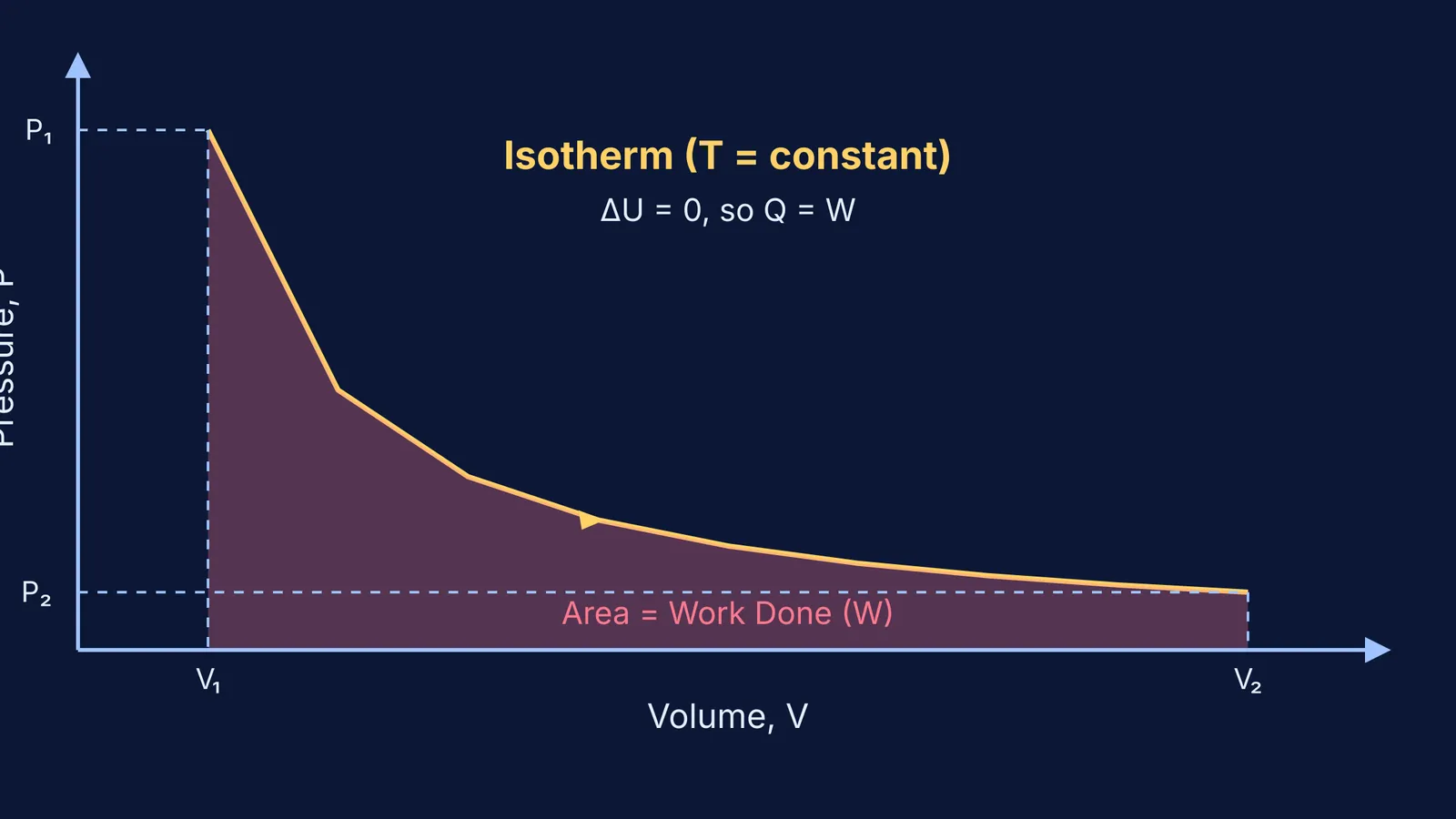
When a gas expands at a constant temperature, it pushes against its container to do work. To keep the temperature from dropping as it expands, the gas must absorb heat from its surroundings. This perfect balance between heat entering and work leaving is the defining feature of an isothermal process.
But why does every single joule of heat turn into work? The answer lies in how an ideal gas stores energy and how the laws of thermodynamics enforce energy conservation.
Why does heat supplied equal work done in an isothermal process?
The relationship between heat (Q), work (W), and internal energy (U) is governed by the first law of thermodynamics, which states that Q = ΔU + W.
For an ideal gas, the internal energy depends only on its absolute temperature (HyperPhysics, Georgia State University). Because an isothermal process, by definition, occurs at a constant temperature (ΔT = 0), the change in internal energy must be exactly zero:
ΔU = 0
When you substitute this zero into the first law equation, the internal energy term disappears entirely:
Q = 0 + W Q = W
This means if you supply 500 J of heat to the gas, it will do exactly 500 J of expansion work. By contrast, heat in isobaric and isochoric processes behaves differently because the temperature changes, meaning ΔU is not zero and heat is split between raising the temperature and doing work.
If you compress the gas by doing 300 J of work on it, it must reject 300 J of heat to the surroundings to stop its temperature from rising.
How to calculate the work done (and heat supplied)
Because Q = W in this process, finding the work done automatically gives you the heat supplied. For an ideal gas expanding from an initial volume V₁ to a final volume V₂ at a constant temperature T, the work done is calculated using the ideal gas law (PV = nRT).
By integrating the pressure over the change in volume (∫ P dV), you arrive at the standard formula:
W = nRT ln(V₂ / V₁)
n is the number of moles of the gas.
R is the universal gas constant (8.314 J/mol·K).
T is the absolute temperature in Kelvin.
ln is the natural logarithm (base e).
If you prefer to use base-10 logarithms, which is common in chemistry numericals, you multiply by 2.303:
W = 2.303 nRT log₁₀(V₂ / V₁)
Because Boyle's law states that P₁V₁ = P₂V₂ at a constant temperature, you can also write the formula in terms of pressure instead of volume:
W = nRT ln(P₁ / P₂)
If you are struggling with the integration steps required to prove this formula, the Fermi Concept Library breaks down the calculus step by step. It shows exactly how the area under the curve on a pressure-volume graph turns into the natural logarithm. For a complete thermodynamic cycle, you would calculate the net work in a cycle by reading the area enclosed by the loop.
What is the sign convention for heat and work?
In physics, work done by the gas (during expansion) is taken as positive, while work done on the gas (during compression) is negative.
Isothermal expansion: The volume increases (V₂ > V₁), making the ratio V₂/V₁ greater than 1. This means ln(V₂/V₁) is positive. The gas does positive work (W > 0). Heat flows into the system from the surroundings, so the heat supplied is also positive (Q > 0).
Isothermal compression: The volume decreases (V₂ < V₁), making the ratio V₂/V₁ a fraction. This makes ln(V₂/V₁) negative. Work is done on the gas (W < 0). To prevent the gas from heating up, heat flows out of the system, so the heat supplied is negative (Q < 0).
Wait, what about a gas expanding into a vacuum? That is a special case known as the free expansion of an ideal gas. Because the external pressure is zero, the gas does no work (W = 0). For an ideal gas, free expansion is also isothermal, meaning ΔU = 0 and consequently Q = 0.
A worked example: expanding helium
Imagine 2.0 moles of an ideal helium gas expanding isothermally at a constant temperature of 300 K to three times its original volume. How much heat is supplied to the gas?
Identify the given values: n = 2.0 mol, T = 300 K, and the expansion ratio V₂/V₁ = 3.
Write down the work formula: W = nRT ln(V₂ / V₁).
Substitute the values: W = 2.0 × 8.314 × 300 × ln(3).
Calculate the result: since ln(3) ≈ 1.0986, we get W = 4988.4 × 1.0986 ≈ 5480 J.
Because the process is isothermal and helium behaves like an ideal gas, the change in internal energy is zero (ΔU = 0). Therefore, the heat supplied is equal to the work done: Q = W = 5480 J. The gas must absorb 5480 J of heat from its heat reservoir to perform this expansion while keeping its temperature pegged at 300 K.
If you often hit a wall during numericals like this, the Fermi Problem Library acts as an AI tutor. Instead of just printing the final answer, it guides you through the reasoning, asking you to set up the First Law equation before doing the maths.
Remember that this perfect conversion between heat and work only applies perfectly to ideal gases. In real gases, intermolecular forces exist. This means a real gas's internal energy does depend weakly on its volume, and ΔU will not be perfectly zero during expansion. However, for JEE and NEET physics, the ideal gas assumption is the gold standard unless a problem explicitly states otherwise.


