On this page
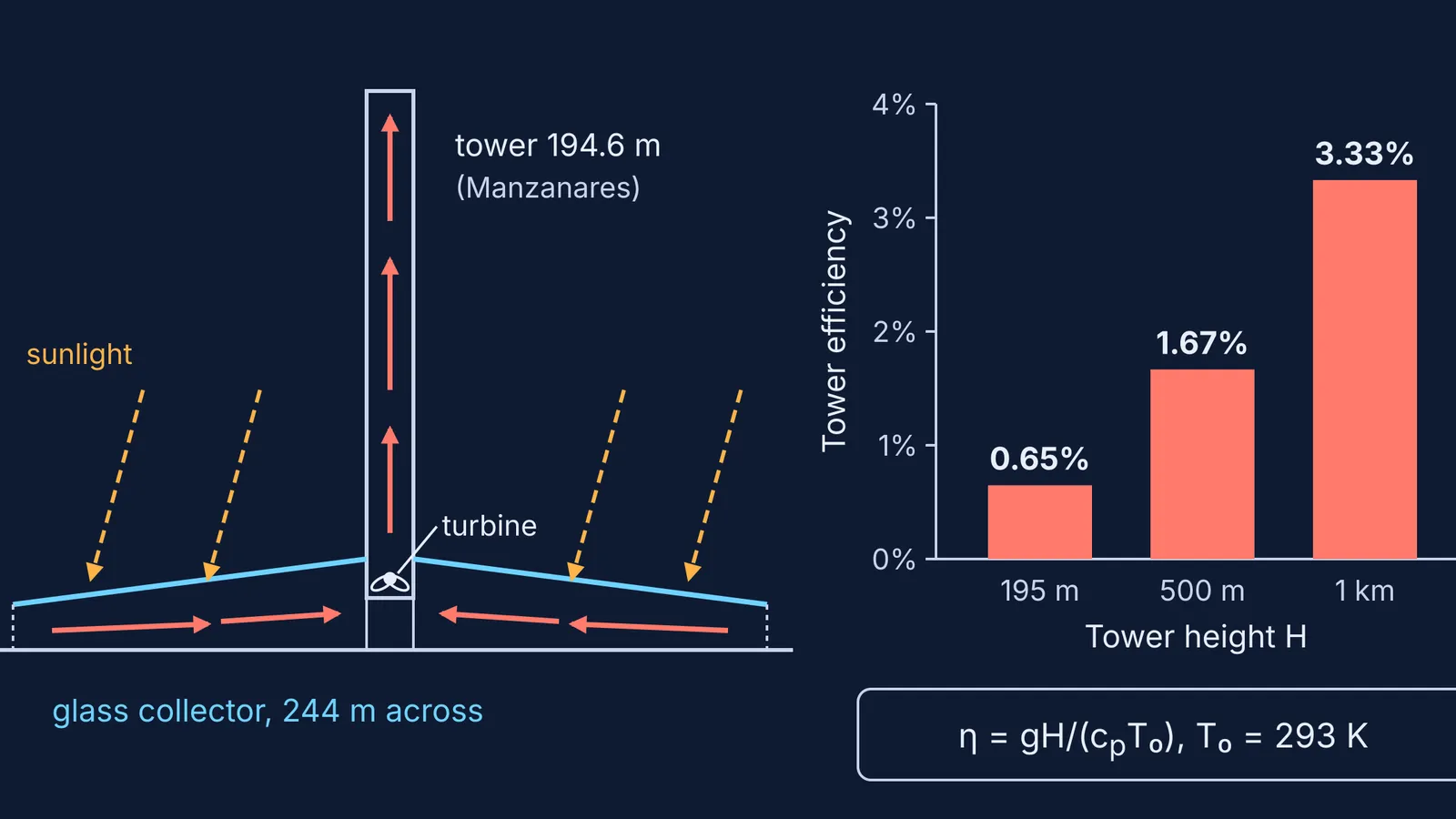
A solar updraft tower is a power station with almost no moving parts. A wide glass roof lets sunlight warm the air underneath it. The warm air, lighter than the air outside, flows to the centre and rises up a tall tower, turning a turbine at its foot. A prototype ran at Manzanares in Spain in the 1980s. The idea sounds simple and clean, but a short piece of Class 11 thermodynamics shows why it has never spread: the tower itself can turn only a tiny fraction of the heat into work, and the fraction depends on just one thing, its height.
How does a solar updraft tower work?
There are three parts.
The collector. A large, nearly flat glass or plastic roof a couple of metres above the ground. Sunlight passes through and heats the ground, and the ground heats the air. The roof traps the warm air.
The tower. A tall open tube at the centre. The column of warm air inside is less dense than the outside air at the same height, so it is pushed upwards.
The turbine. Placed at the base of the tower, where all the air must pass. It takes energy from the moving air and drives a generator.
Hot air rising is the same physics that carries sparks above a fire, explained in why bonfire sparks fly upward. The new question here is how much of the collected heat can become electricity.
What pressure difference drives the air?
Compare a column of warm air of height H inside the tower with a column of outside air of the same height. Outside, the air has density ρ₀ at temperature T₀. Inside, the air is warmer by ΔT, so at the same pressure its density is lower by about ρ₀ΔT/T₀ (from the ideal gas law, density is proportional to 1/T at fixed pressure). The difference in the weight of the two columns, per square metre, is the driving pressure:
Δp ≈ ρ₀gHΔT/T₀
For H = 194.6 m, ΔT = 20 K, T₀ = 293 K and ρ₀ = 1.2 kg/m³, Δp = 1.2 × 9.81 × 194.6 × 20/293 ≈ 156 Pa. That is about 0.15% of atmospheric pressure: a gentle push, but over a large cross-section it moves a lot of air.
Why is the tower's efficiency only gH/(cₚT₀)?
Follow one cubic metre of air through the plant.
Heat in. Warming it by ΔT at constant pressure takes ρ₀cₚΔT joules, where cₚ ≈ 1,005 J/(kg K) is the specific heat of air at constant pressure.
Work out. As that cubic metre is pushed through the turbine by a pressure difference Δp, the most work it can give is Δp × (1 m³) = ρ₀gHΔT/T₀ joules.
Ratio. Divide work by heat. ρ₀ and ΔT cancel:
η = gH/(cₚT₀)
That is the ideal limit for the tower part of the plant. It does not depend on how hot the collector gets, how big it is, or how fast the air moves. Only the height of the tower and the outside temperature appear.
There is a neat way to read this. g/cₚ = 9.81/1,005 ≈ 9.8 K per kilometre is the dry adiabatic lapse rate: the temperature drop of air that rises and expands without exchanging heat. So gH/cₚ is how much the rising air cools on its way up the tower, about 1.9 K for 194.6 m, and η is that small temperature drop divided by T₀. Like any heat engine, the tower's efficiency is set by a temperature ratio, and here the useful temperature drop is tiny. The same ratio of gravitational energy to heat, gh/c, appears in the temperature rise at the bottom of a waterfall, worked the other way round.
Worked example: the Manzanares prototype
The prototype had a tower 194.6 m high, a collector about 122 m in radius (244 m across) and a peak output of about 50 kW. It was built by Jörg Schlaich's team and described in Haaf, Friedrich, Mayr and Schlaich (1983), International Journal of Solar Energy; the same figures are given in the review by Zhou and Xu (2016), Solar Energy.
Tower efficiency. η = 9.81 × 194.6/(1,005 × 293) = 0.00648, or 0.65%.
Sunlight on the collector. Area = π × 122² ≈ 46,760 m². At 1,000 W/m² of strong sunlight, that is about 46.8 MW.
Heat reaching the air. Take a collector efficiency of 32% (an illustrative round value; real collectors lose heat through the glass and into the ground). Heat into the air ≈ 0.32 × 46.8 ≈ 15.0 MW.
Ideal tower output. 15.0 MW × 0.00648 ≈ 97 kW.
After the turbine. With a turbine efficiency of 80% (also illustrative), output ≈ 78 kW.
So the estimate, about 78 kW, is the same order as the reported peak of about 50 kW, which is all a back-of-the-envelope model can promise. The striking number is the overall one: about 50 kW out of about 47 MW of sunlight, roughly 0.1%.
Would a taller tower fix it?
Only slowly, because η grows in proportion to H.
194.6 m: 0.65%.
500 m: 1.67%.
1,000 m: 3.33%.
Even a kilometre-high tower, taller than any building in India by a wide margin, keeps only about one part in thirty of the heat it receives. Compare the Carnot limit for an engine working between 313 K and 293 K, which is 20/313 ≈ 6.4%; the tower is a much poorer engine because the temperature drop it actually uses is the 1.9 K of adiabatic cooling, not the 20 K of solar heating. The Carnot limit is discussed in Sadi Carnot's work on heat engines.
The tower does have real advantages: no fuel, few moving parts, and warm ground under the collector that keeps air flowing for a while after sunset. But to make useful power, it needs an enormous collector and a very tall, very expensive tower.
If the buoyancy argument and the cancelling of ΔT feel slippery, the Concept Library covers the ideal gas law and heat engines step by step.
Quick checklist
Warm air in the tower is lighter by about ρ₀ΔT/T₀ per cubic metre.
Driving pressure: Δp ≈ ρ₀gHΔT/T₀, about 156 Pa for 195 m and 20 K.
Tower efficiency: η = gH/(cₚT₀), independent of ΔT.
g/cₚ ≈ 9.8 K/km is the dry adiabatic lapse rate.
Manzanares: 194.6 m tower, η ≈ 0.65%, peak about 50 kW.
Even a 1 km tower gives only about 3.3%.
Always use kelvin.