On this page
Water at the bottom of a waterfall is, in principle, slightly warmer than at the top: its potential energy ends up as random molecular motion, which is what temperature measures. This classic numerical joins mechanics and heat in one line. Here is that line, a real Indian waterfall worked out, and why a thermometer would disagree.
How do you calculate the temperature rise of water at the bottom of a waterfall?
Assume every kilogram of water that falls a height h converts all its potential energy into internal energy of that same water, with no heat lost to the air or rocks. Then:
Energy lost by the water: mgh
Energy needed to warm it: mcΔT
Set them equal: mgh = mcΔT
The mass cancels: ΔT = gh/c
Because the mass cancels, a trickle and a monsoon flood falling the same height warm by the same amount.
The specific heat capacity of liquid water is about 4184 J per kg per kelvin, the energy that warms 1 kg of water by 1 K (Wikipedia, specific heat capacity). Standard gravity is defined as 9.80665 m/s² (NIST CODATA).
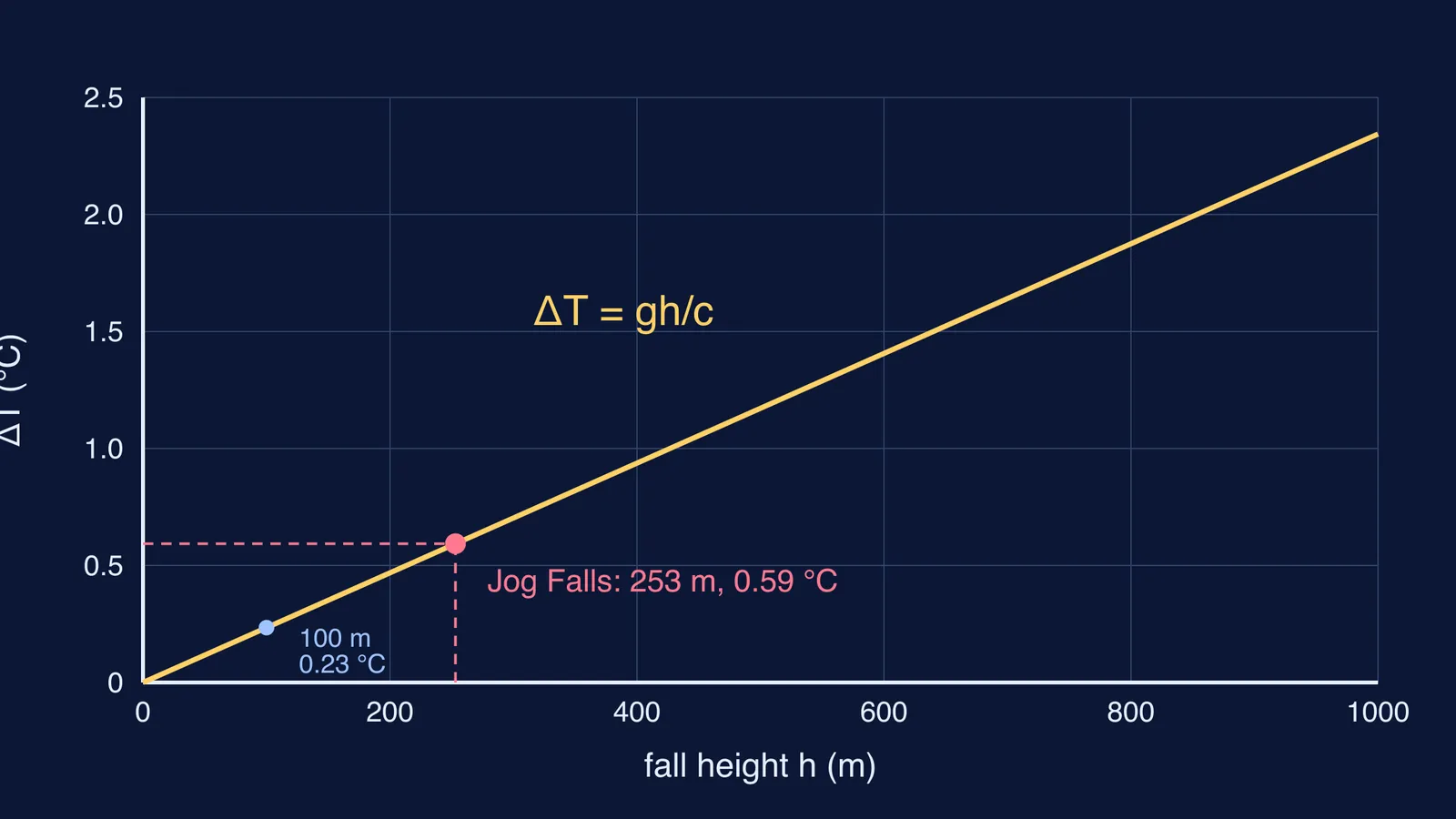
Put h = 100 m into ΔT = gh/c and you get 980.7 / 4184, which is about 0.23 °C for every 100 m of fall.
How much warmer is the water at the bottom of Jog Falls?
Jog Falls on the Sharavati river in Karnataka drops about 253 m (Wikipedia, Jog Falls).
Energy released per kilogram: gh = 9.80665 × 253 ≈ 2481 J
Temperature rise: ΔT = 2481 / 4184 ≈ 0.59 °C
So the ideal answer is a bit under 0.6 °C. If the river arrives at the lip at 24.0 °C, the model says it should reach the pool at about 24.6 °C.
James Joule made this prediction himself. In an 1845 letter to the Philosophical Magazine, he invited readers living amid the scenery of Wales or Scotland to check his experiments by measuring the water at the top and bottom of a cascade. He estimated that a fall of 817 feet would generate one degree of heat (Fahrenheit, given his pound-and-foot units) and that Niagara's 160-foot fall would raise the river by about one fifth of a degree (Joule's letter, transcribed by ChemTeam). Convert 817 feet to 249 m and run it through ΔT = gh/c: you get 0.58 °C, which is 1.05 °F. Joule's estimate was within about 5% of today's value.
Why would the measured temperature rise be smaller?
Joule later planned to try the measurement. On his honeymoon in 1847 he met William Thomson (later Lord Kelvin) at Chamonix, and the two arranged to measure the temperature difference at the Cascade de Sallanches, which proved impractical (Wikipedia, James Prescott Joule). Several things push a real reading below the ideal number.
Evaporation from the spray. A waterfall breaks into droplets and mist with a huge surface area. Evaporating water takes about 2257 J per gram at 100 °C (Wikipedia, enthalpy of vaporization), roughly 2.26 million joules per kilogram, and a little more at everyday temperatures. At Jog Falls each kilogram gains 2481 J, so evaporating only about 1 g of every kilogram, roughly 0.1%, would cancel the entire warming.
Air drag. Spray and thin sheets of water slow down as they fall. Part of the energy goes into pushing and heating the air, not the water.
Energy that leaves with the river. Water still flows away from the plunge pool, so not all of its energy has been turned into heat at the spot where you put the thermometer.
Heat exchange and mixing. Rock, air and sunlight warm or cool the water, and the pool mixes with other water. A fraction of a degree is hard to pick out from that.
The model is an upper limit, not a forecast. In an exam, "assume all the energy heats the water" tells you to use it. In a viva, the list above answers "why is the observed rise less?".
Which mistakes cost marks in this problem?
Mixing units: keep h in metres and c in J/kg·K.
Forgetting that a change of 1 °C equals a change of 1 K.
Saying bigger, fuller waterfalls get hotter. Height matters; flow does not.
The same energy bookkeeping runs through our posts on how much power a waterfall can deliver with P = ρQgh, how a bullet heats up when it stops in a wall and why temperature can rise without heat being added.
If you set up mgh = mcΔT but get stuck when a fraction or a change of units comes in, the Fermi Problem Library has worked problems with a step-by-step solver that explains the reasoning rather than printing an answer. To revise specific heat or energy conservation from the start, try the Fermi Concept Library.
Try it yourself: pick the tallest waterfall near you, find its height, and work out ΔT = gh/c before you check the answer.