

On this page
A bullet hits a wall and stops. Its kinetic energy doesn't vanish. Some of it pushes the wall's material aside, some leaves as sound, and some warms the bullet. Exam questions ask you to follow that last part, usually as a fraction, such as half the kinetic energy becoming heat in the bullet. Here is how to turn that into a temperature.
What happens to a bullet's energy when it stops in a wall?
Working out the real split would need a detailed impact model, so textbook problems give you a fraction f instead. This is a normal modelling choice. In the OpenStax College Physics 2e chapter on heat capacity, a worked example assumes a truck's brakes keep 10% of the energy lost on a descent, and 100 kg of brake material warms by 9.2 °C. Take f from the question. If none is given, assume f = 1.
How do you derive ΔT = fv²/2c?
Specific heat is the heat needed per unit mass to raise the temperature by one degree, so Q = mcΔT (HyperPhysics, specific heat).
The heat that stays in the bullet is f × ½mv². Set the two equal:
f × ½mv² = mcΔT
The mass m appears on both sides, so cancel it: f × ½v² = cΔT
Rearrange: ΔT = fv² / 2c
The mass has dropped out. At the same speed, a heavy bullet and a light one made of the same metal warm by the same amount: the heavy one carries more energy, but it also has more metal to heat.
Worked example: how hot does a lead bullet get?
Lead's specific heat is 128 J/(kg·°C), according to Table 14.1 of OpenStax College Physics 2e and the HyperPhysics specific heat table.
The problem: a lead bullet travelling at 300 m/s stops in a wall. Half its kinetic energy stays in the bullet as heat. It starts at 30 °C. Find its final temperature.
v² = 300² = 90,000 m²/s²
fv²/2 = 0.5 × 90,000 / 2 = 22,500 J per kg
ΔT = 22,500 / 128 ≈ 176 °C
Final temperature ≈ 30 + 176 = 206 °C
You never needed the mass. If a question gives one, it is a distractor or needed for a later part, such as the heat in joules.
Will the bullet melt when it hits the wall?
Lead melts at 327 °C, and its latent heat of fusion is 24.5 kJ/kg, according to Table 14.2 in the OpenStax chapter on phase change and latent heat.
Warming from 30 °C to 327 °C takes 128 × 297 ≈ 38,000 J per kg. So:
At f = 0.5 and 300 m/s, the bullet gets 22,500 J/kg. It does not melt.
At f = 1 and 300 m/s, it gets 45,000 J/kg. The roughly 7,000 J/kg left over melts about 7,000 / 24,500 ≈ 28% of it.
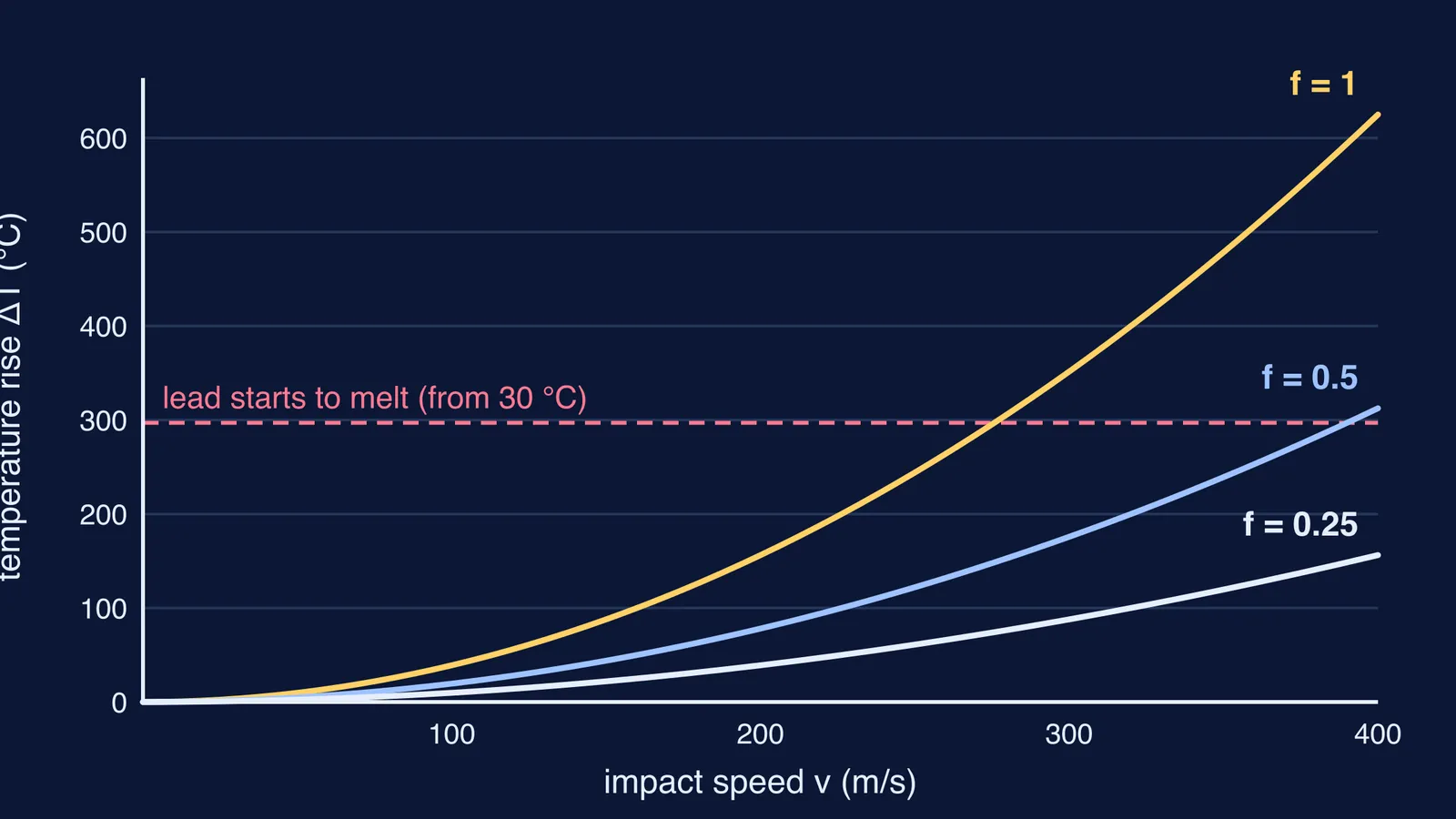
At f = 1, melting starts near 276 m/s, from v = √(2cΔT) = √(2 × 128 × 297). At f = 0.5, it starts near 390 m/s.
Melting the whole bullet at f = 1 needs about 62,500 J/kg, which means about 354 m/s.
The graph at the top of this post plots these curves. The dashed line marks the 297 °C rise to the melting point.
Why do exam questions use lead?
Lead has a low specific heat. Run the same impact (300 m/s, f = 0.5) with copper, which has a specific heat of 386 J/(kg·°C) in the HyperPhysics table, and the rise is only about 58 °C. Lead's low melting point also makes the "does it melt?" twist possible.
What mistakes cost marks on this problem?
Forgetting f, or using 1 − f (the share that goes to the wall) by mistake
Leaving c in J/(g·°C)
Reporting ΔT when the question asks for the final temperature
Adding a temperature rise past lead's melting point without checking for melting: once lead reaches its melting point, extra heat melts it rather than warming it
Using momentum conservation here: that is for bullet-and-block problems, not for energy that turns into heat
If the bullet keeps moving, see finding a bullet's speed after it passes through a block. To practise Q = mcΔT with real readings, try specific heat by the method of mixtures. To see where "lost" kinetic energy goes, test elastic and inelastic collisions in a simulation.
For more problems like this, the Fermi Problem Library has worked problems with a step-by-step solver that explains the reasoning rather than printing an answer. If specific heat or latent heat still feels shaky, each has its own lesson in the Fermi Concept Library.


