

On this page
The problem of a bullet passing through a wooden block is a staple in physics exams. It tests two core concepts simultaneously: linear momentum and kinetic energy. But why do we use one and not the other to find the block's speed?
Why is momentum conserved when a bullet passes through a block?
Momentum is the product of the mass and velocity of an object. The law of conservation of momentum states that if no external horizontal forces act on a system, its total momentum remains constant.
In this scenario, the bullet and the block exert forces on each other as the bullet tears through the wood. Because these are strictly internal forces, the net external force acting on the bullet-block system is zero. Similar to a shell exploding midair, momentum is conserved because the forces are entirely internal to the system.
How do you find the speed of the block after the bullet passes through?
To find the final speed, we equate the total momentum before the impact to the total momentum after the impact.
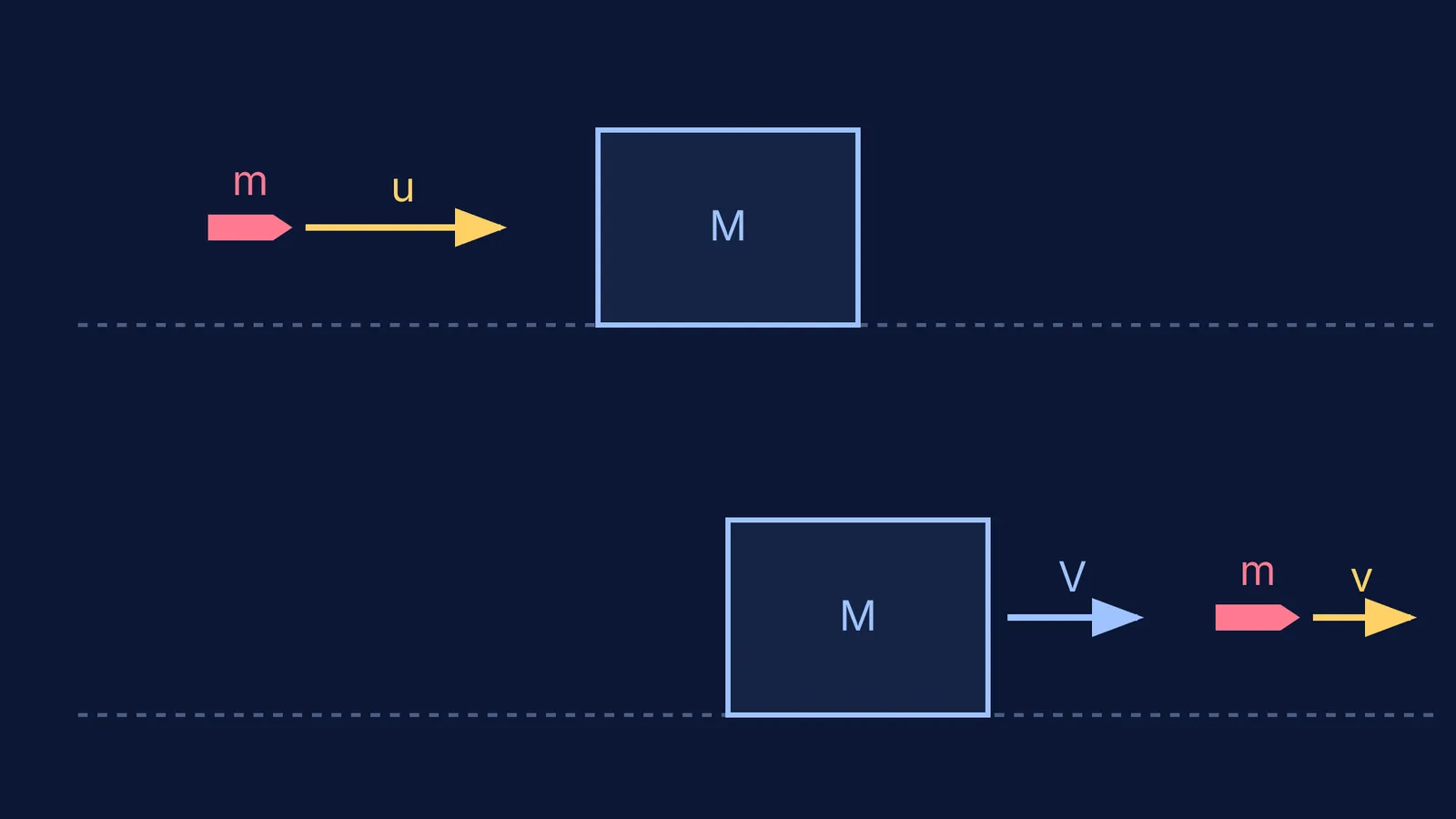
Before the collision, the block of mass M is resting on a frictionless surface, so its momentum is zero. The bullet of mass m is travelling with an initial velocity u. Total initial momentum is m × u.
After passing through, the bullet exits with a reduced velocity v. The block has absorbed some of the bullet's momentum and moves forward with a new velocity V. Total final momentum is m × v + M × V.
By conservation of linear momentum: m u = m v + M V
To isolate the speed of the block (V): M V = m u − m v, which gives V = m(u − v) / M.
If you find yourself stuck when setting up equations for collisions or struggling to know when energy is lost, the Fermi Problem Library has worked problems with a step-by-step solver that explains the reasoning rather than printing an answer. The AI tutor notices where you are stuck and builds a plan for the session, guiding you through concepts like inelastic collisions.
How to calculate the energy lost in the block?
Unlike an oblique elastic collision of equal masses, this event is highly inelastic. An inelastic collision is a collision in which kinetic energy is not conserved due to the action of internal friction. As the bullet tears through the wood, work is done against the wood's resistance, generating heat and permanently deforming the block.
Although inelastic collisions do not conserve kinetic energy, they do obey conservation of momentum.
To find the energy lost (ΔK), we calculate the difference between the total kinetic energy before and after the collision.
Initial kinetic energy is ½ m u².
Final kinetic energy (both objects are moving) is ½ m v² + ½ M V².
Energy lost is Initial KE − Final KE, which equals ½ m u² − (½ m v² + ½ M V²).
Substitute the block's velocity V into the equation to find exactly how much kinetic energy was transformed into heat, sound, and the physical splintering of the block.
How was this principle used in history?
The physics behind this problem was first applied to solve a practical military challenge. The ballistic pendulum was invented in 1742 by English mathematician Benjamin Robins as it provided the first way to accurately measure the velocity of a bullet.
Before high-speed cameras and modern chronographs, catching a bullet in a heavy block and calculating the momentum transfer was the only reliable way to measure how fast a projectile was moving. Understanding the math behind a bullet passing through or lodging in a block remains a fundamental rite of passage for every physics student today.


