On this page
A stream dropping over a 30 m cliff carries energy every second. One formula puts a number on it; a second step tells you how much a real turbine and generator turn into electricity. Here is how to do both, with a worked example.
What is the formula for power from falling water?
Water falling a height h loses potential energy mgh. Divide by time and the mass per second becomes ρQ, so the power carried by the water is P = ρQgh. The Micro Hydropower System Design Guidelines prepared for the Pacific Power Association derive exactly this, and with ρ = 1,000 kg/m³ and g = 9.81 m/s² it becomes P (W) = 9810 × Q × H.
ρ is the density of water, 1,000 kg/m³
Q is the volume flow rate, in m³/s
g is 9.81 m/s²
h is the head, the vertical drop in metres
The same guideline says the theoretical power is in exact proportion to head and flow: double either one and you double the power. Head means vertical height, not the length of the slope, and IRENA's hydropower cost analysis notes that higher heads give greater pressure and therefore greater hydropower potential. For the full plant, see how hydroelectric dams make power.
Why does a real plant give less than ρQgh?
The Pacific Power Association guideline gives typical efficiencies of 85–90% for the channel and penstock, 80–90% for the turbine, 80–90% for the generator and 85–90% for the transmission line. Overall efficiency is the product of these, not the sum.
Friction in the pipe shows up as lost head: gross head minus head losses gives the net head. For small systems the guideline's rough estimate is P (W) = 9810 × η(turbine) × η(generator) × Q × H(net).
How do you estimate the flow of a stream above a waterfall?
Flow is the hard part. The design guideline describes a float method: measure the stream's cross-section, time a float over a known length, and multiply area by speed. Because the surface moves faster than the water below, you then apply a correction factor, which the guideline gives as 0.45 for a shallow (under 0.5 m) turbulent stream and 0.65 for a small, slow, clear one. For a very small stream, it suggests the bucket method: a 200-litre barrel can measure flows up to 20 litres per second.
The habits from our guide to Fermi estimation problems apply: round sensibly and sanity-check.
Worked example: how much power from a 30 m waterfall?
Imagine a hill stream that drops 30 m. The numbers are our own illustration; the method and ranges come from the Pacific Power Association guideline.
Flow. The stream is 5 m wide and 0.4 m deep on average, and a leaf covers 15 m in 10 s, so the surface speed is 1.5 m/s. It is shallow and turbulent, so use 0.45: Q = 5 × 0.4 × 1.5 × 0.45 = 1.35 m³/s.
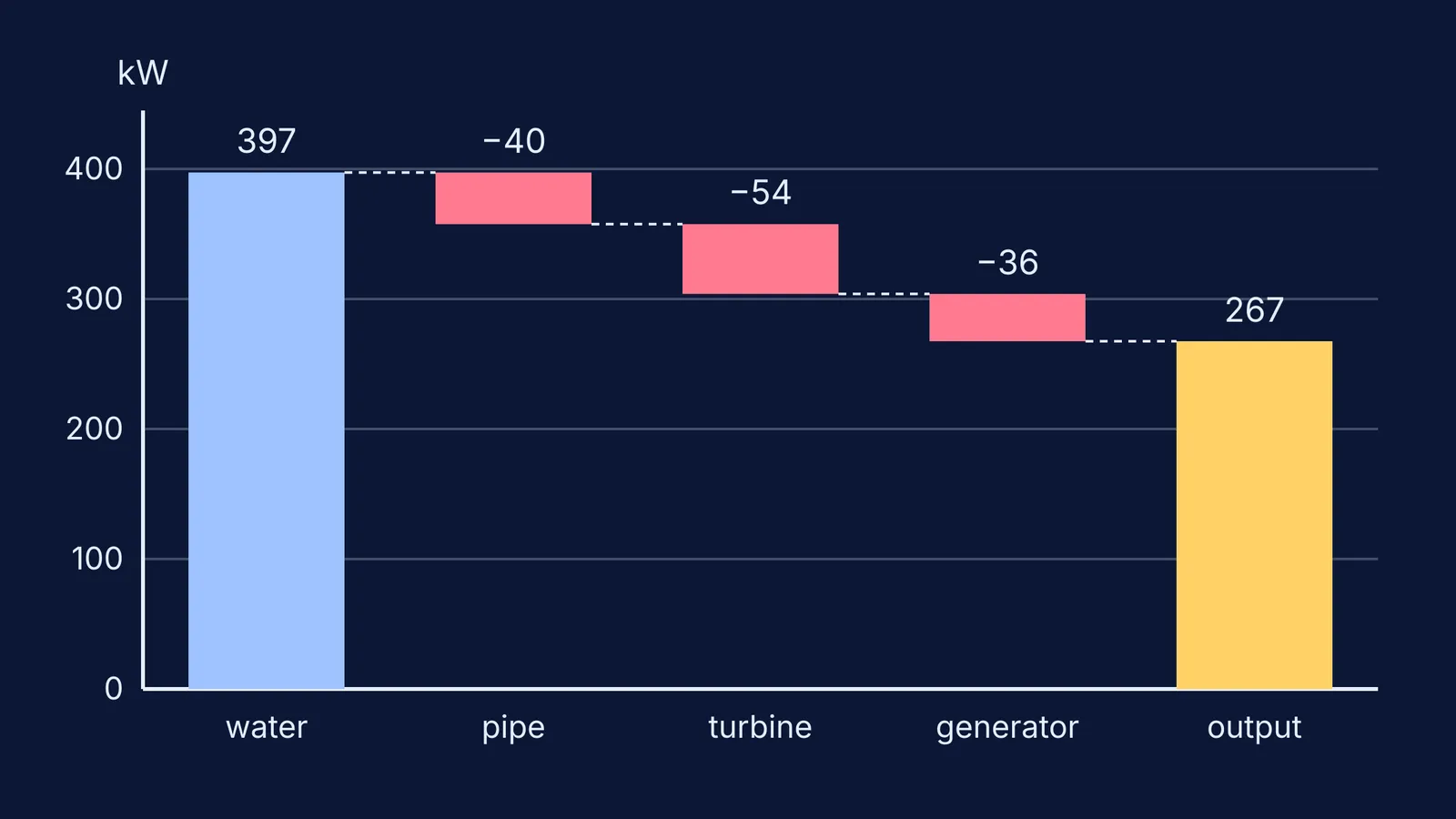
Power in the water. P = 9810 × 1.35 × 30 = 397,305 W, about 397 kW.
Net head. Assume pipe friction costs 10% of the head, leaving 27 m: 9810 × 1.35 × 27 ≈ 357.6 kW.
Turbine and generator. Take 85% and 88%, both inside the 80–90% range: 357.6 × 0.85 × 0.88 ≈ 267 kW.
Sanity check. 267 ÷ 397 ≈ 0.67, so about two-thirds of the water's power reaches the wires.
How big is that? IRENA's typical size bands call 5–100 kW micro-hydro, 100 kW to 1 MW mini-hydro and 1–20 MW small hydro, while noting that India defines small hydro as up to 25 MW. So our waterfall is a mini-hydro site. India's Small Hydro Power Development Scheme, approved by the Union Cabinet in March 2026, supports projects of 1–25 MW, with an outlay of Rs 2,584.60 crore for about 1,500 MW of capacity. To clear the 1 MW mark, our site would need about 3.7 times the flow × head.
What mistakes cost marks on hydropower problems?
Litres per second are not m³/s: 1 L/s = 0.001 m³/s. With ρ = 1,000 kg/m³ (as the guideline uses), one litre of water has a mass of 1 kg.
Use the vertical drop, not the length of the slope or pipe.
Multiply efficiencies (0.85 × 0.88), never add or average them.
If the question gives one overall efficiency, apply it once.
Watch W, kW and MW in the final line.
Reverse the logic for pumps: the input power is ρQgh ÷ η, as in this motor-lifting efficiency problem.
If your method is right but the number is wrong, the Fermi Problem Library has worked problems with a step-by-step solver that explains the reasoning rather than printing an answer. If the gap is in the ideas underneath (potential energy, power, efficiency), the Fermi Concept Library gives each concept its own lesson and shows where it sits in the map.