

On this page
A hydroelectric dam is an energy converter: it holds water high up, lets it fall, and turns that fall into electricity. If you know work and energy and electromagnetic induction, you already know how a dam works. This post joins them up and checks the physics against Tehri dam's official numbers.
How does a dam turn falling water into electricity?
The US Geological Survey describes the path in a few steps, and the US Energy Information Administration gives the same picture:
The dam stores water in a reservoir, above the river.
Water enters an intake and falls through a large pipe called the penstock.
At the bottom, the fast-moving water pushes against the blades of a turbine and makes it spin.
The turbine's shaft turns the rotor of a generator, which moves electromagnets past coils of wire, and current flows.
The water leaves through the tailrace and rejoins the river.
The US Department of Energy puts the key idea in one line: output depends on the volume of water flowing and the head, the change in height the water falls through, so more flow and a higher head give more electricity.
Where does the energy actually come from?
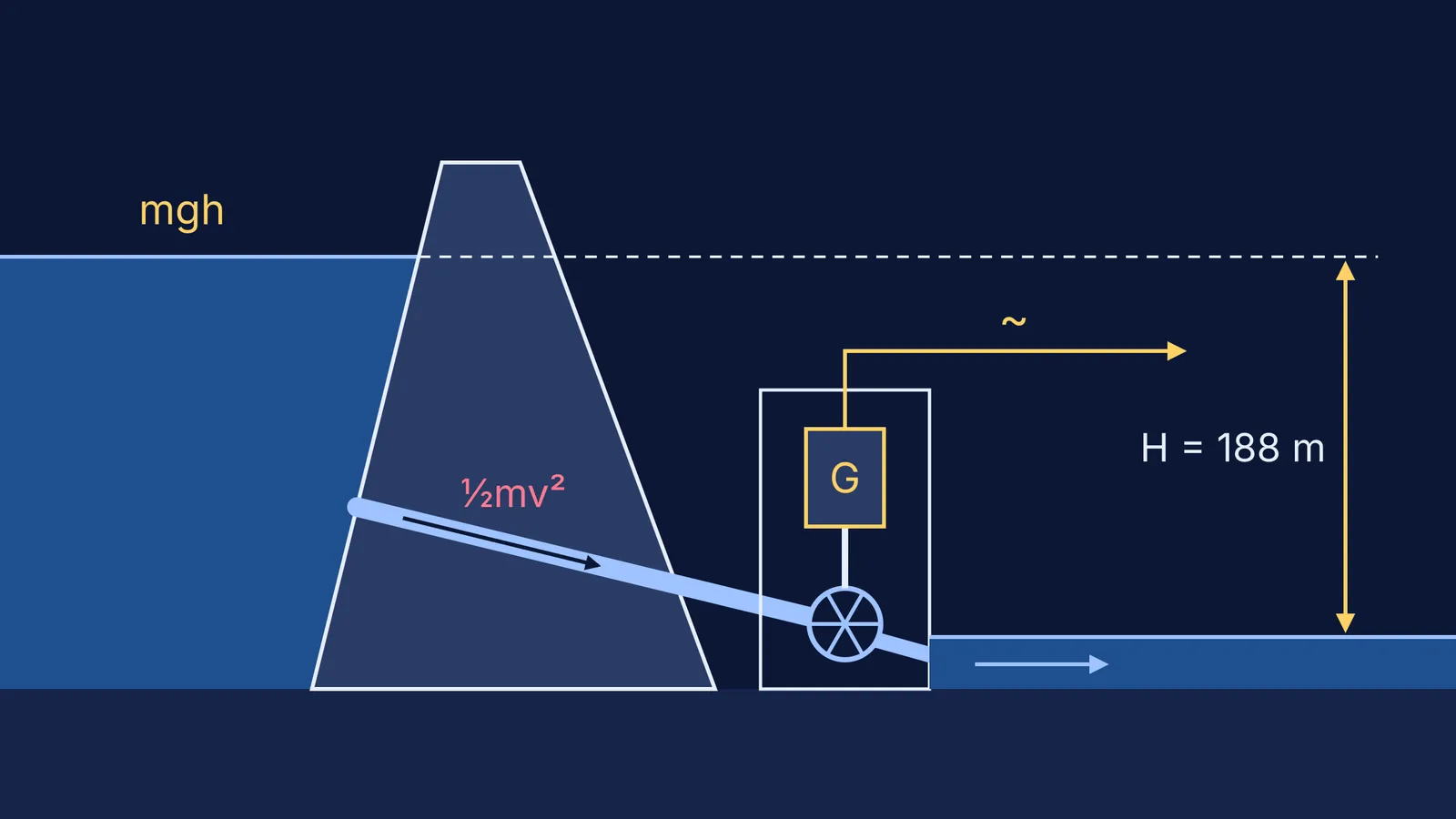
Follow one kilogram of water through the dam:
In the reservoir: it has gravitational potential energy mgh, measured from the river level below.
In the penstock: as the water drops, that potential energy turns into kinetic energy, ½mv², and pressure.
At the turbine: the water slows down and loses pressure as it pushes the blades, so its energy becomes rotational energy of the shaft.
In the generator: the spinning rotor changes the magnetic flux through the coils, and the induced emf drives current into the grid.
The water is not used up. It loses height, not mass, and flows on downstream.
The generator step is the same physics as the textbook coil spinning in a magnetic field; our explainer on the emf in a rotating coil derives it. A wind farm does the same last step with moving air instead of falling water, as in how wind turbines make power.
How much power can one Tehri turbine make?
Power is energy per second. If Q cubic metres of water fall through a head H every second, the water delivers P = ρgQH, where ρ is the density of water (1000 kg per cubic metre) and g is 9.81 m/s².
THDC India's page for the Tehri Hydro Power Project lists the real figures: four Francis turbine units of 250 MW each, a design head of 188 m, and a rated discharge of 145 cumecs (cubic metres per second) per unit. The same page gives the dam's height as 260.5 m.
For one unit:
Energy per kilogram of water: gH = 9.81 × 188 ≈ 1,844 J.
Mass of water per second: 145 m³/s × 1000 kg/m³ = 145,000 kg/s.
Power carried by the water: 145,000 × 1,844 ≈ 267 million watts, or about 267 MW.
Rated electrical output: 250 MW.
Efficiency: 250 ÷ 267 ≈ 0.93, so roughly 93% of the water's energy comes out as electricity.
Treat 93% as an estimate from rated figures, not a measurement. The rest is lost to friction in the tunnels, turbulence at the blades and heating in the generator.
Why doesn't the turbine spin freely once it starts?
Because energy is conserved. Current in the generator's coils feels a magnetic force that opposes the rotation (Lenz's law), so the water must keep pushing. When demand on the grid rises, the generator gets harder to turn and more water must flow. Our post on why a generator is harder to turn under load works through this with numbers.
A five-step check for dam questions in exams
Use this when a board or JEE Main question gives you a dam or a waterfall:
Write the energy chain first: potential, kinetic, rotational, electrical.
Find the head H as a height difference in metres, not the dam's height.
Convert flow to kilograms per second: volume flow × 1000.
Compute P = ρgQH, then multiply by the efficiency if one is given.
Sanity-check the size: each Tehri unit is 250 MW, so an answer in watts or thousands of gigawatts means a slip.
Step 2 catches many students: Tehri's dam is 260.5 m tall, but its design head is 188 m.
If the flux change inside the generator is the part you cannot picture, the Fermi Simulation Lab has interactive simulations for ideas that are easier to see than to read. For practice, the Fermi Problem Library has worked problems with a step-by-step solver that explains the reasoning rather than printing an answer.
Next time you see a dam, look for the powerhouse at its foot: that is where height becomes current.


