

On this page
An AC generator (or alternator) turns mechanical rotation into electrical energy using Faraday's law of induction. This principle is what powers the grid, from massive hydroelectric turbines to small portable generators. As a rectangular coil of wire spins inside a uniform magnetic field, the changing magnetic flux induces an alternating electromotive force (EMF). The formula for this induced EMF is e = NBAω sin(ωt), where e is the voltage at any given time t. This alternating voltage pushes an alternating current through the circuit, driving the electricity we use daily.
What does the formula N B A ω mean?
To see why the voltage behaves the way it does, we break down the peak EMF formula, e₀ = NBAω. This equation tells us the absolute highest voltage the generator produces at the peak of each cycle. It relies on four physical parameters:
N (Number of turns): This represents the number of loops of wire in the rotating coil. Because each loop acts like a tiny battery in series with the others, adding more turns proportionally increases the total voltage.
B (Magnetic field strength): Measured in Teslas (T), this tells us how strong the permanent magnets or electromagnets in the generator are. A denser magnetic field provides more flux for the coil to cut through.
A (Area of the coil): Measured in square metres (m²), a larger face area catches a greater total magnetic flux as it faces the poles of the magnet.
ω (Angular velocity): Measured in radians per second (rad/s), this is the speed at which the coil spins around its axis.
Because ω acts as a multiplier for the entire peak voltage expression, the mechanical rotation speed dictates the electrical output in multiple ways. This principle is fundamentally linked to how flux changes, similar to the circulating electric field inside a solenoid.
Why does faster rotation give both higher voltage and frequency?
In most of the world, including India, mains electricity is delivered at a standard frequency of 50 Hz 1. This means that for a simple two-pole AC generator, the coil must complete 50 full revolutions every single second. To convert this to the angular velocity used in the formula, we multiply by 2π, giving ω = 2π × 50 ≈ 314 rad/s.
When you spin a generator's coil faster, two distinct electrical properties change simultaneously:
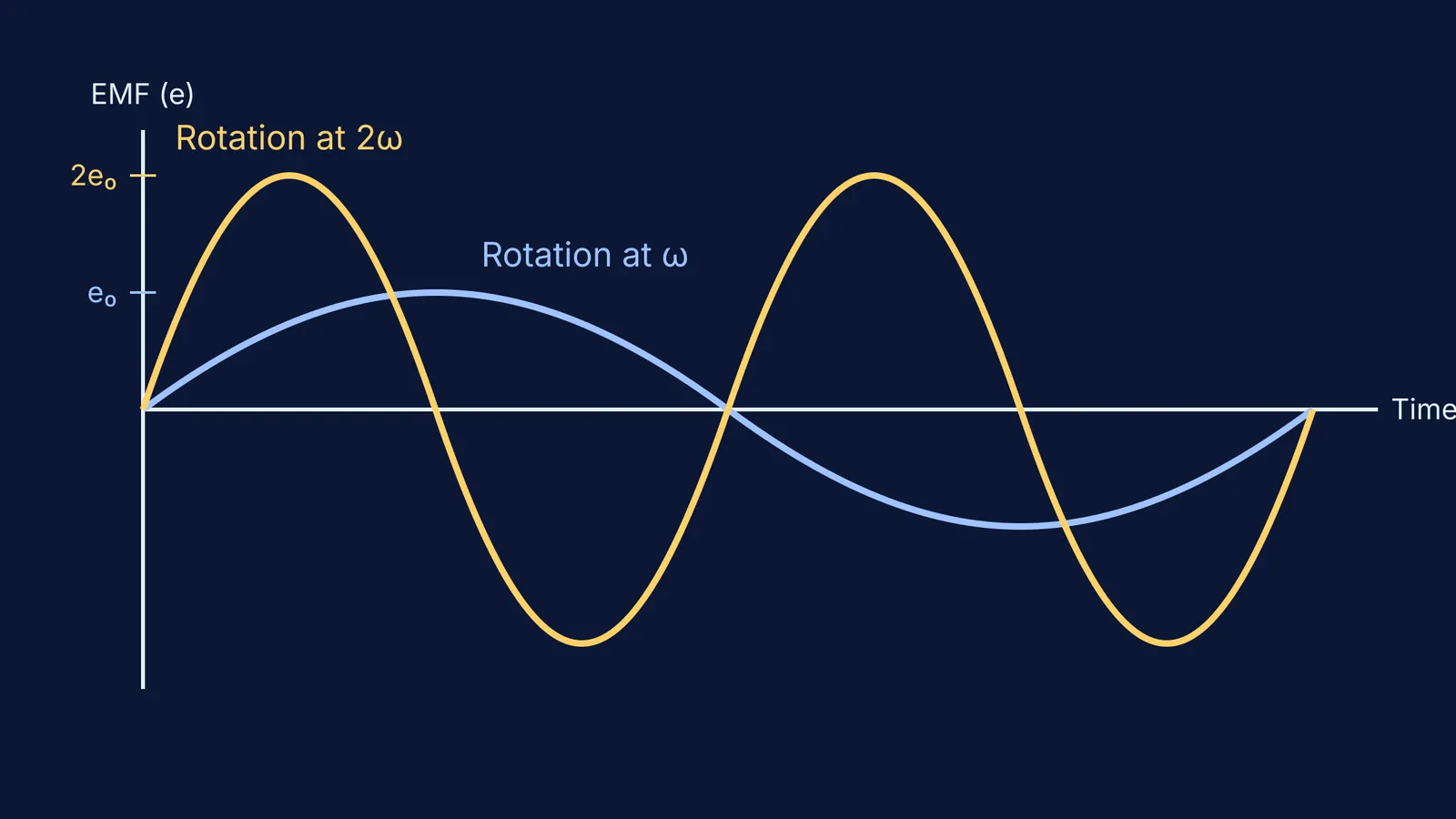
The frequency increases: Because the coil completes a full 360-degree rotation in less time, the alternating current reverses direction more often. If you double the rotation speed to 100 revolutions per second, the electrical frequency becomes 100 Hz, meaning the sine wave on a graph squashes horizontally.
The peak voltage increases: Faraday's law of induction states that the induced EMF depends entirely on the rate of change of magnetic flux. When the coil spins twice as fast, it sweeps through the magnetic field lines twice as quickly. Because the peak voltage is calculated as NBAω, doubling the angular velocity ω strictly doubles the peak EMF. The sine wave on a graph stretches vertically.
This dual effect is a common pitfall in physics exams: students easily remember that faster rotation means a higher frequency, but they often forget that it also scales up the amplitude of the voltage wave. If you have concept gaps, the Fermi Concept Library covers every concept in physics, each with its own lesson and its place in the map.
How do you solve rotating coil AC generator problems?
Exam questions on electromagnetic induction usually give you the physical dimensions of the coil and ask you to find either the peak EMF or the instantaneous EMF at a specific fraction of a second. Here is a reliable step-by-step framework to solve them without dropping terms:
Convert the frequency to radians per second: Problems often disguise the rotation speed by giving it in revolutions per minute (rpm). First, divide the rpm value by 60 to find the frequency f in Hz (revolutions per second). Then, find the angular velocity using ω = 2πf.
Standardise your units: Ensure the coil's area is converted from cm² to square metres (m²) and the magnetic field is in Teslas (T). If the field is given in Gauss, remember that 1 Tesla is 10,000 Gauss.
Calculate the peak EMF (e₀): Multiply the number of turns, the magnetic field strength, the area, and your calculated ω. This result is the maximum voltage amplitude, e₀ = NBAω.
Write the instantaneous equation: Substitute e₀ and ω back into the time-dependent formula e = e₀ sin(ωt).
Solve for the specific time: If the question asks for the voltage at a certain time t, evaluate the sine function. It is critical to ensure your calculator is set to radians, not degrees, because ωt yields an angle in radians.
For practice on related circuit dynamics, such as the quick rules for inductors at t = 0 and t = ∞, you can correct wrong-method mistakes with the Fermi Problem Library, which has worked problems with a step-by-step solver that explains the reasoning rather than printing an answer.


