

On this page
When a crane or a lift hauls a heavy load upwards, it converts electrical energy into gravitational potential energy. The electric motor does the work, but not all the energy drawn from the power supply makes it to the load. Some is lost as heat in the wires, and some is lost to friction in the motor's bearings and the lifting mechanism.
Understanding how to calculate this efficiency is a standard problem in physics and engineering. It brings together electrical power and classical mechanics in one practical situation, much like calculating the tension for a monkey climbing a rope or understanding how Pascal's law in hydraulic machines allows a small push to lift a car. If you are stuck on setting up problems like this, the Fermi Problem Library has worked problems with a step-by-step solver that explains the reasoning rather than printing an answer.
How to calculate lifting efficiency?
Efficiency (η) is the ratio of useful energy output to total energy input. For a motor lifting a mass m through a height h in time t, we can look at it either through energy or power. Both methods will give you the same percentage, provided you are consistent with your units.
Useful work done (output): The work required to lift the mass against gravity is W = mgh, where g is the acceleration due to gravity (usually taken as 9.8 m/s² or 10 m/s²).
Electrical energy supplied (input): The energy consumed by the motor is E = VIt, where V is the voltage and I is the current.
Efficiency formula: η = (mgh / VIt) × 100%
Alternatively, you can frame the problem using power instead of total energy. Since power is the rate at which work is done, you can divide both the input and output energy by time t:
Output power: P_out = mgh / t (which is also force × velocity, mgv)
Input power: P_in = VI
Efficiency: η = (P_out / P_in) × 100%
Efficiency of motor lifting a load calculation
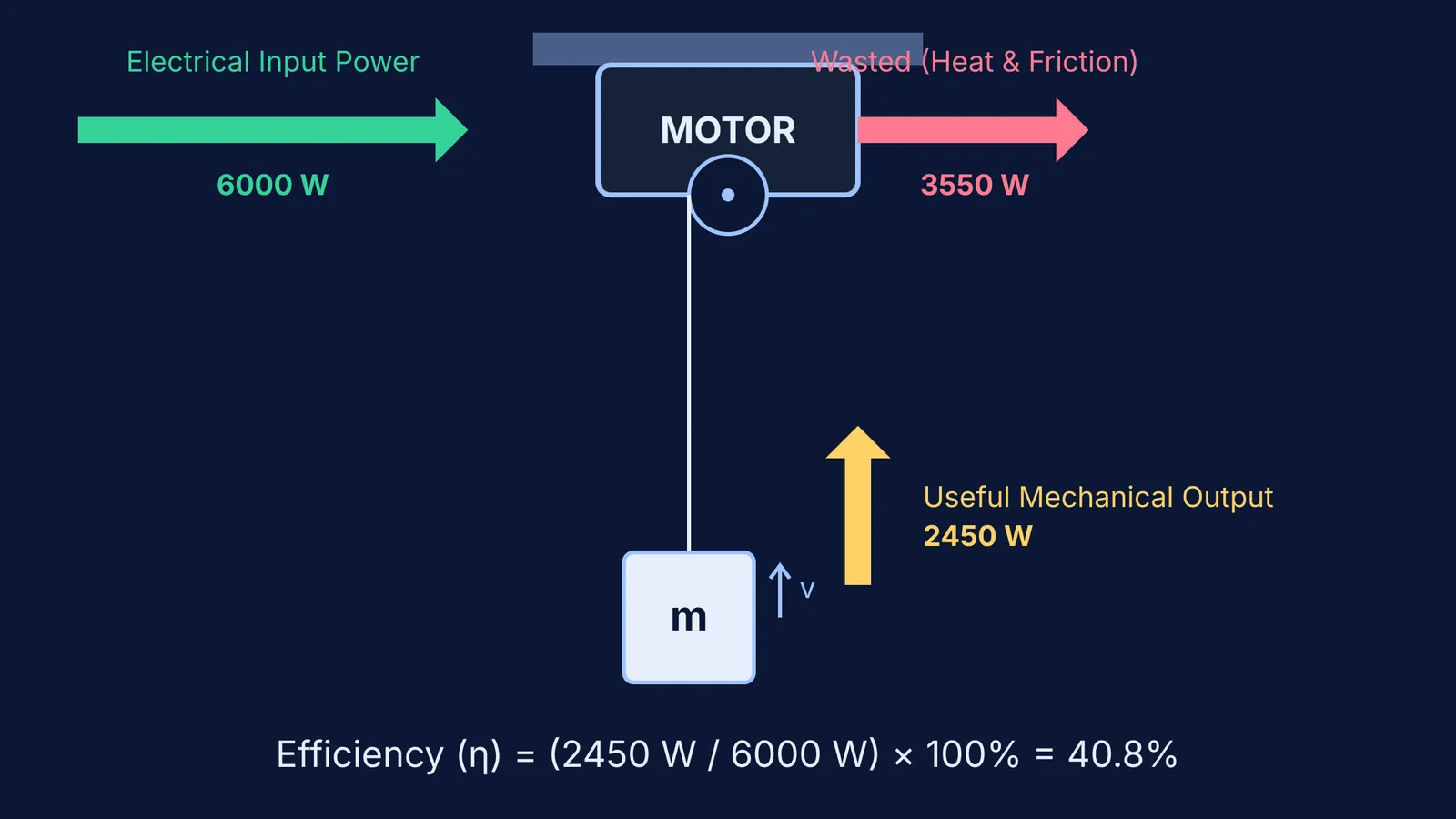
Let's put numbers to the formula. Suppose an electric crane lifts a steel beam of mass 500 kg to a height of 20 m in 40 seconds. The motor runs on a 400 V supply and draws a steady current of 15 A. We will use g = 9.8 m/s².
Step 1: Calculate the useful output power.
The work done in lifting the beam is the change in its potential energy:
W = mgh = 500 × 9.8 × 20 = 98,000 J
The output power is this work divided by the lifting time:
P_out = 98,000 / 40 = 2,450 W
Step 2: Calculate the electrical input power.
The power drawn from the electrical supply depends on voltage and current:
P_in = V × I = 400 × 15 = 6,000 W
Step 3: Find the efficiency.
To find the efficiency, divide the useful output by the total input and multiply by 100:
η = (2,450 / 6,000) × 100% = 40.8%
The crane's lifting system has an overall efficiency of 40.8%. This means nearly 60% of the electrical energy is wasted. Most of this waste occurs as heat in the motor coils and friction in the lifting cables and gearbox.
Where does the lost energy go?
In textbook problems, we sometimes assume ideal conditions where efficiency is 100%. In reality, large electric motors on their own are highly efficient, converting between 70% and 99.99% of electrical energy into kinetic energy according to Wikipedia's energy conversion tables. However, when you add the lifting mechanism—the gears, pulleys, and thick steel cables—the overall system efficiency drops significantly. For comparison, large-scale pumped-storage hydroelectricity, which stores energy by lifting water to a higher elevation reservoir, typically operates at an overall round-trip efficiency of 70% to 85%.
If you find yourself guessing which formula to use for power and energy in exam situations, you might have gaps in how these concepts link together. You can review the fundamentals in the Fermi Concept Library, which covers every concept in physics, chemistry, biology, mathematics and computing, each with its own lesson and its place in the map.
When practising these calculations for JEE or NEET, start by listing your knowns (m, h, t, V, I) and calculating the input and output separately before dividing them. This prevents simple arithmetic errors, makes it easier to track where the energy is going, and helps you pick up partial marks if your final answer goes wrong.
Common variations in exam problems
Examiners often tweak this standard problem to test your understanding. Instead of asking for the final efficiency, they might give you the efficiency and ask you to find the missing current or time.
For example, a question might state that a motor is 60% efficient and ask how long it takes to lift a 200 kg load by 10 m on a 230 V, 10 A supply. In this case, you multiply the input power (VI = 2300 W) by the efficiency (0.60) to find the useful output power (1380 W). You then set this equal to mgh / t to solve for t.
By mastering the core relationship—output is always a fraction of the input—you can rearrange the equation to solve for any missing variable.


