

On this page
Most of us learn early that things get hotter when you heat them. That is only half the story. A gas or a block of metal can get hotter with no heat flowing in, as long as something does work on it. This idea shows up in JEE questions dressed as "insulated cylinder" or "sudden compression".
Can temperature change without heat transfer?
Yes. Energy can cross into a system in two ways: as heat, which flows because of a temperature difference, and as work, such as a piston pushing on a gas or cloth rubbing a surface. The first law of thermodynamics, as written in OpenStax University Physics Volume 2, is ΔE_int = Q − W, where Q is heat added to the system and W is work done by the system.
Now set Q = 0. The law still leaves room for change: ΔE_int = −W. When you push a piston into a gas, the gas does negative work, so −W is positive and internal energy goes up. For an ideal gas, internal energy depends only on temperature, so the temperature goes up too. If that last step feels shaky, our explainer on why ΔU = nCvΔT holds for every ideal gas process walks through it.
An adiabatic process is one with no heat exchange (Q = 0), and OpenStax states that when an ideal gas is compressed adiabatically, work is done on it and its temperature increases, while in an adiabatic expansion the gas does work and its temperature drops.
If the two still blur together, read why heat and temperature are not the same thing.
Why doesn't the gas just lose the extra energy as heat?
It would, given time. If the walls are insulated, or the squeeze is fast, the energy has no chance to leak out. OpenStax explains that in a car engine the compressions "take place so quickly that there is no time for the mixture to exchange heat with its environment".
The molecular picture helps. A molecule that bounces off a piston moving towards it comes back faster, the way a cricket ball comes off an advancing bat faster than off a still one. Faster molecules on average means a higher temperature. Pull the piston back and the molecules return slower, so the gas cools.
It is not only gases. In a worked example in OpenStax, a machinist polishes a 0.50 kg copper fitting with emery cloth for 2.0 minutes. The machinist does 2.4 × 10³ J of work on the fitting, the problem assumes no heat is exchanged with the surroundings, and the copper's temperature rises by about 12°C.
Worked example: how hot does an engine cylinder get?
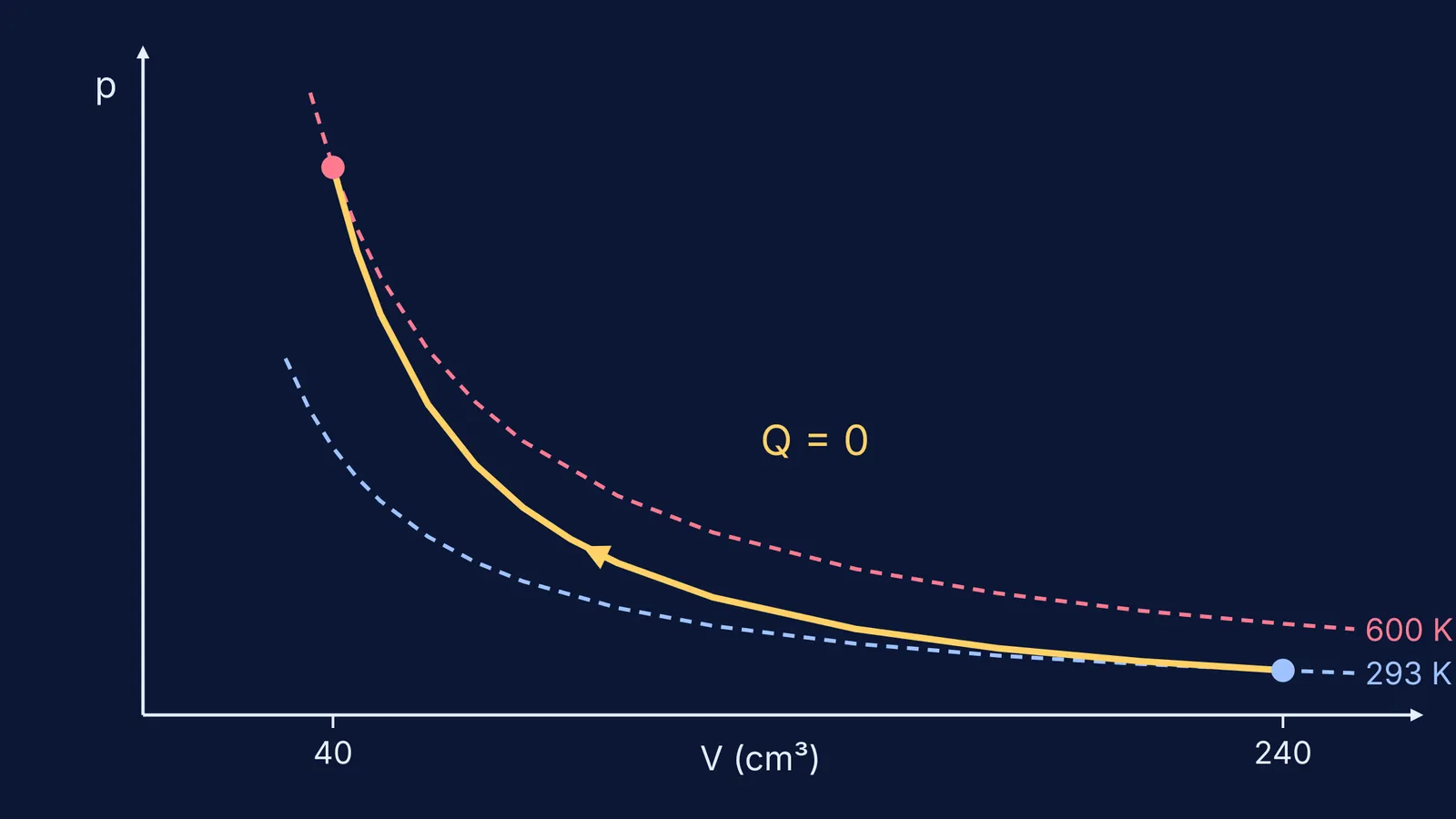
These numbers come from the engine example in OpenStax University Physics, section 3.6, which treats the fuel-air mixture as an ideal diatomic gas with γ = 7/5 = 1.4.
Write down what you know: T₁ = 293 K (20°C), V₁ = 240 cm³, p₁ = 1.00 × 10⁵ N/m², and the gas is compressed adiabatically to V₂ = 40 cm³.
Pick the right relation. For a reversible adiabatic process on an ideal gas, TV^(γ−1) stays constant.
Solve for T₂: T₂ = T₁ × (V₁/V₂)^(γ−1) = 293 × 6^0.4.
Work it out: 6^0.4 is about 2.05, so T₂ ≈ 600 K, which OpenStax gives as 328°C.
Check with energy: Q = 0, and OpenStax finds the work done by the gas is −63 J. So ΔE_int = 0 − (−63 J) = +63 J. All of the temperature rise came from work.
For more practice with this formula, see finding temperature after adiabatic compression using TV^(γ−1).
If you get stuck on a variant of this problem, the Fermi Problem Library has worked problems with a step-by-step solver that explains the reasoning rather than printing an answer.
How do you tell heat from work in an exam question?
Run this checklist before you touch any numbers:
Is energy crossing because of a temperature difference? That is heat.
Is a boundary moving against a force (a piston, a paddle, rubbing cloth)? That is work.
Do you see "insulated", "thermally isolated", "sudden" or "rapid"? Set Q = 0 and expect temperature to change if work is done. The exception is a free expansion into a vacuum: W = 0 as well, so an ideal gas keeps its temperature.
Do you see "isothermal" or "in contact with a reservoir"? Temperature is constant, so ΔU = 0 for an ideal gas and Q equals W.
Which sign convention does your book use for W? Physics books usually take W as work done by the gas; some chemistry books take it as work done on the system. Write the first law in your book's form first.
To revise the first law, internal energy and heat capacity as connected ideas, the Fermi Concept Library gives each concept its own lesson and its place in the map.


