

On this page
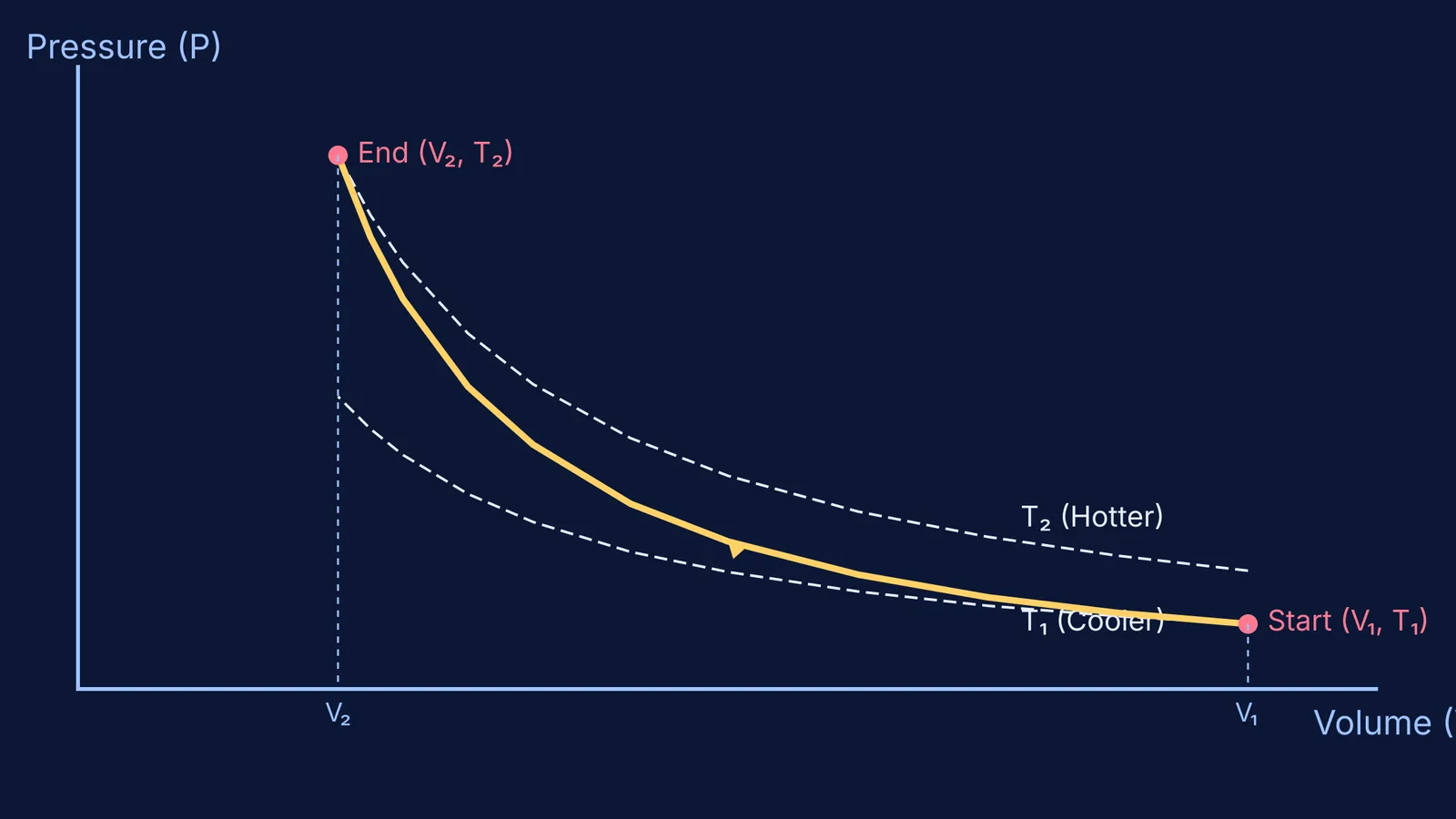
When a gas is compressed so quickly that no heat has time to escape to the surroundings, the process is called adiabatic. Because you are doing work on the gas by crushing it into a smaller volume, and that energy cannot leave as heat, the internal energy of the gas spikes. This means the temperature rises sharply.
This rapid heating is not just a theoretical concept. It is the core mechanism behind how a diesel engine ignites fuel without ever using a spark plug.
What is the formula for temperature after adiabatic compression?
For an ideal gas undergoing a reversible adiabatic process, the temperature T and volume V are linked by a simple equation [1]:
T₁V₁^(γ−1) = T₂V₂^(γ−1)
Here, γ (gamma) is the ratio of specific heats (Cp / Cv). For a diatomic gas like the air we breathe, γ is typically 1.4.
Because γ − 1 is positive (0.4 for air), the V^(γ−1) term shrinks as the volume drops. To keep the product constant, the temperature T must rise.
How hot does a diesel engine get?
In a standard physics example [1], an engine might compress an air-fuel mixture from 240 cm³ down to 40 cm³—a compression ratio of 6:1. If the starting temperature is 20 °C (which is 293 K), you plug the numbers in:
T₂ = 293 × (240 / 40)^(1.4 − 1) T₂ = 293 × 6^0.4 T₂ = 293 × 2.048 ≈ 600 K (or 328 °C)
For a gasoline engine, heating the mixture to 328 °C is already pushing the limits. If the compression ratio is too high, the adiabatic temperature rise will cause the fuel to ignite prematurely before the spark plug fires. This early detonation is what mechanics call "engine knock," which is why gasoline engines require lower compression ratios or higher-octane fuel to prevent it [1].
If we increase the compression ratio to 15:1, as seen in many diesel engines, we can use the same formula:
T₂ = 293 × 15^0.4 T₂ = 293 × 2.954 ≈ 866 K (or 593 °C)
At nearly 600 °C, the air is so fiercely hot that when diesel fuel is injected into the cylinder, it detonates instantly without any spark. This relies entirely on the rapid adiabatic temperature spike to function.
Why does temperature rise during adiabatic compression?
The temperature spike comes directly from the first law of thermodynamics. In any process, the change in internal energy (ΔU) equals the heat added to the system (Q) minus the work done by the system (W).
In an adiabatic compression, Q = 0 because the system is insulated (or the compression is too fast for heat to flow). The gas is being compressed, meaning the system is doing negative work (or work is being done on it).
This makes ΔU positive. For an ideal gas, internal energy is strictly tied to temperature, so a positive ΔU means a guaranteed rise in temperature. This is the exact opposite of the free expansion of an ideal gas: why work and ΔU are both zero, where the temperature stays constant.
If you struggle to recall how internal energy, work, and heat connect across different processes, you can look them up in the Fermi Concept Library. Fermi's AI tutor works through thermodynamics step by step, letting you see exactly how the ideal gas law builds these relations rather than just giving you a formula to memorise.
How do you use P^(1−γ)T^γ = constant?
Sometimes a problem gives you the starting and ending pressures rather than the volumes. You could use the ideal gas law (PV = nRT) to find the volumes first, but there is a faster shortcut.
By substituting V = nRT / P into the primary PV^γ = constant rule, the equation becomes:
P(nRT / P)^γ = constant P × T^γ / P^γ = constant P^(1−γ) T^γ = constant
This gives you a direct relation between pressure and temperature [1]:
P₁^(1−γ) T₁^γ = P₂^(1−γ) T₂^γ
This alternate form is especially useful when reading a cycle on an indicator diagram (like finding the net work in a cycle: reading the loop on an indicator diagram). If a gas is compressed to double its original pressure, so P₂ = 2P₁, you can solve for T₂ without ever needing to know the actual volume of the container or the number of moles of gas.
For example, if you quickly compress air to double its original pressure starting from 300 K, you can find the new temperature using this rule. For air with γ = 1.4, the exponent on pressure is 1 − 1.4 = −0.4.
(P₁)^(−0.4) × (300)^1.4 = (2P₁)^(−0.4) × (T₂)^1.4
T₂^1.4 = 300^1.4 × (1/2)^(−0.4) T₂ = 300 × (0.5)^(−0.4 / 1.4) T₂ = 300 × (0.5)^(−0.286) T₂ = 300 × 1.219 ≈ 366 K
This shows that doubling the pressure adiabatically raises the temperature by about 66 degrees, completely bypassing the need to track volume changes.


