On this page
NCERT's Class 11 Equilibrium chapter has a short table of Kp values at different temperatures. For N₂O₄(g) ⇌ 2NO₂(g) it lists 0.98 at 298 K, 47.9 at 400 K and 1700 at 500 K. The last two agree well with standard thermodynamic data. The 298 K value does not: data tables put it near 0.15, and the table's own 400 K and 500 K entries point to about 0.11. This post shows two checks you can run on any printed equilibrium constant, using N₂O₄ as the example.
What does NCERT Table 6.5 list for N₂O₄ ⇌ 2NO₂?
Table 6.5, "Equilibrium Constants, Kp for a Few Selected Reactions", is on page 178 of the Reprint 2026-27 of NCERT's Equilibrium chapter. For N₂O₄(g) ⇌ 2NO₂(g) it gives:
298 K: Kp = 0.98
400 K: Kp = 47.9
500 K: Kp = 1700
The same page says Kp must be calculated with pressures in bar, because the standard state is 1 bar. So these are dimensionless constants with p° = 1 bar, and that is how we treat them below.
How do you get Kp from ΔG° data?
The first check is independent of the table. Look up the standard Gibbs energies of formation and use ΔG° = −RT ln K. If that formula is new, our guide to finding K from ΔG° walks through it.
The NIST-JANAF thermochemical tables give, at 298.15 K, ΔfG° = 51.258 kJ/mol for NO₂ and 97.787 kJ/mol for N₂O₄. The same tables give ΔfH° = 33.095 and 9.079 kJ/mol, so ΔrH° = 2(33.095) − 9.079 = +57.11 kJ/mol. Other data sets differ by a few tenths of a kJ, which moves K only slightly.
Worked example: auditing the 298 K value
Check 1: K from ΔG°.
ΔrG° = 2 × ΔfG°(NO₂) − ΔfG°(N₂O₄) = 2(51.258) − 97.787 = +4.729 kJ/mol.
RT = 8.314 × 298.15 = 2478.8 J/mol.
ln Kp = −4729 ÷ 2478.8 = −1.908.
Kp = e^(−1.908) = 0.148.
For Kp to be 0.98, ΔrG° would have to be −RT ln 0.98 = +0.05 kJ/mol, almost zero. The data say +4.73 kJ/mol. That is a big difference, not a rounding issue.
Check 2: does the table agree with itself? This one needs no outside data at all. The integrated van 't Hoff equation, covered in our post on how K changes with temperature, is ln(K₂/K₁) = (ΔH°/R)(1/T₁ − 1/T₂).
Take NCERT's 400 K and 500 K values: ln(1700 ÷ 47.9) = ln 35.49 = 3.569.
1/400 − 1/500 = 5.000 × 10⁻⁴ K⁻¹.
ΔH° = 8.314 × 3.569 ÷ (5.000 × 10⁻⁴) = 59 350 J/mol, about +59.3 kJ/mol. That is close to the +57.1 kJ/mol from JANAF, so these two entries are consistent with real data.
Now extrapolate back to 298 K with this ΔH°: 1/298 − 1/400 = 8.557 × 10⁻⁴ K⁻¹.
ln K(298) = ln 47.9 − (59 350 ÷ 8.314) × 8.557 × 10⁻⁴ = 3.869 − 6.108 = −2.239.
K(298) = e^(−2.239) ≈ 0.11.
Run it the other way and the problem is plain. NCERT's 298 K and 400 K values give K(400)/K(298) = 47.9 ÷ 0.98 = 49, which would need ΔH° of only about +38 kJ/mol. The JANAF values give 51.1 ÷ 0.148, a ratio of about 345, as a reaction with ΔH° ≈ +57 kJ/mol should.
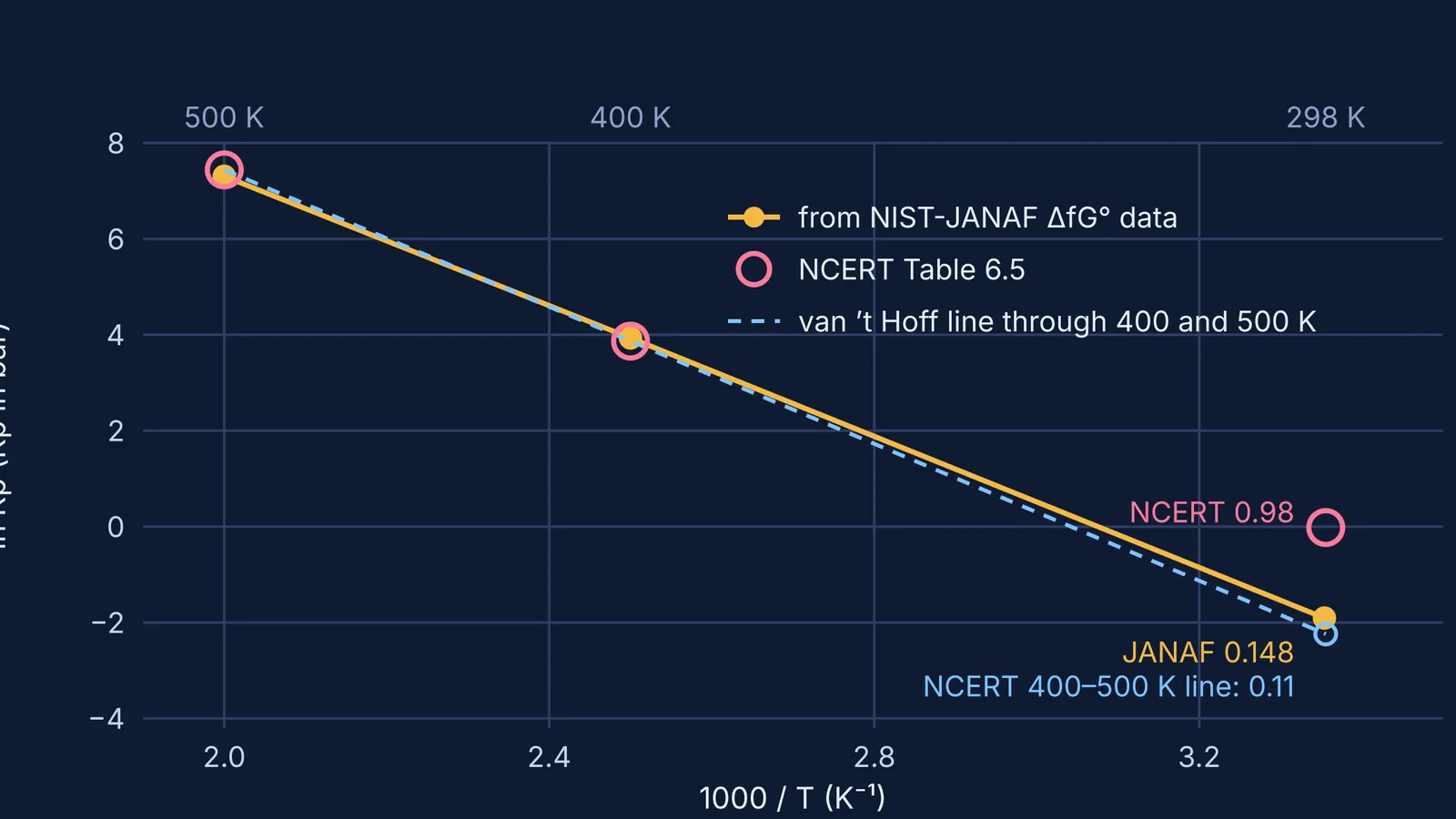
On a plot of ln K against 1/T, which is what the chart at the top shows, a reaction with a roughly constant ΔH° gives a nearly straight line. NCERT's 400 K and 500 K points sit on the JANAF line. The 298 K point sits about 1.9 units of ln K above it. Two independent checks, one from outside data and one from the table itself, both say the 298 K entry is the odd one out.
Could bar versus atm explain the gap?
No. For this reaction Δn = +1, so switching pressure units from bar to atm changes Kp by a factor of 1.01325, about 1%. In atm, 0.148 becomes 0.146. Other conversions move it further from 0.98, not closer: Kc = Kp/RT = 0.148 ÷ (0.08314 × 298.15) = 6.0 × 10⁻³ mol/L, and with pressures in kPa the number would be 14.8. We could not find a unit choice that turns 0.148 into 0.98, and we do not know how the printed value arose.
Why does the difference matter in a problem?
The classic question asks how much N₂O₄ dissociates at 1 bar and 298 K. With α as the fraction dissociated, Kp = 4α²/(1 − α²), so α = √(Kp/(4 + Kp)).
With Kp = 0.148: α = 0.19, about 19% dissociated.
With Kp = 0.98: α = 0.44, about 44% dissociated.
That is more than double. Our post on the Gibbs energy minimum at equilibrium sets up this same calculation from ΔG° and shows why a positive ΔG° still gives a fair amount of NO₂.
Are the other rows of Table 6.5 exact?
Not quite, but the gaps are smaller. Computing K from JANAF ΔfG° values for NH₃, SO₂ and SO₃:
N₂ + 3H₂ ⇌ 2NH₃: 5.4 × 10⁵ at 298 K and 36 at 400 K, close to NCERT's 6.8 × 10⁵ and 41. At 500 K, JANAF gives 0.099 against the printed 3.6 × 10⁻², a factor of about 2.8.
2SO₂ + O₂ ⇌ 2SO₃: JANAF values are 1.7 to 2.7 times the printed ones at 298, 500 and 700 K.
These rows may come from older data, and we have not traced their source, so treat them as approximate rather than wrong. The N₂O₄ entry at 298 K is different in kind: it fails the table's own internal check.
How can you check any equilibrium constant you are given?
Estimate it from ΔfG° data with ΔG° = −RT ln K, and compare.
If the table gives K at three or more temperatures, compute ΔH° from each pair. The answers should roughly agree.
Plot ln K against 1/T. A point well off the line deserves a second look.
Check the sign: for an endothermic reaction, K must rise with temperature, and the size of the rise must fit ΔH°.
For more K, ΔG° and van 't Hoff problems, the Fermi Problem Library has a step-by-step solver that explains the reasoning. If you are preparing for JEE, Fermi Test Prep is JEE Main and Advanced preparation with an AI tutor.
Quick checklist
NCERT Table 6.5 lists Kp(298 K) = 0.98 for N₂O₄ ⇌ 2NO₂.
JANAF data give ΔrG° = +4.73 kJ/mol and Kp ≈ 0.148 bar.
NCERT's own 400 K and 500 K values give ΔH° ≈ +59 kJ/mol and extrapolate to Kp(298) ≈ 0.11.
Bar versus atm changes Kp by about 1%; units do not explain the gap.
At 1 bar and 298 K, about 19% of N₂O₄ dissociates.
In an exam, use the value the question gives.