

On this page
Heat a sealed tube of brown nitrogen dioxide and the colour deepens; cool it in ice and the colour fades. The equilibrium has not just shifted. The equilibrium constant itself has changed, and the van't Hoff equation tells you by how much.
How does the equilibrium constant change with temperature?
Changes in concentration, pressure or volume only push the reaction quotient Q away from K; a change in temperature alters the value of K itself, according to section 6.8.4 of the NCERT Class 11 Chemistry chapter on equilibrium. The same section gives the rule in two lines:
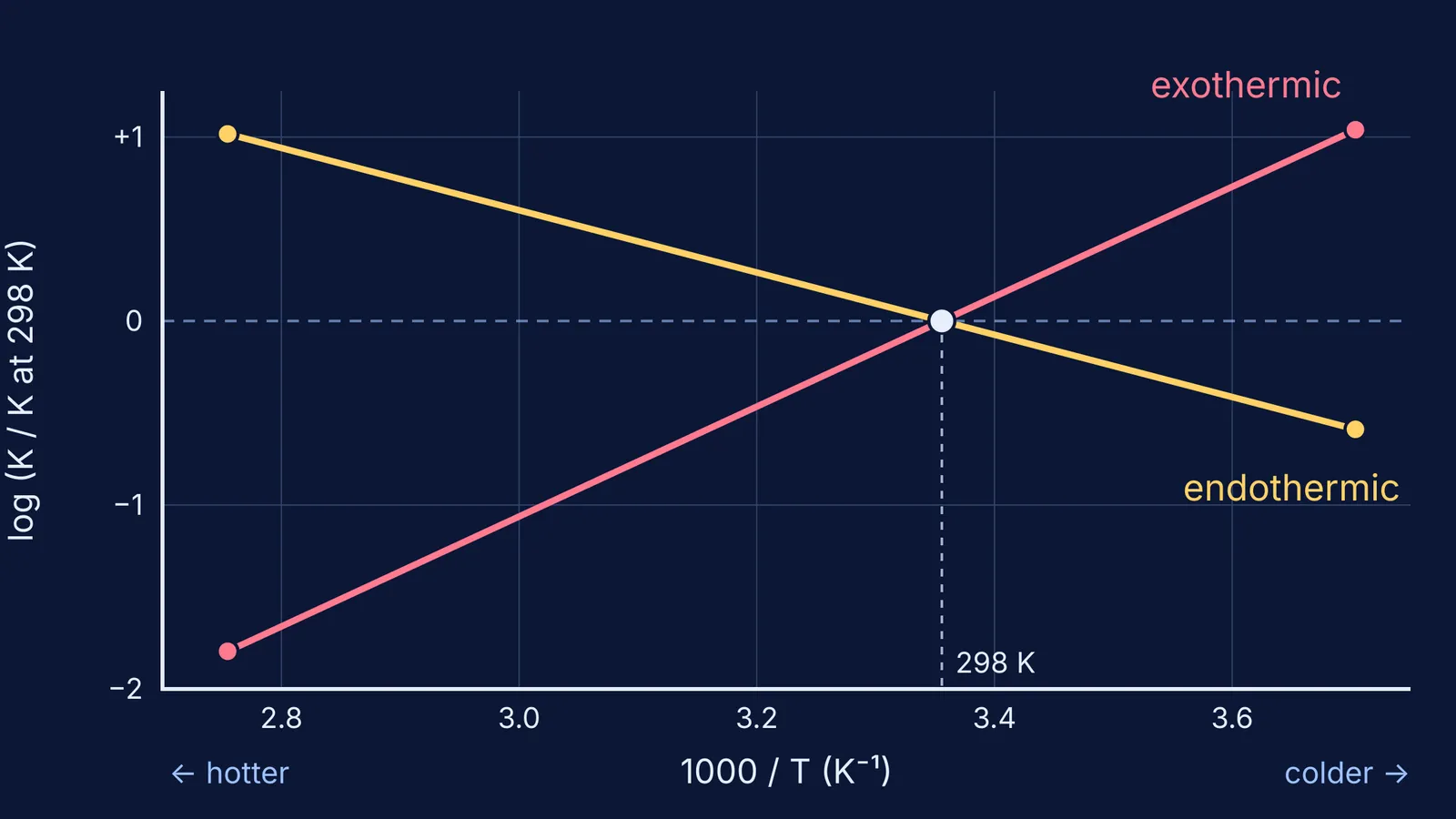
For an exothermic reaction (negative ΔH), K decreases as temperature increases.
For an endothermic reaction (positive ΔH), K increases as temperature increases.
That rule tells you the direction. The van't Hoff equation tells you the size.
What is the van't Hoff equation formula?
In natural logs, the integrated van't Hoff equation is ln(K₂/K₁) = −(ΔH°/R)(1/T₂ − 1/T₁), as written on this LibreTexts page on the temperature dependence of equilibrium constants/21%3A_Extension_14_-_Temperature_Dependence_of_Equilibrium/21.01%3A_Temperature_Dependence_of_Equilibrium_Constants_-_the_vant_Hoff_Equation). Absorb the minus sign by flipping the bracket, divide by 2.303 to switch to base-10 logs, and you get the form most numericals use:
log(K₂/K₁) = ΔH°/(2.303R) × (1/T₁ − 1/T₂)
The 2.303 is just ln 10; our explainer on why 2.303 appears in chemistry formulas walks through the conversion. Three things to hold onto:
T is in kelvin, always.
R is 8.314 J mol⁻¹ K⁻¹ here, so ΔH° comes out in J mol⁻¹. If you are unsure which R to pick, see which value of the gas constant R to use.
The equation assumes ΔH° stays constant over the temperature range, the key assumption the LibreTexts derivation states.
Plot log K against 1/T and you get a straight line with slope −ΔH°/2.303R. If that looks familiar, it is the same idea as finding activation energy from an Arrhenius plot, with ΔH° in place of Ea.
How do you find ΔH° from two K values?
Take the numbers from the worked example on the LibreTexts van't Hoff page/21%3A_Extension_14_-_Temperature_Dependence_of_Equilibrium/21.01%3A_Temperature_Dependence_of_Equilibrium_Constants_-_the_vant_Hoff_Equation) and run it backwards: K₁ = 0.0260 at 298 K and K₂ = 0.0431 at 310 K. Find ΔH°.
Ratio: K₂/K₁ = 0.0431 ÷ 0.0260 = 1.658, so log(K₂/K₁) = 0.2195.
Temperature bracket: 1/T₁ − 1/T₂ = 1/298 − 1/310 = 0.0033557 − 0.0032258 = 1.299 × 10⁻⁴ K⁻¹.
Constant: 2.303R = 2.303 × 8.314 = 19.15 J mol⁻¹ K⁻¹.
Rearrange: ΔH° = 2.303R × log(K₂/K₁) ÷ (1/T₁ − 1/T₂) = 19.15 × 0.2195 ÷ (1.299 × 10⁻⁴).
Answer: ΔH° ≈ 32,400 J mol⁻¹, or +32.4 kJ mol⁻¹, the value LibreTexts started from.
The sign is positive and K went up on heating: an endothermic reaction, exactly as the NCERT rule predicts.
Why does the sign of ΔH decide which way K moves?
Read the equation as a sign machine. 2.303R is always positive. When you heat (T₂ greater than T₁), 1/T₂ is smaller than 1/T₁, so the bracket is positive. That leaves ΔH° alone to decide whether log(K₂/K₁) is positive (K rises) or negative (K falls).
Now try it on NCERT's own demonstration. The NCERT equilibrium chapter uses 2NO₂(g) ⇌ N₂O₄(g) with ΔH = −57.2 kJ mol⁻¹, and places sealed tubes in a freezing mixture at 270 K, water at 298 K and hot water at 363 K. Treating ΔH as constant over that range:
Heating from 298 K to 363 K: log(K₂/K₁) = (−57,200 ÷ 19.15) × (1/298 − 1/363) = −1.80, so K drops to about 1/62 of its room-temperature value. Less colourless N₂O₄, more brown NO₂.
Cooling from 298 K to 270 K: log(K₂/K₁) = +1.04, so K rises about 11 times. More N₂O₄, a paler tube.
That is Le Chatelier's principle with numbers attached: heating favours the endothermic direction, which here is N₂O₄ breaking back into NO₂.
Which mistakes cost marks in van't Hoff numericals?
Using degrees Celsius instead of kelvin.
Putting ΔH in kJ while R is in J. Convert one of them.
Swapping T₁ and T₂ in the bracket but not K₁ and K₂, which flips the sign of ΔH.
Mixing forms: ln with 2.303, or log without it. Pick one form and stay with it.
Skipping the sign check at the end.
If your answer keeps coming out with the wrong sign, the Fermi Problem Library has worked problems with a step-by-step solver that explains the reasoning rather than printing an answer, so you can see which step flipped. For the ideas underneath, such as Gibbs energy and Le Chatelier's principle, the Fermi Concept Library gives each concept its own lesson.
Next time a question hands you K at two temperatures, do the sign check first and the arithmetic second.


