

On this page
You work out ΔrG° for N₂O₄ ⇌ 2NO₂ at 298 K and get +4.7 kJ/mol. A positive ΔG° seems to say "no reaction". Yet a sealed flask of N₂O₄ at room temperature soon holds a brown mixture with plenty of NO₂ in it. The opposite puzzle is just as common: reactions with a negative ΔG° never quite reach 100% products. Both puzzles go away once you draw one graph: the Gibbs energy of the whole reaction mixture plotted against how far the reaction has gone.
What is the extent of reaction, ξ?
The extent of reaction ξ (xi) measures how far a reaction has run, in moles. Start with 1 mol of N₂O₄ and no NO₂. When the reaction has advanced by ξ:
n(N₂O₄) = 1 − ξ
n(NO₂) = 2ξ
total moles = 1 + ξ
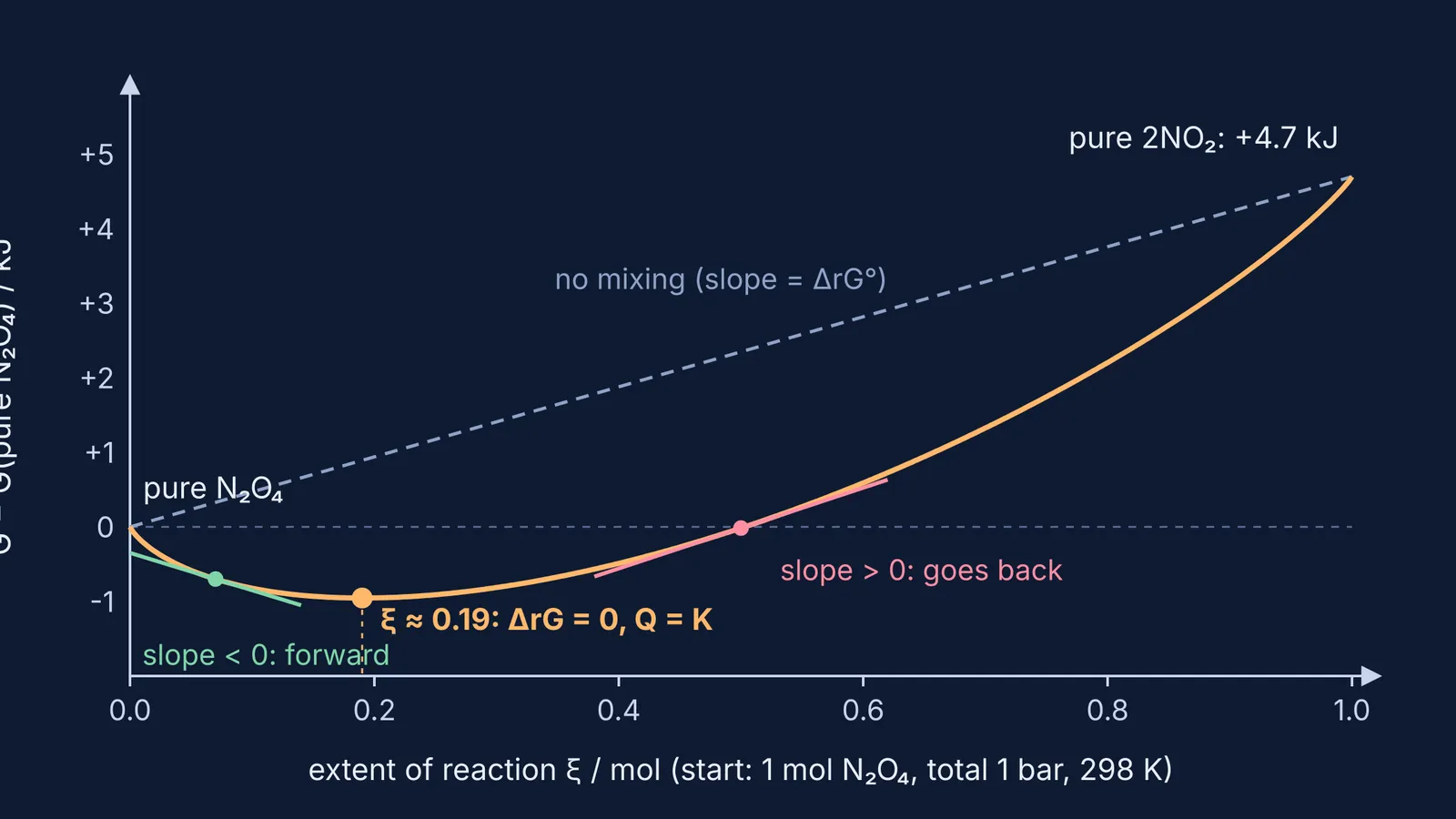
So ξ = 0 is pure N₂O₄ and ξ = 1 is pure NO₂ (2 mol). Every point in between is a mixture. The total Gibbs energy of that mixture is G = Σ nᵢμᵢ, where each chemical potential is μᵢ = μᵢ° + RT ln(pᵢ/p°), with p° = 1 bar. Hold the temperature and the total pressure fixed and G becomes a function of ξ alone. That function is the curve in the diagram above.
Why is ΔrG the slope of the G curve?
Differentiate G with respect to ξ at constant T and p. Each extra bit of reaction removes μ(N₂O₄) and adds 2μ(NO₂), so
dG/dξ = 2μ(NO₂) − μ(N₂O₄) = ΔrG = ΔrG° + RT ln Q
This is the key idea. ΔrG is the slope of the curve at the current composition. It is not the drop from the start of the curve to its end. The slope tells you which way G goes down from where the mixture is now:
Slope negative (Q < K): moving right lowers G, so the reaction goes forward.
Slope positive (Q > K): moving left lowers G, so the reaction goes back.
Slope zero (Q = K): G is at its minimum. This is equilibrium.
ΔrG° is a different number. It is the slope of the straight line joining the two pure ends, each at 1 bar. That is why one ΔrG° belongs to a reaction, but its ΔrG changes all the way along the curve. The difference between the two is covered in the difference between ΔG and ΔG°. The direction rule on its own is in predicting which way a reaction moves from Q and K.
Why does the curve have a minimum even when ΔG° is positive?
Split G into two parts.
A straight line. Σ nᵢμᵢ° is linear in ξ. It runs from the G of pure N₂O₄ to the G of pure NO₂, with slope ΔrG°. On its own it would say "stay at whichever end is lower".
A mixing term. At a total pressure of 1 bar, pᵢ equals the mole fraction xᵢ, so this part is RT Σ nᵢ ln xᵢ. Every xᵢ is below 1, so every log is negative. The term is zero at both pure ends and negative everywhere in between. It pulls the middle of the line down into a sag.
Near ξ = 0 there is almost no NO₂, so Q is close to zero and ln Q heads towards minus infinity. The slope there is steeply negative however positive ΔrG° is. Making the first trace of product always lowers G. The same thing happens in reverse near ξ = 1, where ln Q heads to plus infinity. So the curve must turn round somewhere in between, and that turning point is equilibrium.
That is the honest answer to "why do reactions stop short?" The minimum comes from the mixing term in G, not from the reaction's ΔrS°. ΔrH° and ΔrS° only decide ΔrG°, which tilts the straight line and so slides the minimum left or right.
Worked example: how far does N₂O₄ dissociate at 298 K?
Data used: ΔfG°(N₂O₄, g) = 97.9 kJ/mol and ΔfG°(NO₂, g) = 51.3 kJ/mol at 298 K. Tables differ by a few tenths of a kJ, so your answer may move slightly in the second figure.
ΔrG°. ΔrG° = 2(51.3) − 97.9 = +4.7 kJ/mol.
Kp. ln Kp = −ΔrG°/RT = −4700/(8.314 × 298) = −1.897, so Kp ≈ 0.150. Pressures are in bar, with p° = 1 bar.
Set up the equilibrium. Start with 1 mol N₂O₄ and let a fraction α dissociate. Moles: N₂O₄ 1 − α, NO₂ 2α, total 1 + α. At a total pressure of 1 bar, p(NO₂) = 2α/(1 + α) and p(N₂O₄) = (1 − α)/(1 + α).
Write Kp. Kp = p(NO₂)²/p(N₂O₄) = 4α²/(1 − α²).
Solve. α² = Kp/(4 + Kp) = 0.150/4.150 = 0.0361, so α ≈ 0.19. About 19% of the N₂O₄ dissociates, even though ΔrG° is positive.
Check with slopes. RT = 2.48 kJ/mol. At ξ = 0.10, Q = 0.040 and ΔrG = 4.7 + 2.48 ln 0.040 ≈ −3.3 kJ/mol, so the mixture still moves forward. At ξ = 0.30, Q = 0.40 and ΔrG ≈ +2.4 kJ/mol, so it moves back. The zero lies between them, at 0.19.
How deep is the dip? Adding up G = Σ nᵢμᵢ at ξ = 0.19 gives a value about 0.95 kJ below pure N₂O₄. Pure NO₂ sits 4.7 kJ above it. The minimum is shallow, but it is a real minimum.
The Concept Library covers Gibbs energy, chemical potential and equilibrium constants as separate concepts if any step here felt like a jump.
Notice three different numbers here. ΔrG° (+4.7 kJ/mol) compares the two pure ends at 1 bar. ΔrG is the slope at the current mixture and changes as you move. The Gibbs energy actually given up on the way to equilibrium is the depth of the dip, about 0.95 kJ. Mixing them up is the commonest error on this topic.
What does a large ΔG° do to the minimum?
A larger |ΔrG°| tilts the straight line more steeply, and the minimum slides towards the lower end. The mixing term never vanishes, so the minimum never reaches an end exactly. It just gets very close. For a reaction with K = exp(−ΔrG°/RT) at 298 K:
ΔrG° = +20 kJ/mol gives K ≈ 3 × 10⁻⁴. Very little product forms.
ΔrG° = −10 kJ/mol gives K ≈ 57. Mostly products, with reactants still easy to detect.
ΔrG° = −50 kJ/mol gives K ≈ 6 × 10⁸. In practice this is complete.
So "ΔG° negative means it goes, positive means it does not" is a rough rule for large values only. Near zero, both sides are present in amounts you can measure. Converting ΔG° to K in more examples is covered in how to calculate K from ΔG°.
Quick checklist
ξ measures how far the reaction has gone; plot G of the mixture against it.
ΔrG = ΔrG° + RT ln Q is the slope of that curve, not the end-to-end drop.
The minimum, where the slope is zero, is equilibrium: Q = K.
The mixing term makes the slope steeply negative near pure reactants, so every reaction makes some product.
N₂O₄ ⇌ 2NO₂ at 298 K: ΔrG° = +4.7 kJ/mol, Kp ≈ 0.15, α ≈ 0.19 at 1 bar.
Large |ΔG°| only pushes the minimum very close to one end.


