

On this page
Data tables give reaction enthalpies at 298 K, but exam questions often want them somewhere else. Kirchhoff's equation is the bridge: one extra number, ΔCp, and one line of algebra. Here is the idea, a worked conversion from 298 K to 373 K, and the mistakes that cost marks.
What does Kirchhoff's equation say?
At constant pressure, the rate at which a reaction enthalpy changes with temperature equals ΔCp, the heat capacity of the products minus the heat capacity of the reactants (LibreTexts, The Temperature Dependence of H). In symbols, d(ΔH)/dT = ΔCp, and integrating gives ΔH(T2) = ΔH(T1) + ∫ΔCp dT from T1 to T2.
If ΔCp stays roughly constant over the range, the integral collapses to ΔH(T2) = ΔH(T1) + ΔCp × (T2 − T1). The LibreTexts module on Kirchhoff's law/Thermodynamics/Energies_and_Potentials/Enthalpy/Kirchhoff_Law) limits this shortcut to small changes, under about 100 K, because heat capacities drift with temperature.
Why it works is a Hess's law argument. Route A: react at 298 K, then heat the products to 373 K. Route B: heat the reactants to 373 K, then react. Both routes start and end in the same states, so they carry the same total enthalpy change (see why different routes give the same enthalpy), and equating them gives the Kirchhoff result. Heat capacity at constant pressure is the right one here because ΔH is the heat at constant pressure, as explained in why ΔH equals heat at constant pressure.
How do you convert ΔH from 298 K to 373 K?
Take the ammonia synthesis, N2(g) + 3H2(g) → 2NH3(g), the same reaction LibreTexts uses for its ΔCp example.
ΔH at 298 K. The NIST Chemistry WebBook entry for ammonia lists ΔfH° of NH3(g) as −45.94 kJ/mol. N2 and H2 are elements in their standard states, so their ΔfH° is zero. ΔH(298) = 2 × (−45.94) = −91.88 kJ.
Heat capacities at 298 K. From the NIST Shomate heat-capacity fits for ammonia, nitrogen and hydrogen, evaluated at 298.15 K: Cp(NH3) = 35.65, Cp(N2) = 29.12 and Cp(H2) = 28.84 J/(mol K).
ΔCp, with coefficients. ΔCp = 2(35.65) − [29.12 + 3(28.84)] = 71.30 − 115.64 = −44.34 J/K.
ΔT. 373.15 K − 298.15 K = 75 K. A difference of 75 °C is the same 75 K, so a question set in Celsius gives the same ΔT.
Convert units, then add. ΔCp × ΔT = −44.34 J/K × 75 K = −3325 J = −3.33 kJ.
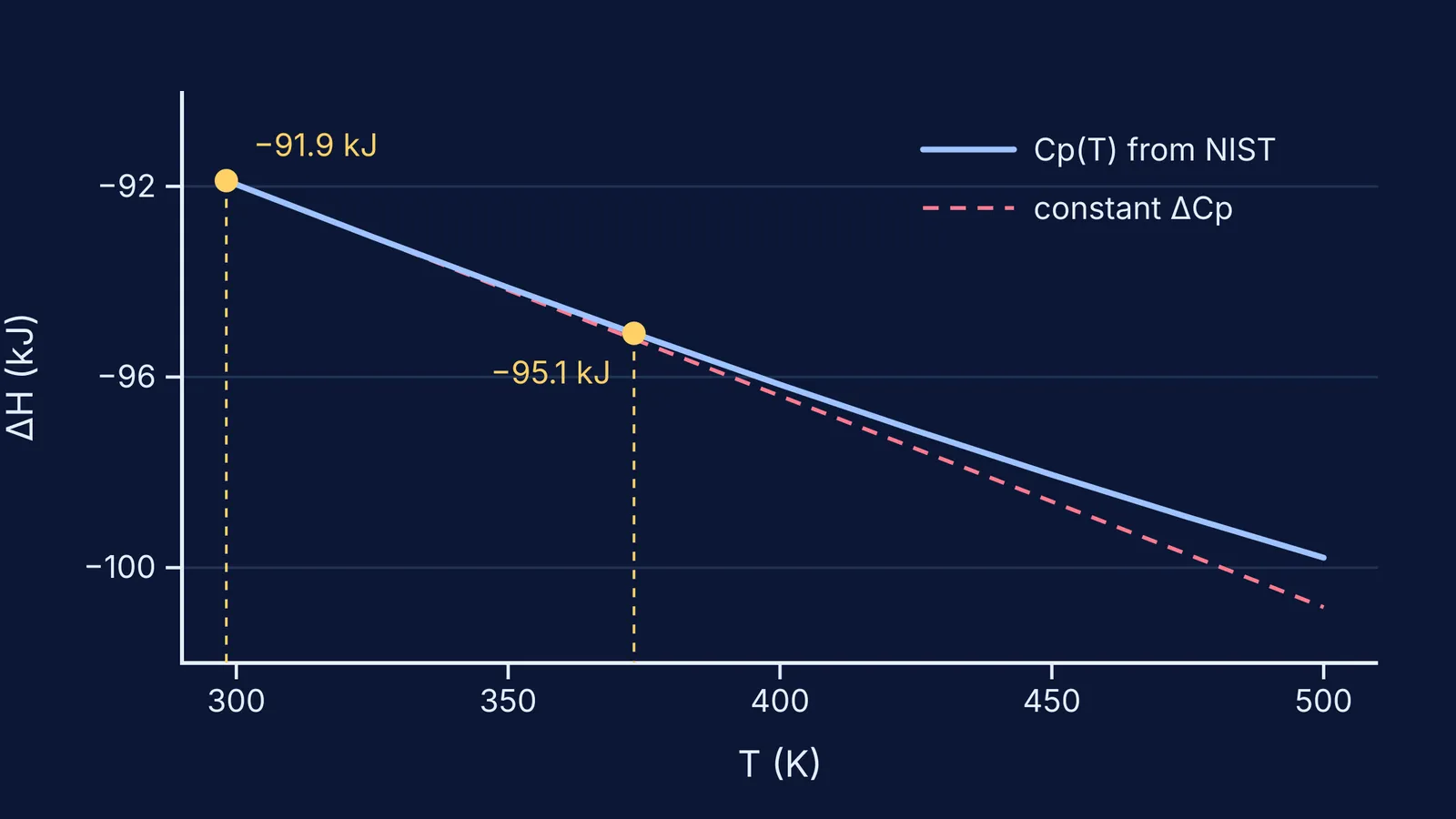
Answer. ΔH(373) = −91.88 kJ − 3.33 kJ = −95.21 kJ.
Sense-check the sign. ΔCp is negative because four moles of gas become two, so the products store less heat per kelvin. A negative ΔCp makes ΔH more negative as temperature rises: the reaction is slightly more exothermic at 373 K. The shift is about 3.6% of the original value.
How accurate is the constant-ΔCp shortcut?
We checked it against the full calculation. Using the same NIST Shomate polynomials, ΔCp itself drifts from −44.3 J/K at 298 K to −40.8 J/K at 373 K. Integrating ΔCp exactly over the range gives ΔH(373) = −95.08 kJ, so the shortcut's −95.21 kJ is off by 0.13 kJ, roughly 0.1%. For a 75 K step, the shortcut is fine; over a few hundred kelvin the gap grows.
A quick decision guide:
Range under about 100 K, no phase change (the LibreTexts limit/Thermodynamics/Energies_and_Potentials/Enthalpy/Kirchhoff_Law)): use ΔCp at 298 K, or the average of the two ends if both are given.
Larger range: write each Cp as a polynomial such as a + bT + c/T² and integrate term by term, as the LibreTexts chapter does.
A phase change inside the range: split the path. Heat to the transition temperature, add the latent heat, then continue with the new phase's Cp.
What mistakes cost marks in Kirchhoff's equation questions?
Leaving out stoichiometric coefficients: ΔCp for this reaction uses 2 × Cp(NH3) and 3 × Cp(H2), not one of each.
Reversing the order. It is always products minus reactants, the same convention as ΔH.
Using Cv instead of Cp. If the two still blur, our post on heat in isobaric and isochoric processes separates them.
Adding joules to kilojoules (see the callout).
Ignoring a boiling or melting point between T1 and T2. Water formed as a liquid at 298 K but taken past 373 K needs its enthalpy of vaporisation added.
For more conversions to practise, the Fermi Problem Library has worked problems with a step-by-step solver that explains the reasoning rather than printing an answer, so you can see exactly where a ΔCp went wrong. If the idea of heat capacity itself still feels shaky, the Fermi Concept Library gives every chemistry concept its own lesson.
Next time a question hands you ΔH at 298 K and asks for another temperature, write ΔCp first, with coefficients, and the rest is one multiplication.


