

On this page
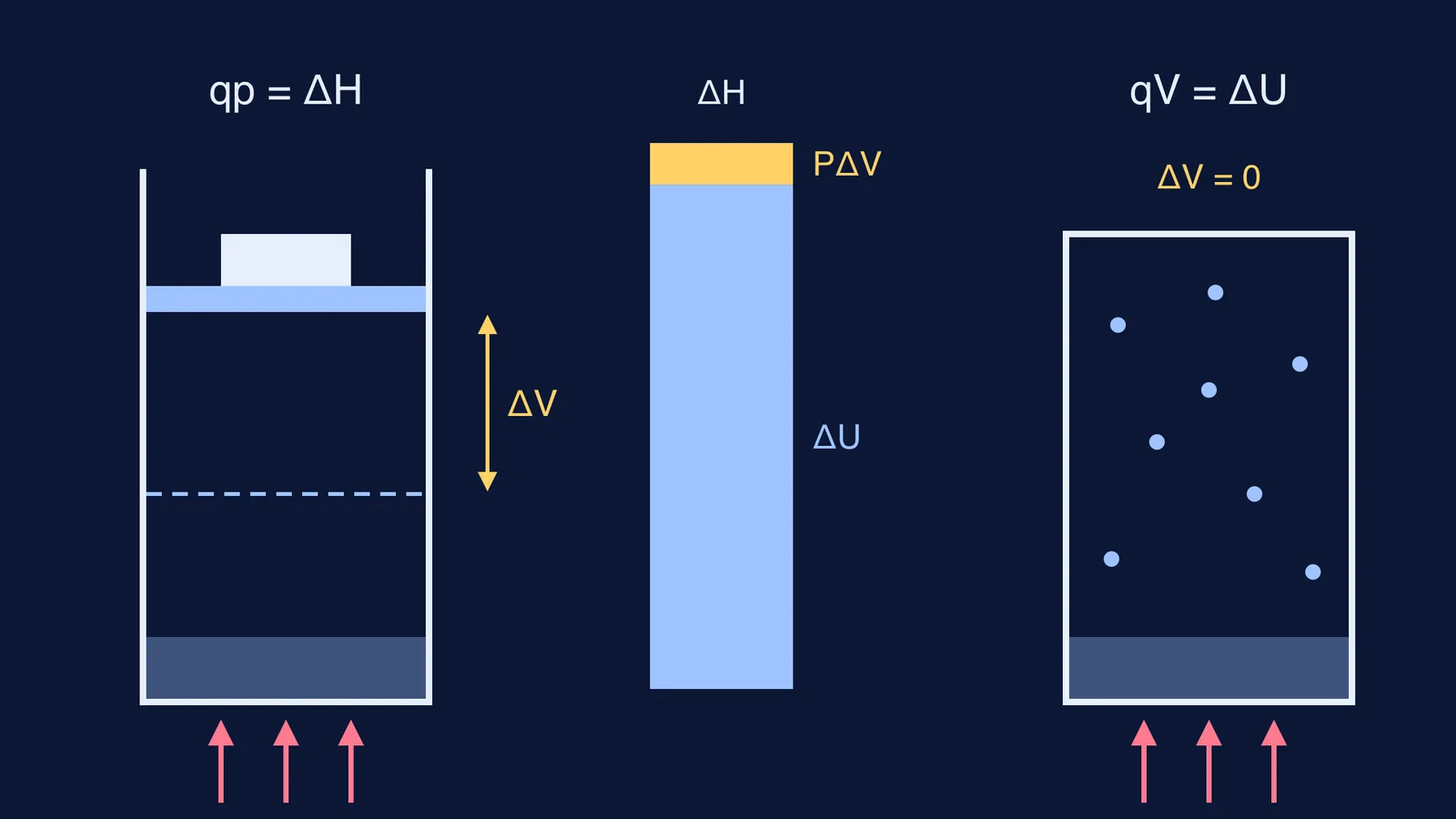
Most chemistry happens in open flasks and beakers, where the air above pushes down at a steady pressure. Enthalpy is the quantity whose change equals the heat you measure under those conditions. Here is that result built from two equations you already know, and why a sealed steel vessel gives you ΔU instead.
What is enthalpy, in one line?
Enthalpy is defined as the sum of a system's internal energy and the product of its pressure and volume, H = U + PV, according to OpenStax Chemistry 2e, section 5.3.
U is the energy stored inside the system: molecular motion, bonds, attractions. PV is the extra term that accounts for the room the system takes up while the surroundings press on it. Because U, P and V are all state functions, H is a state function too. Its change depends only on the start and end states.
Why does ΔH equal heat at constant pressure?
Start with the first law in the form ΔU = q + w, where w is work done on the system. For expansion against a constant external pressure, w = −PΔV, so work done by an expanding system is negative, as the LibreTexts physical chemistry chapter on enthalpy/02%3A_Work_Heat_and_the_First_Law/2.07%3A_Enthalpy) sets out.
Now follow the four lines.
Definition: H = U + PV.
At constant pressure, a change gives ΔH = ΔU + PΔV.
First law with only expansion work: ΔU = qp − PΔV.
Substitute line 3 into line 2: ΔH = qp − PΔV + PΔV = qp.
The PΔV terms cancel. The heat you put in at constant pressure does two jobs: it raises the internal energy and it pays for pushing the atmosphere back. Enthalpy was built to count both, so its change equals the heat in full. OpenStax states the condition carefully: if a process runs at constant pressure and the only work is expansion or contraction, then qp and ΔH are equal (OpenStax Chemistry 2e).
Why is qV = ΔU in a closed rigid vessel?
A closed rigid vessel cannot change its volume, so ΔV = 0 and no expansion work is done. Put w = 0 into the first law and you get ΔU = qV. The LibreTexts chapter/02%3A_Work_Heat_and_the_First_Law/2.07%3A_Enthalpy) puts it the same way: under constant volume the system can do no work, so the heat equals the change in internal energy.
This is exactly why a bomb calorimeter measures ΔU. OpenStax notes that the heat from a reaction in a bomb calorimeter is not equal to ΔH because the closed, constant-volume container stops the pressure from staying constant (OpenStax Chemistry 2e). To get ΔH from a bomb reading, you add back the PV change; our post on converting a bomb calorimeter ΔU into ΔH walks through it, and relating ΔH and ΔU with ΔngRT covers the gas-mole shortcut and its traps.
How big is the PΔV part? A worked example
Take 1 mol of water boiling at 100 °C and 1 atm. OpenStax gives the enthalpy of vaporisation at the boiling point as 40.67 kJ/mol (OpenStax Chemistry 2e, section 10.3). That is qp, the heat you supply on an open stove.
Volume of the liquid is tiny next to the vapour, so ΔV ≈ V(gas).
Treat the steam as an ideal gas: PΔV ≈ nRT.
With R = 8.314462618 J mol⁻¹ K⁻¹, which is exact (NIST CODATA), and T = 373.15 K: PΔV ≈ 1 × 8.3145 × 373.15 ≈ 3.10 kJ.
ΔU = ΔH − PΔV ≈ 40.67 − 3.10 = 37.57 kJ/mol.
So about 8% of the heat (3.10 out of 40.67 kJ) goes into pushing the atmosphere aside, and the rest goes into pulling water molecules apart. A rigid sealed vessel allows no expansion work, so the heat measured there is ΔU, not ΔH.
Which one should you use in a problem?
Run through these three questions in order.
Is the volume fixed (bomb calorimeter, sealed steel cylinder)? Then the measured heat is ΔU.
Is the pressure fixed (open beaker, coffee-cup calorimeter, frictionless piston with a constant load)? Then the measured heat is ΔH.
Is there work other than expansion, such as electrical work? Then neither shortcut holds, and you go back to ΔU = q + w.
If you mix up which equation applies, set the problem out line by line and check each substitution. The Fermi Problem Library has worked problems with a step-by-step solver that explains the reasoning rather than printing an answer. If the gap is in the idea itself (state functions, sign conventions for work), the Fermi Concept Library gives each concept its own lesson and shows where it sits in the map.


