

On this page
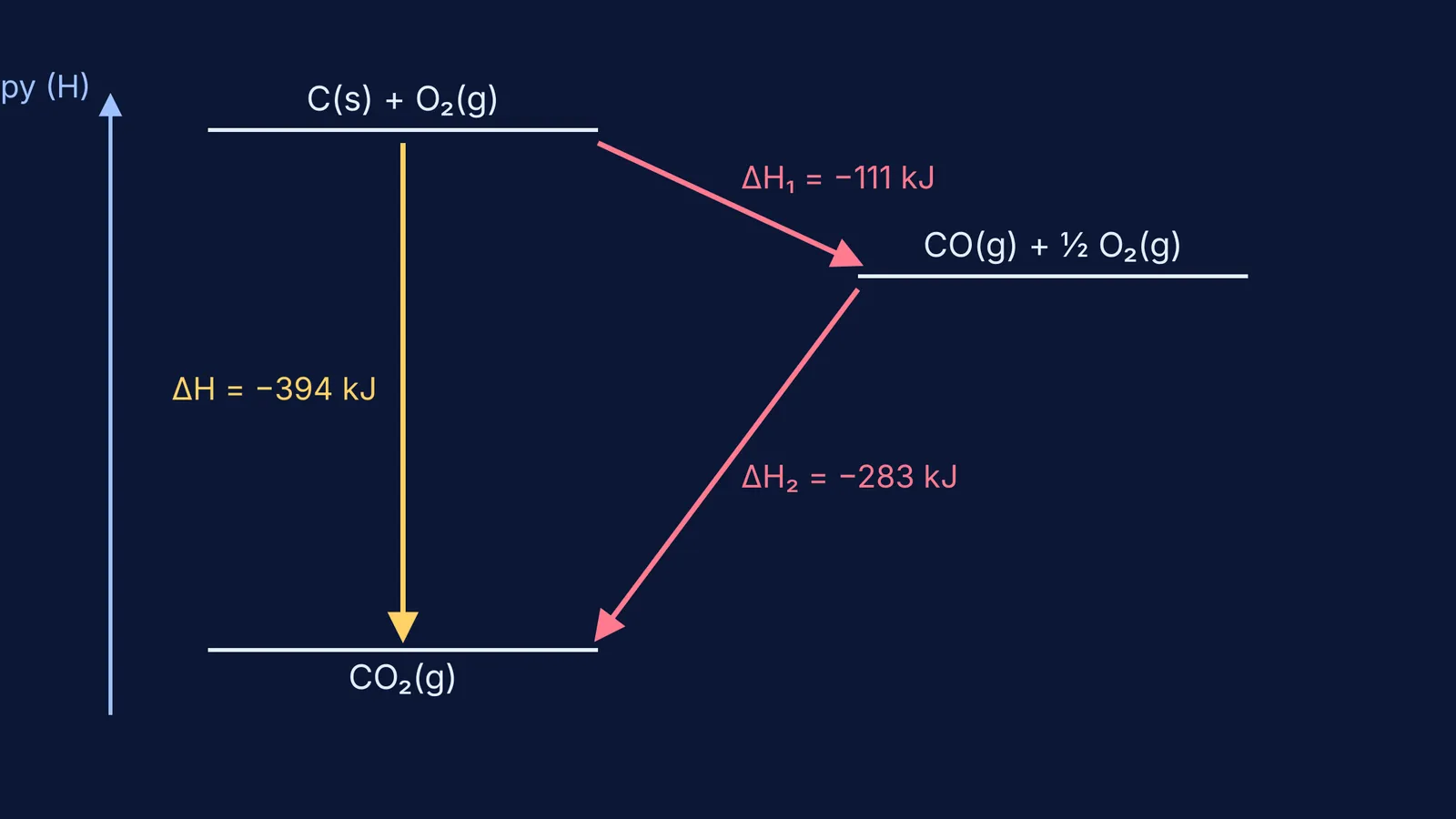
When you burn carbon in a plentiful supply of oxygen, it forms carbon dioxide. But carbon can also burn in a limited supply of oxygen to form carbon monoxide first, which can then be burned to form carbon dioxide. You might wonder if the heat released by these two different routes is the same.
According to Hess's law, the total enthalpy change for a chemical reaction is the same regardless of whether the reaction takes place in one step or several steps (OpenStax Chemistry 2e). The energy released depends only on the start and end states.
Do different routes to carbon dioxide release the same heat?
Yes, the heat released is identical. Enthalpy is a state function, meaning its change is entirely independent of the path taken between the initial and final states. You can think of it like the altitude on a mountain: whether you hike straight up the steep face or take a winding path with two different stops, the total change in your elevation from base to summit is exactly the same.
If you burn one mole of solid carbon directly to carbon dioxide, the standard enthalpy change is −394 kJ/mol (OpenStax Chemistry 2e). The negative sign tells you that the reaction is exothermic and heat is released to the surroundings.
Alternatively, you could take a two-step route:
Burn the solid carbon in a limited supply of oxygen to make carbon monoxide. This first step releases −111 kJ/mol.
Burn that carbon monoxide in more oxygen to make carbon dioxide. This second step releases −283 kJ/mol.
When you add the enthalpies of the two steps together (−111 kJ/mol and −283 kJ/mol), the total heat released is exactly −394 kJ/mol. The total energy remains constant, whether you take one step or two, perfectly demonstrating the first law of thermodynamics.
Why is Hess's law useful?
You might wonder why we need a dedicated scientific rule just to add up known numbers. In practice, chemists use Hess's law not to state the obvious, but as a clever tool for finding unknown numbers.
In a laboratory setting, it is extremely difficult to measure the enthalpy of formation for carbon monoxide directly. When carbon burns, it almost always produces a messy, uneven mixture of both carbon monoxide and carbon dioxide. You cannot easily isolate the heat from just the first step.
However, scientists can easily measure the complete combustion of carbon using a sealed bomb calorimeter to find the total enthalpy. They can also take a separate canister of pure carbon monoxide and burn it cleanly to find the enthalpy of the second step. Hess's law allows them to calculate the exact enthalpy of that difficult intermediate step algebraically. The mathematics works identically whether you are tracking a simple combustion or comparing complex enthalpies of atomisation and sublimation for a larger molecule.
How do you avoid common mistakes with Hess's law?
One of the most frequent mistakes students make when applying Hess's law is forgetting to balance the signs when reversing a reaction. Because enthalpy is an extensive property, if you flip a chemical equation backwards, you must also reverse the sign of its enthalpy change. For instance, while burning carbon monoxide to carbon dioxide releases −283 kJ/mol, the reverse process of splitting carbon dioxide back into carbon monoxide and oxygen would require an input of +283 kJ/mol. Paying close attention to the direction of your arrows and the signs of your energy values will prevent simple algebraic errors from ruining a perfectly good calculation.
How can you predict enthalpy changes?
When tackling chemistry problems for your exams, predicting enthalpy from abstract equations alone can feel challenging. Memorising the formulas is often not enough if you do not understand the underlying energy landscapes. This is where active learning and interactive tools help you build a stronger intuition for thermodynamics.
If you want to test how changing the reactants or adding more intermediate steps shifts the total heat output, the Fermi Simulation Lab lets you adjust variables and watch the energy graphs respond in real time. Seeing the stepwise reactions plotted out makes the invisible mathematics visible, so you sit down to a clear picture of exactly where every joule of heat comes from.


