On this page
Photographers have an old rule for hand-held shots: do not use a shutter time longer than 1 divided by the focal length. With a 50 mm lens, shoot at 1/50 s or faster. With a 200 mm lens, 1/200 s. The rule comes straight out of one line of Class 12 ray optics, and that line tells you how much your hand is assumed to shake and why a phone's zoom camera blurs so easily.
How far does the image move when the camera turns?
Light from a distant point arrives as parallel rays. The ray through the centre of the lens goes straight on, so the point is imaged on the sensor, a distance f behind the lens, where that ray lands.
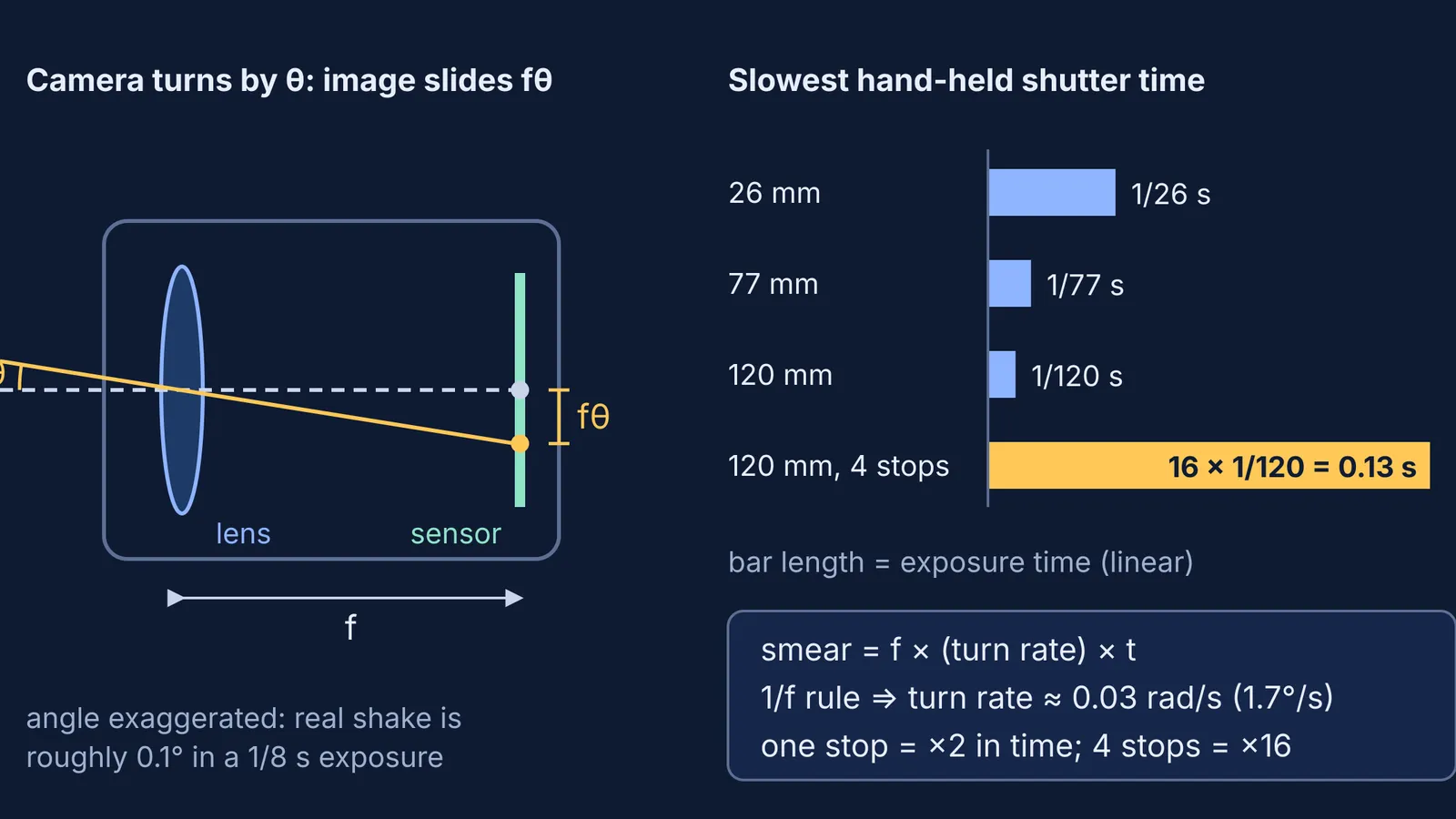
Now turn the camera by a small angle θ. The ray now meets the lens at θ to the axis. It still passes through the centre undeviated, so it lands a distance f tan θ from where it landed before. For small angles tan θ ≈ θ (in radians), so:
image shift = fθ
If your hand turns the camera at a steady rate ω (radians per second) while the shutter is open for a time t, the angle turned is ωt and the point is smeared into a streak of length:
smear = f × ω × t
The camera industry uses exactly this geometry. The CIPA DC-X011 standard for measuring image stabilisation computes its theoretical blur as the 35 mm-equivalent focal length × tan(average shake angle). It also says that turning (yaw and pitch) dominates camera shake, and sideways sliding of the camera can be neglected at normal subject distances.
What is the 1/focal-length rule?
The rule says the slowest safe shutter time is t = 1/f seconds, with f in millimetres on the 35 mm film scale (a 36 × 24 mm frame). Phones quote a "35 mm-equivalent" focal length so the rule still works.
"Safe" means the streak is too small to see. That limit is the permissible circle of confusion. The CIPA standard works it out for a postcard-size print viewed from about 450 mm by an eye that can just separate points 1 arcminute apart. Scaled back to the 35 mm frame, that is about 31.4 µm. The figure commonly used for 35 mm photography is 0.03 mm, and we will use that.
What hand shake does the 1/f rule assume?
Put t = 1/f into smear = fωt:
smear = f × ω × (1/f) = ω, with the smear in mm when f is in mm and ω in rad/s.
Set the smear equal to the blur limit: ω = 0.03 rad/s.
Convert: 0.03 × 180/π = 1.72° per second.
So the rule quietly assumes your hand turns the camera at about 1.7° a second. The focal length cancels, so one rule covers every lens.
Is that realistic? Real shake is a jitter, not a steady turn, and it varies a lot from person to person and with how you hold the camera. CIPA built its test waveforms from many measured hand-held shots. Reading its graph of average shake angle, a 1/8 s exposure turns the camera by roughly 0.1°, an average of about 0.8° a second. The rule's 1.7° a second leaves a safety margin of about two, which fits a rule meant for most people on most days.
Worked example: a phone at 1/8 s
You shoot indoors with a phone's main camera, which we take as 26 mm equivalent. The phone picks 1/8 s. Take ω = 0.03 rad/s, the rate the rule assumes (an illustrative value, not a measurement of your hand).
Smear on the 35 mm scale. 26 mm × 0.03 rad/s × 0.125 s = 0.0975 mm.
Compare with the limit. 0.0975/0.03 = 3.25, so the streak is 3.25 times the blur limit.
What the rule wanted. 1/26 s = 0.038 s. Your exposure is 3.25 times longer, which is log₂(3.25) ≈ 1.7 stops too slow.
Smear on the real sensor. The phone's real focal length is much shorter. With a crop factor of about 4.3 (an illustrative round value for a phone main camera), f = 26/4.3 ≈ 6.0 mm, and the streak on the sensor is 0.0975/4.3 mm ≈ 22.7 µm.
In pixels. If the pixels are about 1 µm across (again an illustrative round value), the point is dragged across roughly 23 pixels.
Units: mm × (rad/s) × s = mm, as the radian is dimensionless.
Why does the zoom camera blur first?
The smear grows in proportion to f. At the same shake rate and 1/8 s:
26 mm: 0.0975 mm, 3.25 times the limit.
77 mm: 0.289 mm, about 9.6 times the limit.
120 mm: 0.45 mm, 15 times the limit.
So the rule asks for 1/26 s at 26 mm, 1/77 s at 77 mm and 1/120 s at 120 mm. A telephoto lens magnifies the shake as much as the scene. For how phones get around long exposures by taking many short frames and combining them, see how night mode on a phone camera works.
What does a "4-stop" stabiliser actually do?
A stop is a factor of 2. CIPA defines it on the shutter scale: 1/1000 s to 1/500 s is one stop, as is 1/125 s to 1/60 s. (Aperture stops follow the same doubling of light; see how aperture size affects brightness and blur.)
An optical stabiliser uses gyroscopes to measure the turn rate and moves a lens element or the sensor to cancel the image shift. A rating of 4 stops means you can hold the shutter open 2⁴ = 16 times longer for the same sharpness:
At 120 mm, the rule gives 1/120 s. With 4 stops, 16/120 = 0.133 s, about 1/7.5 s.
Without correction, 0.133 s at 120 mm would smear 120 × 0.03 × 0.133 = 0.48 mm. The stabiliser has to cancel 15/16 of that motion to bring it down to 0.03 mm.
CIPA measures these ratings by mounting the camera on a shake table that replays recorded hand shake, then comparing blur with stabilisation on and off. Two limits are worth knowing:
It cannot fix subject motion. A child running across the room still blurs; only a shorter exposure helps.
The 0.03 mm limit is for a small print. If you zoom in to the full pixel size on a screen, you need a shorter exposure than the rule gives. Lens sharpness has its own limits too, for example diffraction at small apertures.
If you want to revise how a ray through the optical centre fixes where an image forms, the Concept Library explains thin lenses and focal length step by step.
Quick checklist
Turning the camera by θ moves the image by fθ on the sensor.
Smear = f × ω × t for a steady turn rate ω.
The 1/f rule plus a 0.03 mm blur limit means the rule assumes ω ≈ 0.03 rad/s, about 1.7° a second.
Use the 35 mm-equivalent focal length for the rule, the real one for the sensor smear.
Smear grows with f, so zoom cameras need faster shutters.
One stop doubles the time; a 4-stop stabiliser allows 16 times longer, but not for moving subjects.