

On this page
If you mix hydrochloric acid and sodium hydroxide in a beaker, the solution gets hot. The same thing happens if you swap the acid for nitric acid or the base for potassium hydroxide. In fact, if you measure the heat released by any combination of a strong acid and a strong base, the answer is always between 57 and 58 kJ per mole of water formed 1. This is a fundamental concept in chemical energetics, showing how macroscopic measurements like temperature reflect the microscopic reality of ions interacting in a solution.
What is the heat of neutralisation?
The standard enthalpy of neutralisation is the enthalpy change when an acid and a base react to form exactly one mole of water under standard conditions.
When a neutralisation reaction happens, the new oxygen-hydrogen bonds formed in the water molecule are very strong and stable. The transition from free-floating ions to strongly bonded water molecules releases a significant amount of potential energy into the surrounding solution as heat.
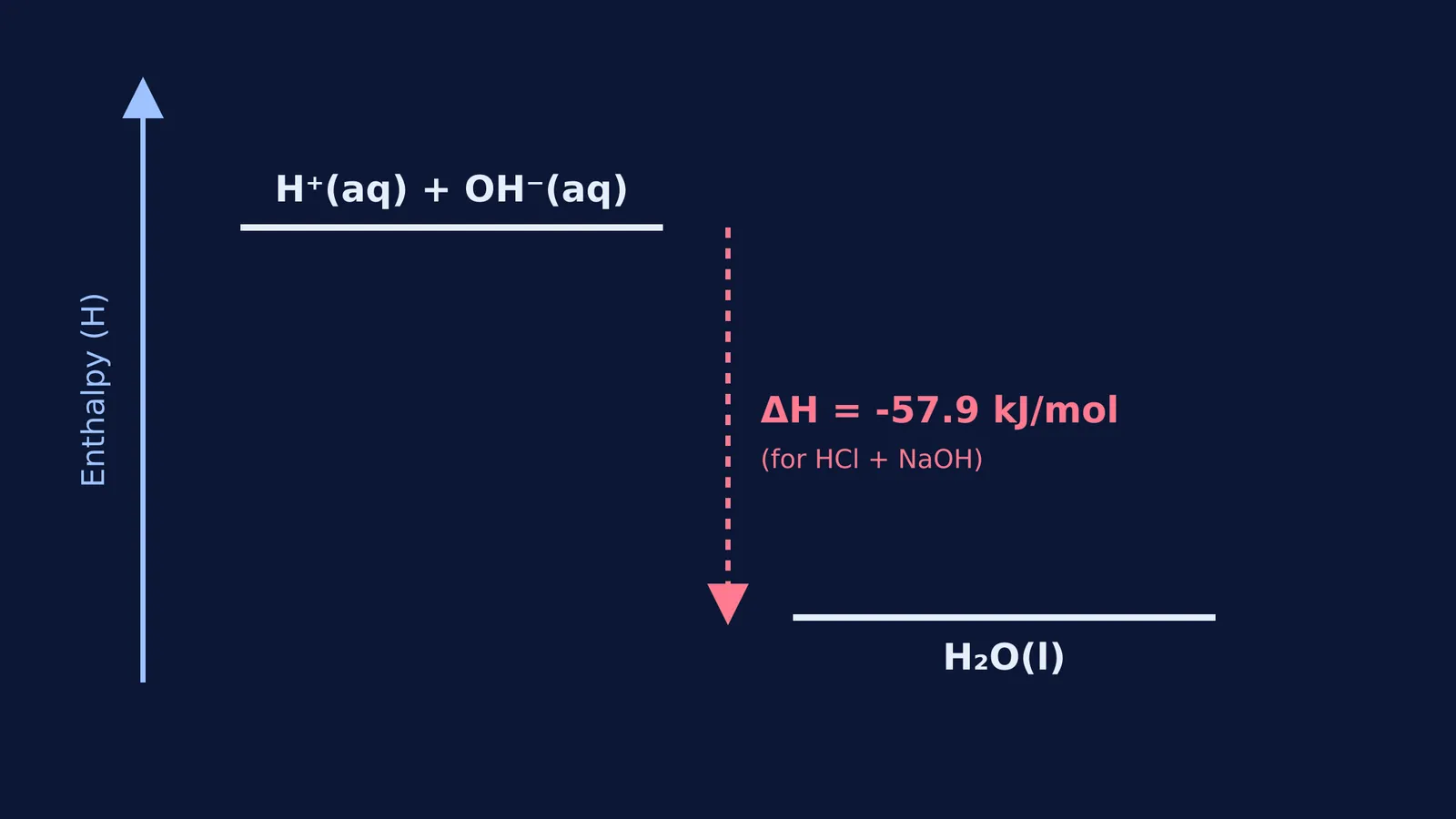
Because the reaction gives out heat, it is exothermic. By convention, exothermic changes have a negative sign, so the value is typically between -57 and -58 kJ/mol 1. For example, reacting hydrochloric acid with sodium hydroxide releases 57.9 kJ/mol. If you are comparing this to enthalpies of atomisation, sublimation and phase change, remember that neutralisation is always exothermic.
Why is it constant for strong acids and bases?
The reason the enthalpy of neutralisation is consistently around -57.9 kJ/mol for strong acids and bases is that the actual chemical reaction taking place is identical every time 1.
Strong acids (like HCl or HNO₃) and strong bases (like NaOH or KOH) are completely dissociated in water. When you pour them together, you are not reacting intact molecules. You are mixing a soup of already separated ions.
Take HCl and NaOH as an example. Before they mix, you have H⁺ and Cl⁻ in one beaker, and Na⁺ and OH⁻ in the other. When they combine, the hydrogen and hydroxide ions join to form liquid water:
H⁺(aq) + OH⁻(aq) → H₂O(l)
The sodium (Na⁺) and chloride (Cl⁻) ions do nothing. They are spectator ions that remain dissolved in the water. Because the only chemical change is the formation of new oxygen-hydrogen bonds to make water, the energy released is always exactly the same.
If you struggle to picture how ions behave in solution, you can explore the Fermi Concept Library, which has a dedicated lesson for every concept in chemistry.
What happens with weak acids and bases?
If you use a weak acid, such as ethanoic acid (acetic acid), or a weak base, like ammonia, the enthalpy change is less exothermic. For example, ethanoic acid and sodium hydroxide give -56.1 kJ/mol 1.
Weak acids and bases only partially ionise in water. For the neutralisation to finish, the intact molecules must first be broken apart into ions. Breaking those bonds costs energy. This energy penalty is subtracted from the heat released by the H⁺ and OH⁻ joining, resulting in a smaller net release of heat. (You can brush up on the relationship between weak acids and their salts in our guide to conjugate acid-base pairs.)
A worked example: finding the temperature rise
A classic exam question asks you to calculate the temperature rise when you mix two solutions. If you are ever stuck on these, you can bring the problem to the Fermi Problem Library, where the step-by-step solver explains the reasoning behind the calorimetry equations.
Here is how you set it up. Suppose you mix 100 mL of 1 M HCl with 100 mL of 1 M NaOH.
Find the moles of water formed: 100 mL of a 1 M solution contains 0.1 moles of H⁺ and OH⁻. They will form 0.1 moles of water.
Calculate the heat released: Since 1 mole releases 57.9 kJ, 0.1 moles will release 5.79 kJ (or 5790 J) 1.
Find the mass of the mixture: The total volume is 200 mL. Assuming the density is the same as pure water, the mass is 200 g.
Use the specific heat equation: The specific heat capacity of water (c) is about 4.18 J/(g K).
q = mcΔT 5790 = 200 × 4.18 × ΔT ΔT = 5790 / 836 = 6.9 K
The temperature of the mixture will rise by 6.9 °C. The actual temperature rise in a real laboratory experiment might be slightly lower due to heat lost to the surroundings or absorbed by the beaker itself, but the theoretical calculation assumes a perfectly insulated system. If you were working with a very dilute solution, you might also need to account for the pH of a very dilute acid, but the heat calculation follows the exact same logic.


