On this page
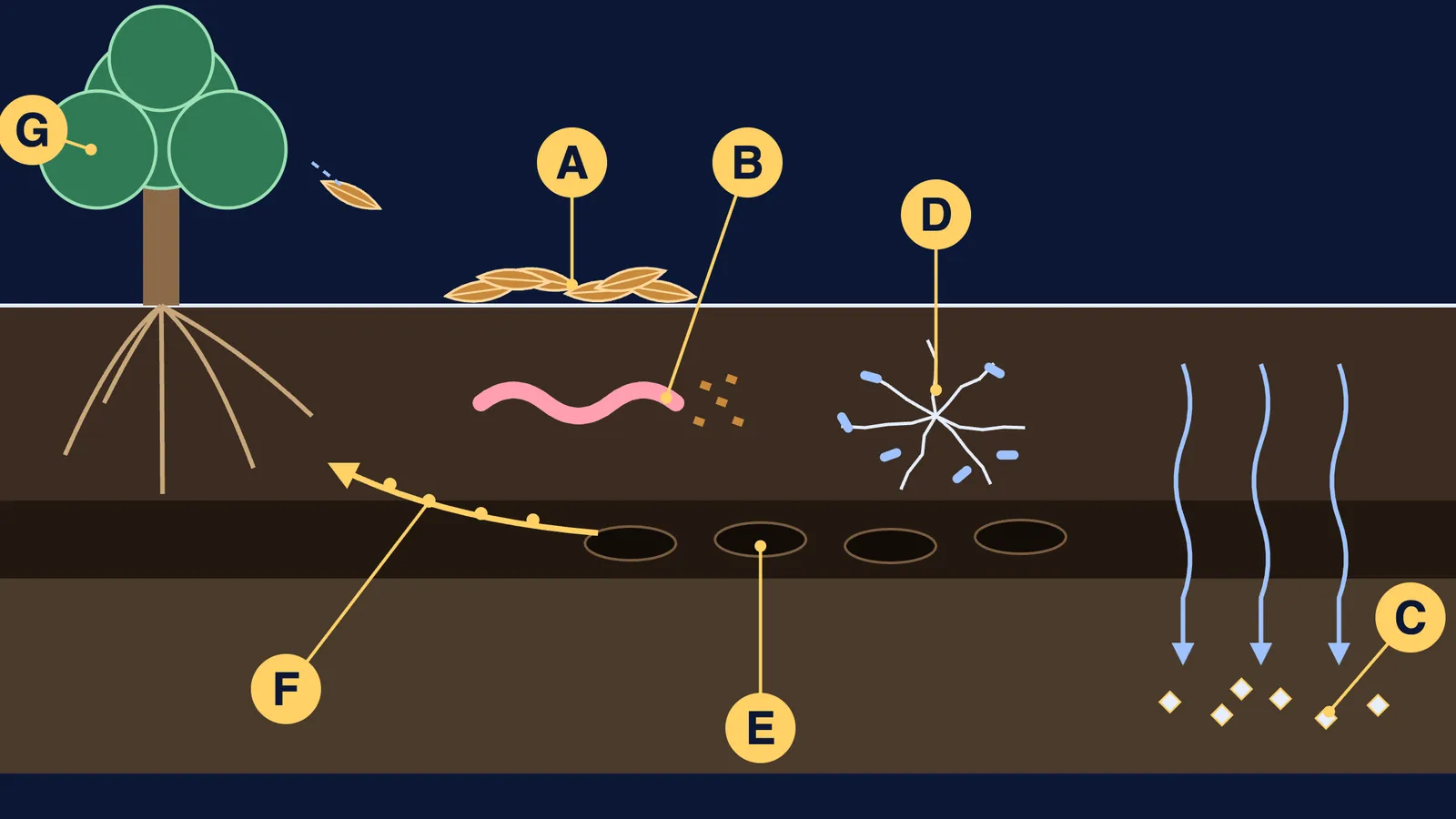
This set starts with a dead leaf and follows it into the soil: the schematic above letters seven parts A to G for Q1 to Q6, and Q7 to Q14 turn the remaining NCERT figures into word problems. Every fact comes from NCERT Class 12 Biology, Chapter 12, Ecosystem (Reprint 2026-27), and the NMC's NEET (UG) syllabus lists Ecosystem under Unit 10, Ecology and Environment.
What does the lettered soil diagram show?
A side view of the ground: a plant, surface litter, topsoil, a dark band and a deeper layer. NCERT's Figure 12.1 draws decomposition as a cycle; ours cuts through the soil, so depth is a clue.
How should you read a process diagram like this one?
Find where material enters and where it leaves.
Use depth: surface, topsoil and deeper soil host different steps.
Watch qualifiers such as "unavailable" or "slowly"; one can make a statement false.
What is happening at A to G under the leaf litter?
Two-statement code for Q2, Q6, Q8, Q12 and Q14: (1) I right, II wrong (2) I wrong, II right (3) both right (4) both wrong.
Q1. Organism B breaks the litter at A into smaller particles. NCERT calls this step: (1) leaching (2) humification (3) fragmentation (4) mineralisation
Answer: (3). NCERT says detritivores such as the earthworm fragment detritus into smaller particles.
Q2. I: Band E is a dark, amorphous substance formed by humification. II: Microbes degrading E to release F is the step called leaching.
Answer: (1). Humification gives dark, amorphous humus; releasing nutrients from humus is mineralisation.
Q3. Match each lettered part (List-I) to what it shows (List-II). List-I: A; C; D; F. List-II: I. Unavailable salts left after soluble nutrients sink; II. Dead leaves, bark and animal remains; III. Inorganic nutrients released from humus; IV. Fungi and bacteria whose enzymes drive catabolism. (1) A-II, C-I, D-IV, F-III (2) A-II, C-IV, D-I, F-III (3) A-III, C-I, D-IV, F-II (4) A-I, C-II, D-III, F-IV
Answer: (1). Detritus, leaching, catabolism and mineralisation, in NCERT's terms.
Q4. The wavy arrows leading down to C show nutrients that: (1) G takes up at once (2) turn into humus (3) are fixed by D (4) move down the soil horizon and precipitate as unavailable salts
Answer: (4). That is NCERT's description of leaching.
Q5. Which soil condition would make D work so slowly that organic matter piles up? (1) warm, moist soil (2) loose, well-aerated soil (3) low temperature and anaerobiosis (4) frequent rain on warm days
Answer: (3). NCERT: decomposition largely needs oxygen; cold and anaerobiosis inhibit it, so organic matter builds up.
Q6. I: The steps at B, C and D act on detritus at the same time. II: G belongs to the detritus food chain because it absorbs F.
Answer: (1). NCERT says the steps operate simultaneously; G is a producer, not part of a chain that begins with dead matter.
Answer key for the lettered diagram: soil cross-section
A: detritus (leaf litter). B: detritivore (earthworm), fragmentation. C: unavailable salts after leaching. D: decomposers, bacteria and fungi (catabolism). E: humus. F: inorganic nutrients from mineralisation. G: producer, the plant.
Can you solve pyramid and energy-flow figures from a description?
Sketch each figure from the stem before reading the options.
Q7. NCERT's trophic-level figure stacks four boxes with an examples column. Match them. List-I: R. Producer; S. Primary consumer; T. Secondary consumer; U. Tertiary consumer. List-II: i. Birds, fishes, wolf; ii. Man, lion; iii. Phytoplankton, grass, trees; iv. Zooplankton, grasshopper, cow. (1) R-iii, S-i, T-iv, U-ii (2) R-iv, S-iii, T-i, U-ii (3) R-iii, S-iv, T-ii, U-i (4) R-iii, S-iv, T-i, U-ii
Answer: (4). These are the examples in NCERT's Figure 12.2.
Q8. The energy-flow figure shows the sun, four trophic levels with "heat" arrows, and arrows from each level down to a decomposer. I: The downward arrows show dead organisms of every level feeding decomposers. II: The heat arrows show energy returning from consumers to producers.
Answer: (1). Dead organisms become detritus for decomposers; energy flow is unidirectional.
Q9. Match the panels of Figure 12.4 with their features. List-I: R. 12.4(a); S. 12.4(b); T. 12.4(c); U. 12.4(d). List-II: i. Two bars only, the consumer bar wider; ii. Counts of individuals in a grassland; iii. Ideal energy values in joules, sunlight written beneath the base; iv. Dry weight per square metre, falling sharply upwards. (1) R-ii, S-i, T-iv, U-iii (2) R-ii, S-iv, T-i, U-iii (3) R-iv, S-ii, T-i, U-iii (4) R-iii, S-iv, T-i, U-ii
Answer: (2). Numbers, biomass, inverted biomass and energy, in NCERT's order.
Q10. In the inverted biomass pyramid, the narrow base is: (1) zooplankton (2) fishes (3) phytoplankton (4) decomposers
Answer: (3). Per NCERT's caption, little phytoplankton biomass supports far more zooplankton biomass.
Q11. The upright biomass pyramid labels each bar in: (1) individuals per unit area (2) dry weight, kg per square metre (3) joules per year (4) fresh weight of one organism
Answer: (2). NCERT says dry weight is the more accurate measure of biomass.
Q12. In the ideal energy pyramid: I: Sunlight appears as a value written under the producer bar, not as a bar of its own. II: Each bar shows the energy held at one trophic level per unit area, over a set period or a year.
Answer: (3). Both match the figure and NCERT's description of energy-pyramid bars.
Q13. In the energy-flow figure, the decomposer at the bottom belongs to a group that is mainly: (1) herbivorous insects (2) phytoplankton (3) top carnivores (4) fungi and bacteria, called saprotrophs
Answer: (4). NCERT: detritus food chain decomposers are mainly fungi and bacteria.
Q14. I: In Figure 12.4(b), the tertiary consumers sit at the apex with the smallest dry weight. II: In Figure 12.2, the cow is placed at the third trophic level.
Answer: (1). The apex bar is the top consumer; the cow, a herbivore, is a primary consumer at the second level.
What should a wrong answer here tell you?
Cover the key, name A to G aloud, then redraw the section as NCERT's cycle.
Mark each miss "wrong letter" or "wrong fact" and reread that NCERT paragraph.
Switch formats: the Ecosystem statement and match-the-list set, the Ecosystem assertion-reason questions, and why a single tree inverts the pyramid of numbers.
Unsure whether pyramids or decomposition needs work first? Fermi's AI tutor works out what you already know and builds a plan for the session.