On this page
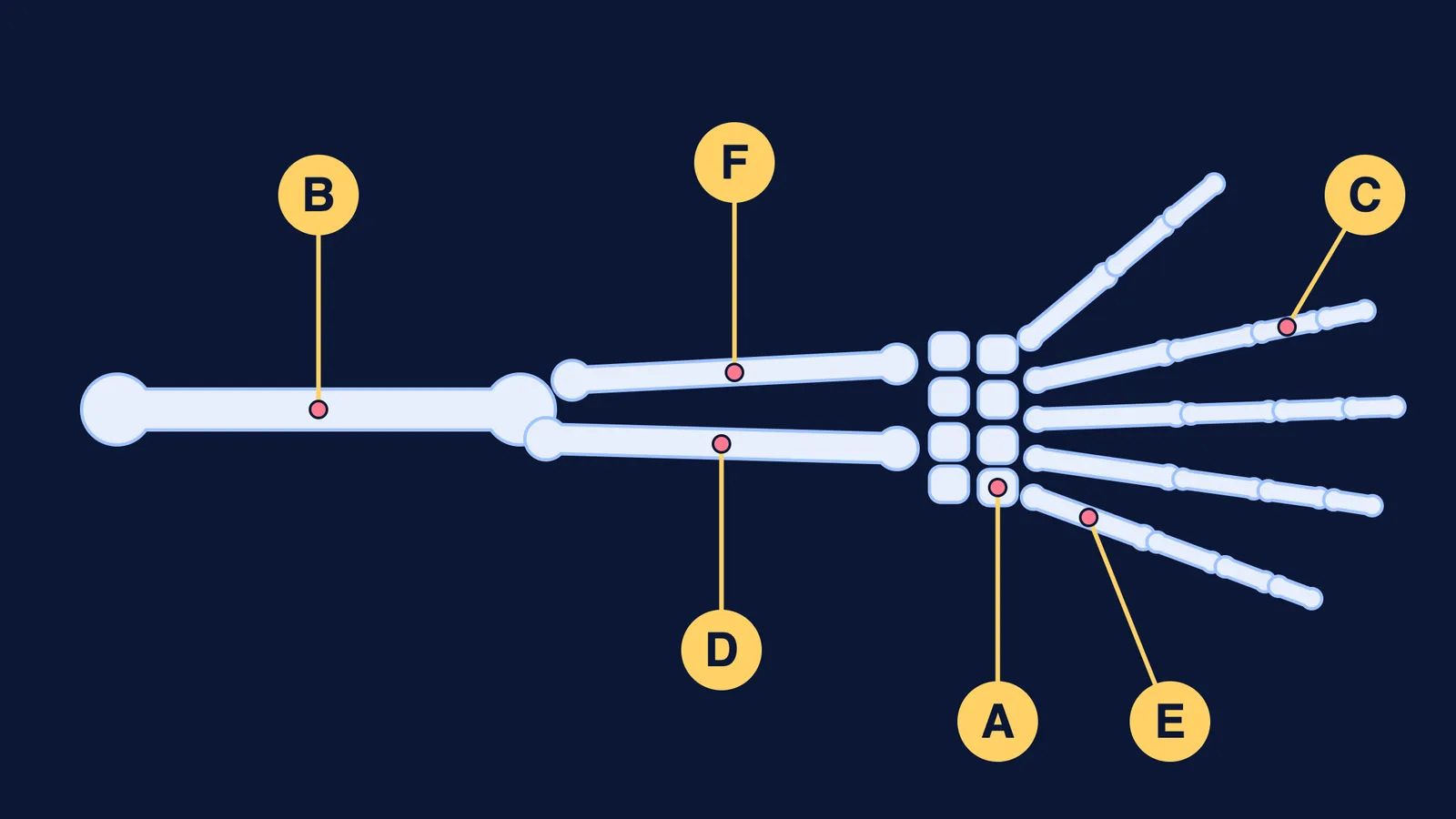
Evolution leans on eleven figures. Here are 14 original questions: 1 to 6 use the lettered forelimb above, and 7 to 14 put the rest of the chapter's figures into words. Every answer is checked against Chapter 6 of NCERT Class 12 Biology (Reprint 2026-27).
What will you find in the 11 figures of Chapter 6?
The chapter's figures are: Miller's experiment (6.1), a dinosaur family tree (6.2), homologous organs in plants and animals (6.3), white and dark moths on tree trunks (6.4), finch beaks (6.5), Australian marsupials (6.6), marsupials beside placental mammals (6.7), three kinds of natural selection (6.8), plant and vertebrate history through geological periods (6.9 and 6.10) and skulls of a human and two chimpanzees (6.11). Hardy-Weinberg has no figure, so it is left out.
The NMC syllabus for NEET (UG) 2026 lists Evolution under Unit 7, Genetics and Evolution.
How do you turn a bone diagram into answers?
Start at the shoulder end: that single bone anchors every other letter.
Count small bones; a group gives itself away by its number.
Read the dot, not the circle: each leader line ends on one bone.
Ask what the figure is evidence for, ancestry or selection.
Q1 to Q6: what are bones A to F?
Bone counts come from NCERT Class 11 Chapter 17. Two-statement code for this whole post: (1) Only II stands (2) Neither stands (3) Both stand (4) Only I stands.
Q1. Which letter marks the palm bones?
(1) A (2) C (3) E (4) F
Q2. NCERT's list of bones shared by homologous forelimbs opens with the single upper-arm bone. Which letter is it?
(1) B (2) D (3) A (4) F
Q3. Statement I: A human forelimb has more bones in group C than in group A. Statement II: NCERT reads the shared set A to F in different mammals as a sign of common ancestry.
Q4. Which coding links each List-I letter to its List-II description correctly?
List-I: J. A, K. C, L. E, M. D
List-II: I. Digit bones; II. The forearm bone paired with F; III. Wrist bones; IV. Palm bones
(1) J-IV, K-I, L-III, M-II (2) J-III, K-I, L-IV, M-II (3) J-III, K-IV, L-I, M-II (4) J-II, K-IV, L-III, M-I
Q5. Statement I: Finding A to F in a bat's wing and a whale's flipper alike shows one structure modified in different directions for different needs. Statement II: Because the two limbs share A to F, NCERT calls them analogous.
Q6. A butterfly's wing does a bird wing's job but contains none of the bones A to F. How does NCERT classify the two wings?
(1) Homologous, from divergent evolution (2) Analogous, from convergent evolution (3) Homologous, from convergent evolution (4) Analogous, from divergent evolution
Answer key for the lettered diagram
A carpals; B humerus; C phalanges; D ulna; E metacarpals; F radius.
Q1: (3). E is the metacarpals, the palm bones.
Q2: (1). NCERT's list starts with the humerus, B.
Q3: (3). Phalanges (14) outnumber carpals (8), and homology indicates common ancestry.
Q4: (2). Carpals, phalanges, metacarpals, ulna.
Q5: (4). This is divergent evolution, and the limbs are homologous, not analogous.
Q6: (2). Alike in function, unlike in structure: analogy, from convergent evolution.
Q7 to Q14: which chapter figure is each question describing?
Sketch each described figure before choosing an option.
Q7. Sparks passed through methane, hydrogen, ammonia and water vapour, sealed in one flask, yielded amino acids. Whose idea did this support?
(1) Lamarck's use and disuse (2) Oparin and Haldane's chemical evolution (3) Darwin's branching descent (4) de Vries's saltation
Q8. A family tree of dinosaurs ends in modern counterparts. Which two does NCERT's caption name?
(1) Lizards and snakes (2) Turtles and frogs (3) Whales and seals (4) Crocodiles and birds
Q9. Two panels show white and dark moths on trunks, unpolluted and polluted. Statement I: On the pale, lichen-covered trunk, predators pick out the dark moth. Statement II: Where industrialisation did not occur, the count of melanic moths stayed low.
Q10. In the finch-beak figure, the many beak forms arose from ancestors with which feeding habit?
(1) Insect-eating (2) Seed-eating (3) Nectar-feeding (4) Fish-eating
Q11. Match each described figure (List-I) with what it shows (List-II).
List-I: T. Many Australian marsupials from one ancestral stock; U. A placental wolf beside a Tasmanian wolf; V. Moths on soot-darkened bark; W. Skulls of a human, a baby chimpanzee and an adult chimpanzee
List-II: I. Convergent evolution; II. Adaptive radiation; III. Survival through camouflage; IV. A young ape's skull closer to the adult human one
(1) T-II, U-I, V-III, W-IV (2) T-I, U-II, V-III, W-IV (3) T-II, U-III, V-I, W-IV (4) T-II, U-I, V-IV, W-III
Q12. In one panel of the natural selection figure, the peak stays at the mean while more individuals crowd into it. This is:
(1) Disruptive selection (2) Directional selection (3) Stabilising selection (4) Genetic drift
Q13. The sketch of plant forms through geological periods includes giant ferns. What became of them, per NCERT?
(1) They fell and slowly formed coal deposits (2) They became the first land plants (3) They gave rise to seaweeds (4) They survive unchanged as tall trees
Q14. A chart of vertebrate history. Statement I: The first mammals were large, horse-sized animals. Statement II: Reptile eggs are thin-shelled and dry up in the sun, unlike amphibian eggs.
How did you do on Q7 to Q14?
Q7: (2). NCERT presents Miller's result as support for chemical evolution.
Q8: (4). The caption names crocodiles and birds.
Q9: (3). Both match NCERT's account of the moths.
Q10: (2). The original seed-eating form gave rise to insectivorous and vegetarian finches.
Q11: (1). Sections 6.3 and 6.4, and Figure 6.11's caption.
Q12: (3). In stabilising selection more individuals take the mean value.
Q13: (1). Giant ferns fell to form coal deposits slowly.
Q14: (2). The first mammals were shrew-like; reptile eggs are thick-shelled.
What should you redo after marking?
Redraw the forelimb with names instead of letters, and sketch every figure behind a miss. For text-only practice, try our Evolution statement and match-the-list set. For the skulls and hominid dates, read Australopithecus to Homo sapiens: brain sizes and dates.
Unsure where your Evolution gaps are? Fermi's AI tutor works out what you already know and builds a plan for the session.