

On this page
Evolution is full of names, dates and paired ideas, which NEET's statement and match-the-list formats test. Below are 13 original questions, each with an answer and NCERT reason.
What does this Evolution set cover?
The NMC syllabus for NEET (UG)-2026 places Evolution in Unit 7, Genetics and Evolution, from origin of life to human evolution. Every fact here is from Chapter 6 of NCERT Class 12 Biology (Reprint 2026-27). We skip origin of life and the items in our Evolution assertion-reason set, so you meet new traps.
How do you attack two-statement questions?
Judge Statement I alone, then Statement II alone, before you read the options. Write T or F beside each, with the NCERT line that decides it. Then find the option that matches your pair.
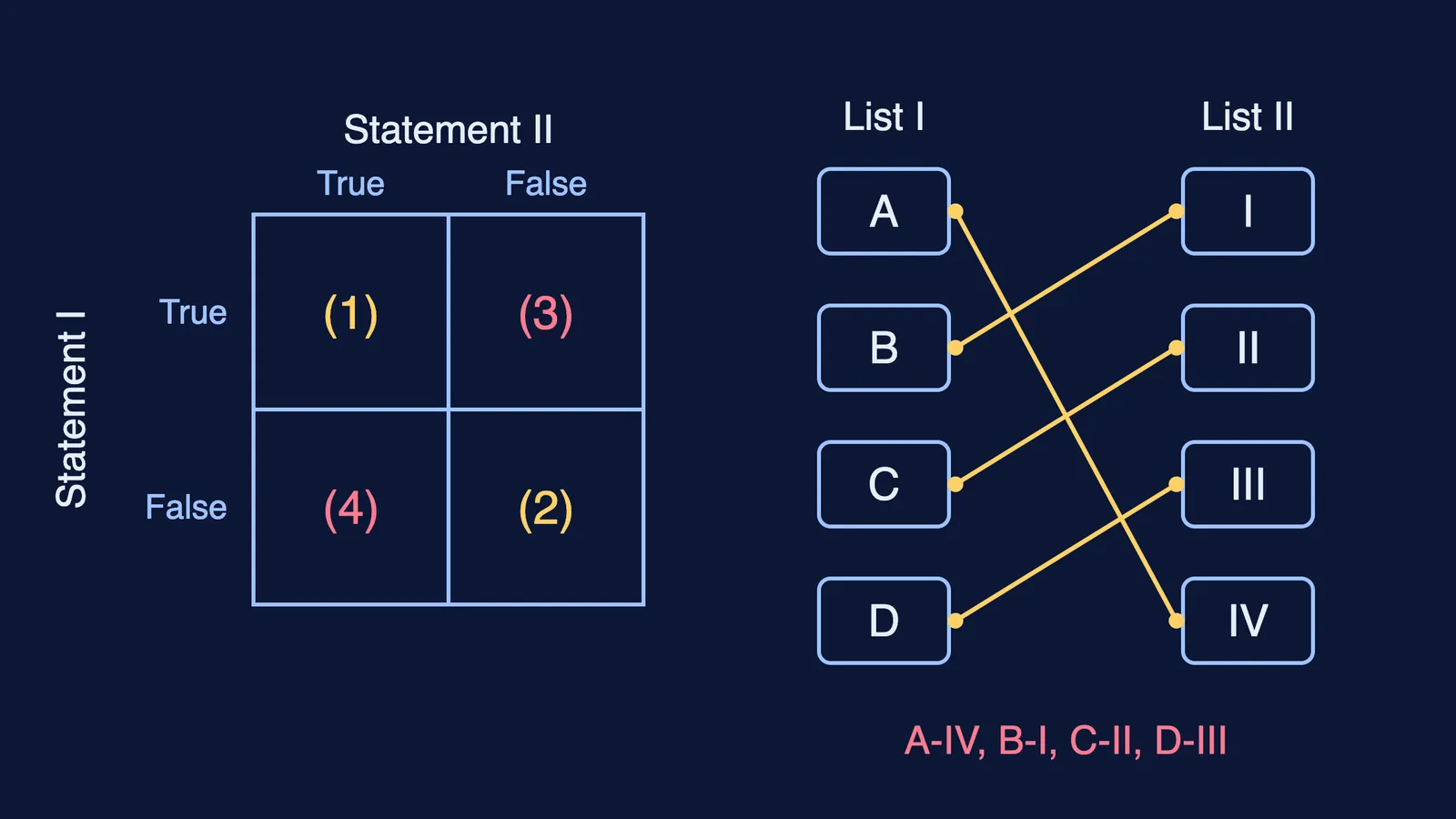
Options for S1 to S4:
(1) Both I and II are correct
(2) Both I and II are incorrect
(3) I is correct, II is incorrect
(4) I is incorrect, II is correct
S1. I: Heckel's embryological argument used the row of vestigial gill slits behind the head of every vertebrate embryo, humans included. II: Karl Ernst von Baer's later study backed Heckel. Answer: (3). Von Baer rejected it: he found embryos never pass through other animals' adult stages.
S2. I: Shared proteins and genes doing one job in very different organisms point to common ancestry. II: For Darwin, fitness meant, in the end, only reproductive fitness. Answer: (1). Both match NCERT: the first is biochemical evidence, and Darwin's fitness is the ability to leave more progeny.
S3. I: NCERT says Darwin built Mendel's inheritable factors into his theory. II: NCERT calls evolution a stochastic process, resting on chance events and chance mutation, not a directed one. Answer: (4). NCERT says Darwin either ignored Mendel's observations or stayed silent on them.
S4. I: A coelacanth caught in South Africa in 1938 belonged to a group thought to be extinct. II: Lobefins gave rise to the first reptiles. Answer: (3). Lobefins became the first amphibians; reptiles came from amphibians.
S5. Which statements are correct? A: Invertebrates were formed and active by about 500 mya. B: Jawless fish probably evolved around 350 mya. C: NCERT names climate change as the proven reason dinosaurs vanished about 65 mya. D: Ichthyosaurs are fish-like reptiles that evolved from land reptiles which went back to water, probably about 200 mya. (1) A, B and D only (2) A, B, C and D (3) A and C only (4) B and D only Answer: (1). On the dinosaurs, NCERT says we do not know the true reason.
How do you attack match-the-list questions?
Read the four coded options first. Fix the pair you are surest of, cross out every option that disagrees, then check one pair that splits what is left. See our match-the-list method for NEET.
M1. List I: A. Hugo de Vries B. Alfred Wallace C. Thomas Malthus D. Charles Darwin. List II: I. Voyage on H.M.S. Beagle II. Naturalist in the Malay Archipelago III. Work on evening primrose IV. Work on populations (1) A-III, B-II, C-IV, D-I (2) A-II, B-III, C-I, D-IV (3) A-III, B-IV, C-II, D-I (4) A-IV, B-II, C-III, D-I Answer: (1). NCERT says Malthus's work on populations may have influenced Darwin; the rest match sections 6.2 and 6.6.
M2. List I: A. Different fossils in rock layers of different ages B. Same-function proteins in diverse organisms C. Vertebrate hearts and brains D. New dog breeds made within hundreds of years. List II: I. Homology II. Human breeding argument III. Paleontological evidence IV. Biochemical evidence (1) A-IV, B-III, C-I, D-II (2) A-III, B-I, C-IV, D-II (3) A-III, B-IV, C-I, D-II (4) A-II, B-IV, C-I, D-III Answer: (3). Hearts and brains are NCERT homology examples; dog breeds support the human breeding argument.
M3. List I: A. About 15 mya B. 75,000 to 10,000 years ago C. About 18,000 years ago D. About 10,000 years ago. List II: I. Agriculture and settlements begin II. Dryopithecus and Ramapithecus III. Pre-historic cave art IV. Ice age in which modern Homo sapiens arose (1) A-II, B-III, C-IV, D-I (2) A-II, B-IV, C-III, D-I (3) A-IV, B-II, C-III, D-I (4) A-II, B-IV, C-I, D-III Answer: (2). These are NCERT's section 6.9 dates; the cave art example is Bhimbetka in Madhya Pradesh.
M4. List I: A. Stabilising selection B. Directional selection C. Disruptive selection D. Adaptive radiation. List II: I. More individuals at both ends of the curve II. Many species evolving in one area and spreading into other habitats III. More individuals at the mean value IV. More individuals at a value away from the mean (1) A-IV, B-III, C-I, D-II (2) A-III, B-I, C-IV, D-II (3) A-III, B-IV, C-II, D-I (4) A-III, B-IV, C-I, D-II Answer: (4). These match NCERT's descriptions of the three selection types and of adaptive radiation.
How should you handle single-correct MCQs?
Name the NCERT section first, then eliminate. If two options look right, re-read the stem for "not".
Q1. In a population in Hardy-Weinberg equilibrium, 1 in 100 individuals shows the recessive phenotype (aa). What is the heterozygote frequency? (1) 0.09 (2) 0.18 (3) 0.01 (4) 0.81 Answer: (2). q² = 0.01, so q = 0.1 and p = 0.9; 2pq = 2 × 0.9 × 0.1 = 0.18.
Q2. Which pair is homologous rather than analogous? (1) Wings of butterfly and bird (2) Eyes of octopus and mammals (3) Flippers of penguins and dolphins (4) Thorn of Bougainvillea and tendril of Cucurbita Answer: (4). NCERT gives this plant pair as homology; the other three are its analogy examples.
Q3. Which is NOT one of the five factors NCERT lists as affecting Hardy-Weinberg equilibrium? (1) Adaptive radiation (2) Gene flow (3) Genetic drift (4) Natural selection Answer: (1). The five are mutation, gene flow, natural selection, genetic recombination and genetic drift.
Q4. According to NCERT, which organisms invaded land first? (1) Amphibians (2) Plants (3) Lobefins (4) Reptiles Answer: (2). Plants were widespread on land before animals came.
What should you do with your misses?
Sort each miss into a fact gap or a reading slip, re-read the NCERT paragraph behind each gap, and retry the set in a new order later. To revise the concepts, read our Evolution guide for NEET.
Not sure which part of Evolution to revise first? Fermi's AI tutor works out what you already know and builds a plan for the session.


