On this page
Evolution reads like a story, so its assertion-reason items catch students who skim. Every statement below was checked against the NCERT Class 12 Biology chapter on Evolution (2026-27 reprint), and every topic sits inside the NMC syllabus for NEET (UG)-2026 (Genetics and Evolution unit). For notes on the whole chapter, start with our Evolution Class 12 board exam guide.
How do you answer assertion-reason questions?
Judge each statement on its own first. Only when both are true do you ask: is R the direct reason NCERT gives for A? Two true facts from one story are not automatically cause and effect.
Keys for every question:
Assertion-reason: (A) Both A and R are true and R is the correct explanation of A. (B) Both A and R are true but R is NOT the correct explanation of A. (C) A is true but R is false. (D) A is false but R is true.
Statement pairs: (A) Both statements are correct. (B) Both statements are incorrect. (C) Statement I is correct, Statement II is incorrect. (D) Statement I is incorrect, Statement II is correct.
Evolution assertion-reason questions with answers
All facts below are from the NCERT Evolution chapter.
Q1 (easy). Assertion (A): The forelimbs of a whale, a bat, a cheetah and a human are homologous organs. Reason (R): Though they do different jobs, all of them are built from the same set of bones: humerus, radius, ulna, carpals, metacarpals and phalanges.
Answer: (A). Both are true, and the shared bone pattern is why NCERT calls them homologous. Trap: thinking different functions rule out homology.
Q2 (easy). Assertion (A): Lichens can be used as indicators of industrial pollution. Reason (R): After industrialisation in England, dark-winged moths survived better because predators could not spot them on soot-darkened tree trunks.
Answer: (B). Both are true, but lichens are indicators because they do not grow in polluted areas. R explains the rise of melanised moths, not the use of lichens. Trap: linking two facts only because they come from the same example.
Q3 (medium). Assertion (A): Sweet potato and potato are analogous structures. Reason (R): Analogous structures are the result of divergent evolution.
Answer: (C). A is true: sweet potato is a root modification and potato a stem modification, doing the same job. R is false: analogy comes from convergent evolution; divergent evolution produces homology. Trap: swapping "divergent" and "convergent".
Q4 (medium). Assertion (A): Lamarck explained the long neck of the giraffe by natural selection. Reason (R): Lamarck held that characters acquired through use and disuse of organs are passed on to the next generation.
Answer: (D). R is true, but A is false: natural selection is Darwin's mechanism; Lamarck explained it by use and inheritance of the acquired longer neck. Trap: mixing up Lamarck and Darwin.
Q5 (medium). Assertion (A): A new variant can take over a bacterial colony within days after its medium changes, while a comparable change in fish would take millions of years. Reason (R): How quickly new forms arise depends on how long the organism's life cycle or life span is.
Answer: (A). Both are true, and NCERT gives the life-span link as the direct reason: bacteria divide fast, while fish live for years. Trap: picking (B) because R sounds too general.
Q6 (hard). Assertion (A): Through the founder effect, a drifted population can change so much in allele frequency that it becomes a new species. Reason (R): Repeated migration of alleles between populations is called gene flow.
Answer: (B). Both are true, but the founder effect comes from genetic drift, a chance change in allele frequency. Gene flow is repeated migration, a separate factor. Trap: treating gene flow and genetic drift as one idea.
Statement I and Statement II questions on evolution
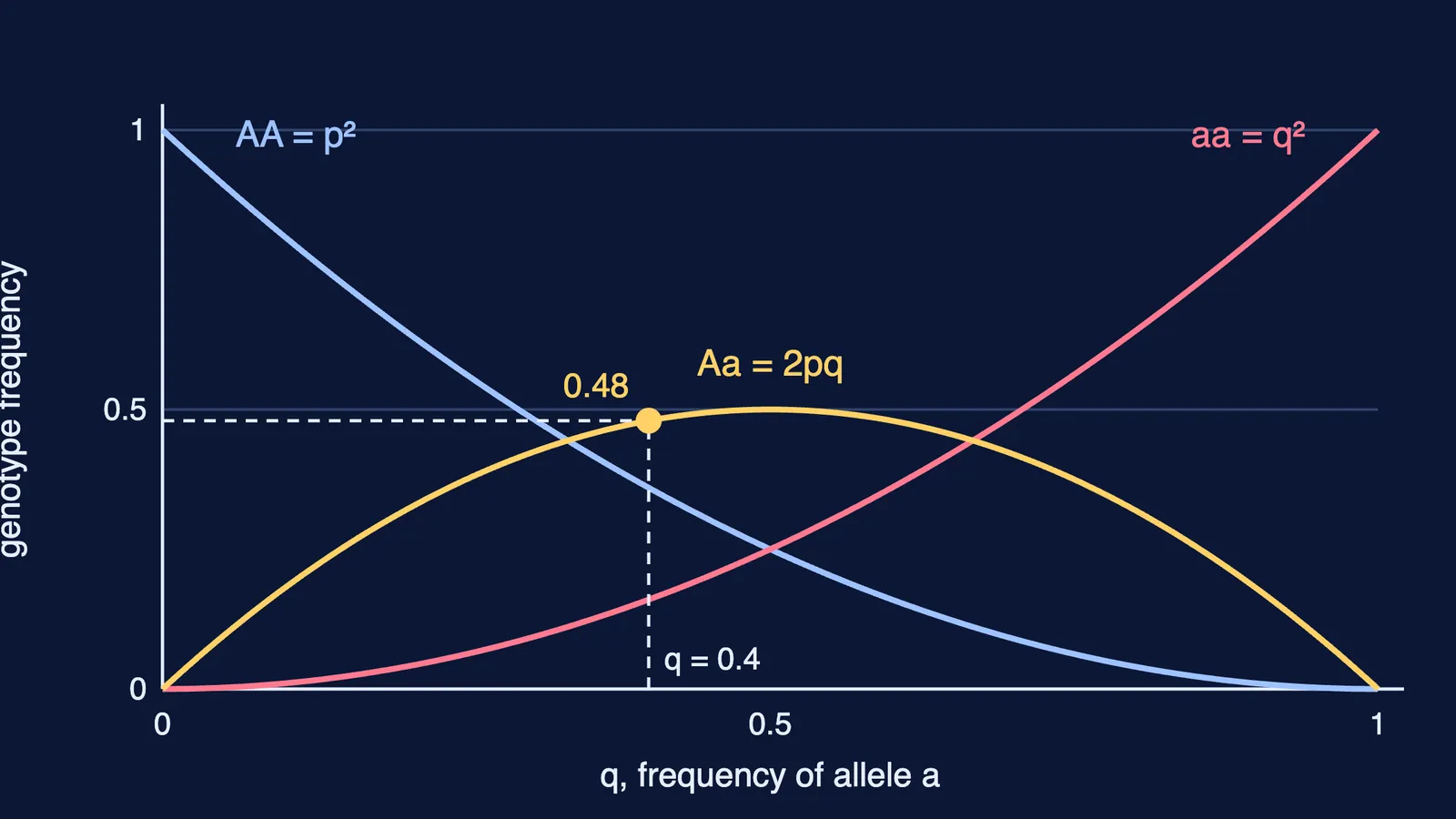
Same source: the NCERT chapter. Under Hardy-Weinberg equilibrium, p² + 2pq + q² = 1, where p and q are the frequencies of alleles A and a.
Q7 (easy). Statement I: In Miller's experiment, an electric discharge in a closed flask of CH4, H2, NH3 and water vapour produced amino acids. Statement II: Pasteur showed that new organisms arose from killed yeast in pre-sterilised flasks.
Answer: (C). Statement I matches NCERT. Statement II is reversed: in pre-sterilised flasks no life came from killed yeast; organisms appeared only in the flask open to air. Trap: remembering "killed yeast" but not which flask.
Q8 (medium). Statement I: Darwin's finches of the Galapagos Islands are an example of adaptive radiation. Statement II: If several adaptive radiations take place inside one isolated region, the result can be described as convergent evolution.
Answer: (A). Both are NCERT's own points; Australian marsupials and placental mammals are its example for Statement II. Trap: assuming adaptive radiation can only ever be divergent.
Q9 (medium). Statement I: Hugo de Vries held that small, directional variations piling up slowly cause speciation. Statement II: According to de Vries, mutations are random and directionless.
Answer: (D). Statement I describes Darwin, not de Vries, who said single large mutations cause speciation (saltation). Statement II is correct. Trap: mixing up the two scientists' views on variation.
Q10 (hard). Statement I: In a population in Hardy-Weinberg equilibrium where q = 0.4, the frequency of heterozygotes is 0.24. Statement II: Genetic recombination is not one of the factors that affect Hardy-Weinberg equilibrium.
Answer: (B). With q = 0.4, p = 0.6, so heterozygotes are 2pq = 2 × 0.6 × 0.4 = 0.48; 0.24 is just pq. NCERT lists recombination among the five factors. Trap: dropping the 2 in 2pq.
How should you use this practice set?
Do all ten in one sitting, without notes.
For every miss, note which step failed: a false statement you believed, or a wrong cause-and-effect call.
Re-read the NCERT paragraph behind each miss, then list the pairs you swapped: homology and analogy, drift and gene flow, Darwin and de Vries.
Retry the set after three days in a new order.
If one idea keeps tripping you, such as why heterozygotes are 2pq, the Fermi Concept Library gives every concept in biology its own lesson, so you can rebuild it first. For a NEET-focused review of natural selection and the evidence for evolution, read our Evolution for NEET guide, and for the method behind this format across subjects, see how to crack assertion-reason questions.