On this page
Evolution is Chapter 6 of Unit VII, Genetics and Evolution, in the CBSE Biology curriculum for 2026-27. The Class XII theory table prints that unit at 20 marks out of 70. Evolution has no separate printed mark; it shares the unit with two inheritance chapters. For the MCQ side, see our Evolution for NEET guide.
What does CBSE 2026-27 ask from Evolution?
The 2026-27 sample paper has 33 questions: 16 of 1 mark, 5 of 2 marks, 7 of 3 marks, 2 case-based questions of 4 marks and 3 of 5 marks. Its evolution items are a giraffe-neck MCQ, a 2-mark continental-drift question and one part of a 3-mark nematode-ant case asking how natural selection keeps the interaction going.
Which NCERT facts and differences must you know?
Everything below follows NCERT Chapter 6, Evolution (Reprint 2026-27).
Miller's experiment (1953): sparks passed through a sealed mix of CH4, H2, NH3 and water vapour, held at 800°C, gave amino acids.
Homologous vs analogous: homologous organs share a structure but do different jobs (forelimbs of whale, bat, cheetah and human; thorn of Bougainvillea and tendril of Cucurbita) and show divergent evolution. Analogous organs do the same job with different structures (wings of butterfly and bird; eye of octopus and mammal; sweet potato and potato) and show convergent evolution.
Embryology: Haeckel pointed to the vestigial gill slits of all vertebrate embryos; von Baer rejected the idea, as embryos do not go through other animals' adult forms.
Fossils: different-aged rock layers hold different life forms (paleontological evidence).
Industrial melanism: in England, white-winged moths outnumbered dark ones in the 1850s; by 1920 the proportion had reversed; soot darkened tree trunks and predators spotted moths that stood out.
Darwin vs Lamarck: Lamarck credited use and disuse, with acquired traits (a stretched giraffe neck) inherited; Darwin credited heritable variation and natural selection, fitness meaning reproductive fitness. Our Darwin vs Lamarck explainer works through the giraffe.
Types of natural selection: stabilising favours the mean value, directional favours one end, disruptive favours both ends.
Adaptive radiation: Darwin's finches; Australian marsupials from one ancestral stock.
Human evolution, in NCERT's order: Dryopithecus and Ramapithecus (about 15 mya), Australopithecines (about 2 mya), Homo habilis (650-800cc), Homo erectus (about 1.5 mya, around 900cc), Neanderthal man (1400cc), Homo sapiens.
How do you set out 2-, 3- and 5-mark answers?
The 2026-27 marking scheme gives the 2-mark continental-drift question one mark per example: South American mammals replaced by North American ones once the continents joined, and Australian marsupials surviving because no other mammals competed with them.
2 marks: two points, each with a named example.
3 marks: define, explain, give an example. For homologous vs analogous, compare structure, function and type of evolution in three lines.
5 marks: a definition, a labelled sketch where it helps (Miller's apparatus, selection curves), four or five points, each with an example.
How do you solve a Hardy-Weinberg question?
Hardy-Weinberg says allele frequencies stay constant across generations, with p² + 2pq + q² = 1; gene flow, genetic drift, mutation, recombination and natural selection disturb it (NCERT).
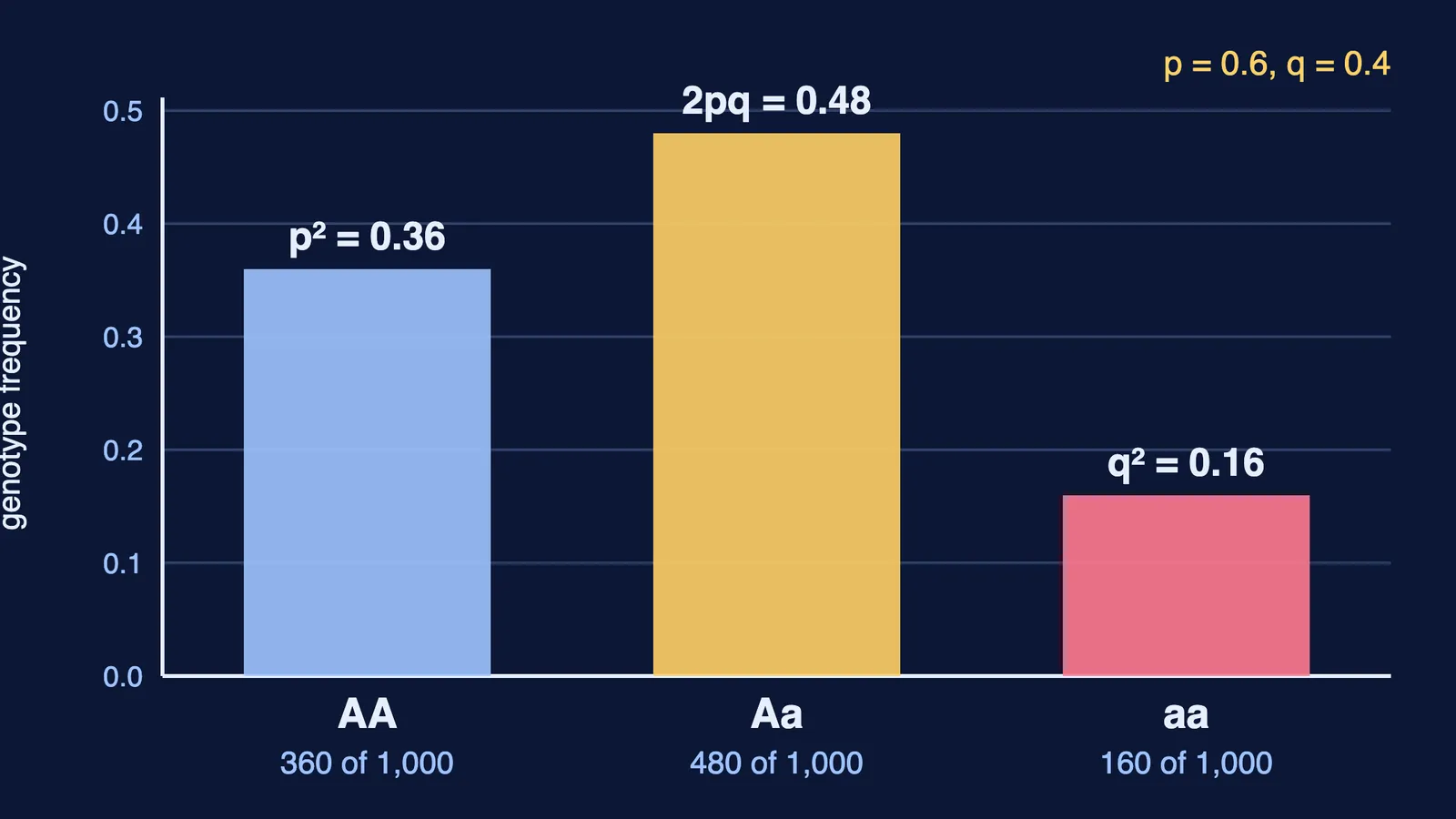
Example: a population of 1,000 has 360 AA, 480 Aa and 160 aa. Find p and q; is it in equilibrium?
Count alleles: 1,000 people carry 2,000 alleles. A = 2 × 360 + 480 = 1,200, so p = 0.6. a = 2 × 160 + 480 = 800, so q = 0.4.
Use genotype frequencies: p = 0.36 + 0.48 ÷ 2 = 0.6, and q = 0.16 + 0.24 = 0.4.
Check independently: p + q = 1. Expected numbers are p² × 1,000 = 360, 2pq × 1,000 = 480 and q² × 1,000 = 160, matching what was observed, and √0.16 = 0.4 again. The population is in equilibrium; a mismatch would signal evolutionary change.
More practice is in our Hardy-Weinberg numericals guide. The Fermi Problem Library has worked problems with a step-by-step solver that explains the reasoning rather than printing an answer.
What are the assertion-reason and case-study traps?
"Wings of butterfly and bird are homologous because they do the same job": the assertion is false; they are analogous.
"Melanic moths wiped out white moths": false; NCERT stresses that neither form disappears entirely.
The giraffe-neck MCQ in the sample paper is answered as directional selection (longer necks favoured), not stabilising or disruptive.
Haeckel's embryology idea was disproved; do not present it as current evidence.
Antibiotic and pesticide resistance is evolution by human action, over months or years.
Case studies: read the data, name the selection type, link it to leaving more progeny.
How should you revise Evolution in two weeks?
Days 1-2: read NCERT Chapter 6; list every example.
Days 3-4: draw Miller's apparatus and the three selection curves until each takes two minutes.
Days 5-6: write both comparisons from memory; check against NCERT.
Day 7: solve five Hardy-Weinberg problems, each checked two ways.
Days 8-9: human evolution sequence with brain sizes; adaptive radiation.
Days 10-11: sample paper evolution items, marked against the scheme.
Days 12-14: timed mixed practice; reread only what you got wrong.