

On this page
The Hardy-Weinberg equations can look intimidating, but they follow a strict, logical sequence. The core rule for solving any Hardy-Weinberg numerical is always the same: find the frequency of the recessive phenotype first.
Why do you always start with the recessive trait?
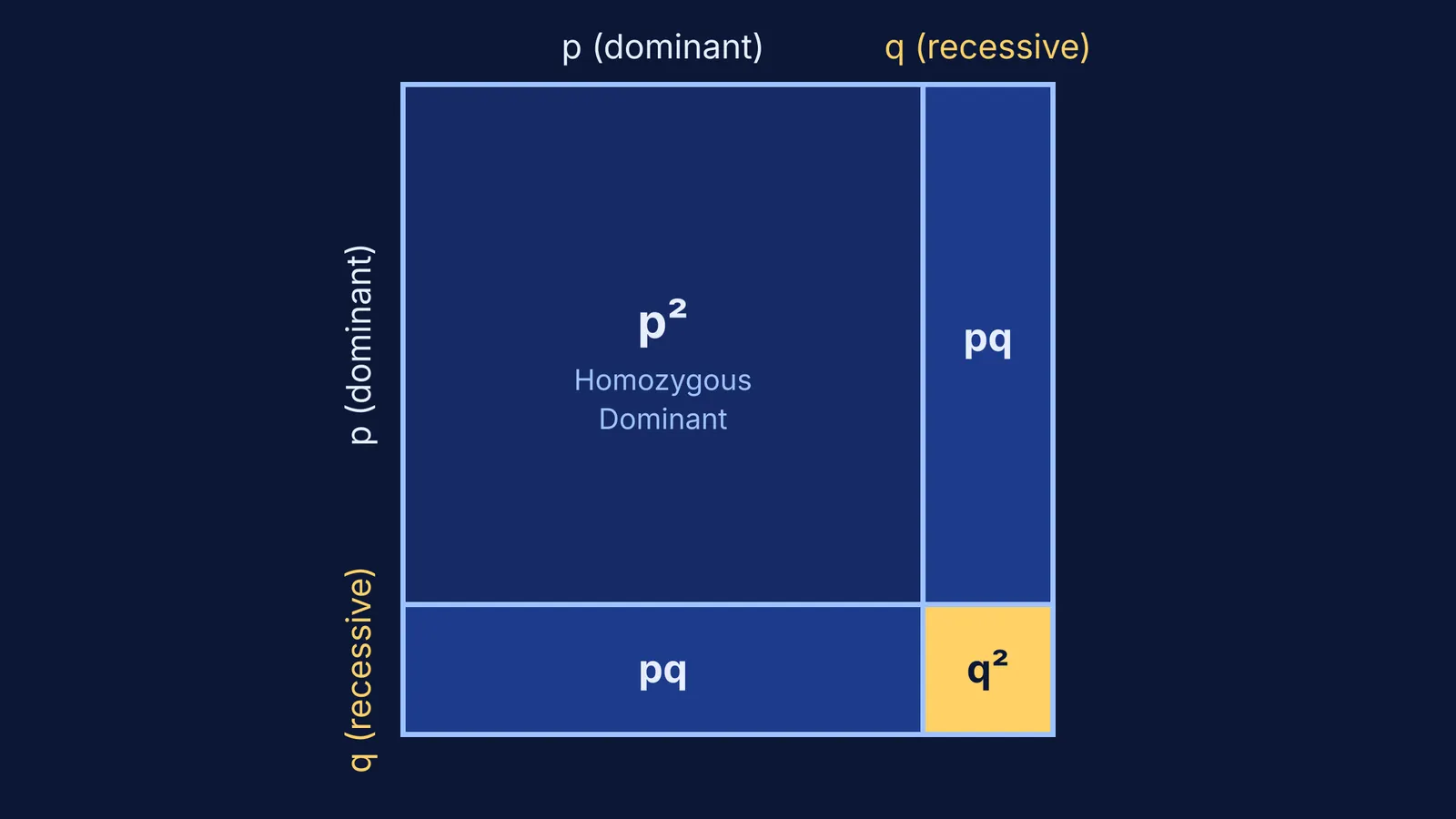
In a population, you can count the number of individuals that look a certain way (their phenotype), but you cannot see their exact genes (their genotype). If an individual shows the dominant trait, they could be homozygous dominant (p²) or heterozygous (2pq). You cannot tell them apart just by looking.
However, if an individual shows the recessive trait, you know their exact genotype: they must have two copies of the recessive allele (q²). Because the recessive phenotype frequency is the only number you can observe directly and link to a single genotype, it is the starting point for almost every Hardy-Weinberg problem.
How do you find p and q in Hardy-Weinberg?
The Hardy-Weinberg principle provides a mathematical baseline for a non-evolving population, according to OpenStax Biology. To solve these problems, you need two equations.
The allele frequency equation describes the individual gene pool: p + q = 1 Here, p is the frequency of the dominant allele, and q is the frequency of the recessive allele.
The genotype frequency equation describes the individuals in the population: p² + 2pq + q² = 1
p² is the frequency of the homozygous dominant genotype.
2pq is the frequency of the heterozygous genotype (the carriers).
q² is the frequency of the homozygous recessive genotype.
If you are stuck on the theory behind these terms, the Fermi Concept Library maps out every core idea in biology so you can trace the definitions before you tackle the maths.
Problem 1: Finding carrier frequency from disease incidence
Let's look at a real-world medical example. Cystic fibrosis is an autosomal recessive condition that occurs in about 1 in 2,500 to 3,500 newborns in the U.S. white population, according to MedlinePlus Genetics. How many people in this population are carriers?
If we use the 1 in 2,500 estimate:
Find q²: The disease incidence is the recessive phenotype frequency.
q² = 1 / 2500 = 0.0004
Find q: Take the square root of q².
q = √0.0004 = 0.02
Find p: Use the allele frequency equation.
p = 1 - 0.02 = 0.98
Find 2pq: Calculate the carrier frequency.
2pq = 2 × 0.98 × 0.02 = 0.0392
This means approximately 3.92% of this population, or about 1 in 25 people, are carriers of the cystic fibrosis allele.
You can test your understanding of how alleles spread or vanish over time using a genetic drift simulation.
Problem 2: Finding allele frequencies from a population count
Often, exams provide raw population counts instead of percentages. OpenStax Biology provides a classic example involving 500 plants where violet flowers are dominant and white flowers are recessive. If 20 plants have white flowers, calculate the frequencies of both alleles and the number of heterozygous plants.
Find q²: Divide the recessive count by the total population.
q² = 20 / 500 = 0.04
Find q: Take the square root.
q = √0.04 = 0.2
Find p: Subtract q from 1.
p = 1 - 0.2 = 0.8
Find 2pq: Calculate the heterozygous frequency.
2pq = 2 × 0.8 × 0.2 = 0.32
Find the number of heterozygous plants: Multiply by the total population.
0.32 × 500 = 160 plants.
If you struggle to set up the maths for these counts, learning how to use an AI tutor for genetics cross problems can show you how to break the question into manageable steps.
Problem 3: Working backwards from the dominant phenotype
Sometimes, a question tries to trap you by giving the frequency of the dominant phenotype. Remember, you cannot take the square root of the dominant frequency because it includes both p² and 2pq.
For example: If an exam problem states that the dominant phenotype frequency is 0.84, find p and q.
Find q²: Since the total frequency is 1, subtract the dominant frequency to find the recessive frequency.
1 - 0.84 = 0.16 (so q² = 0.16)
Find q: Take the square root.
q = √0.16 = 0.4
Find p: Subtract q from 1.
p = 1 - 0.4 = 0.6
These hidden traps are common in competitive exams. You can spot similar tricks by practising assertion-reason questions in genetics. By anchoring every problem on q², you can solve any Hardy-Weinberg numerical systematically.


