

On this page
Genetics problems are famous for looking easy while hiding the hard parts. If you are predicting inheritance for a school exam, a Punnett square feels like a comfortable, safe routine. You write the parents' alleles on the outside, drag the letters into the boxes, and count up the results.
But that routine is a trap. It teaches you an algorithm without teaching you the underlying biology. When an exam question twists the scenario—asking about linked genes, incomplete dominance, or lethal alleles—the algorithm breaks down. This is where an AI tutor changes how you study. Instead of asking it for the final answer, you can ask it to act as your opponent in setting up the cross.
Why do worked genetics examples fail?
When you read a worked example of a dihybrid cross, your brain recognises the pattern and assumes it could reproduce it under exam conditions. Learning scientists call this the illusion of competence. You mistake your ability to follow someone else's logic for the ability to generate your own.
Active problem-solving forces you to build the pattern yourself. Active learning increases average examination scores by 6% in STEM subjects (1). In the same analysis, students in traditional, lecture-based classes were 1.5 times more likely to fail than those using active learning methods (2).
Watching a teacher or a chatbot solve a pedigree diagram gives you the answer to one specific problem. Figuring out which gametes go on the axes gives you the fundamental tool to solve any problem. It shifts your focus from the final ratio to the biological process of meiosis.
How does AI help solving genetics cross problems?
Most chatbots give you a wall of text with the completed Punnett square and the final phenotypic ratio. This does the thinking for you, defeating the purpose of practice.
Fermi's AI tutor teaches rather than answers. It holds a line of reasoning across a session, noticing where you are stuck and deciding whether to explain, ask, or show. If you bring a complex problem about predicting the inheritance of Mendelian disorders, Fermi works out what you already know and builds a plan for the session.
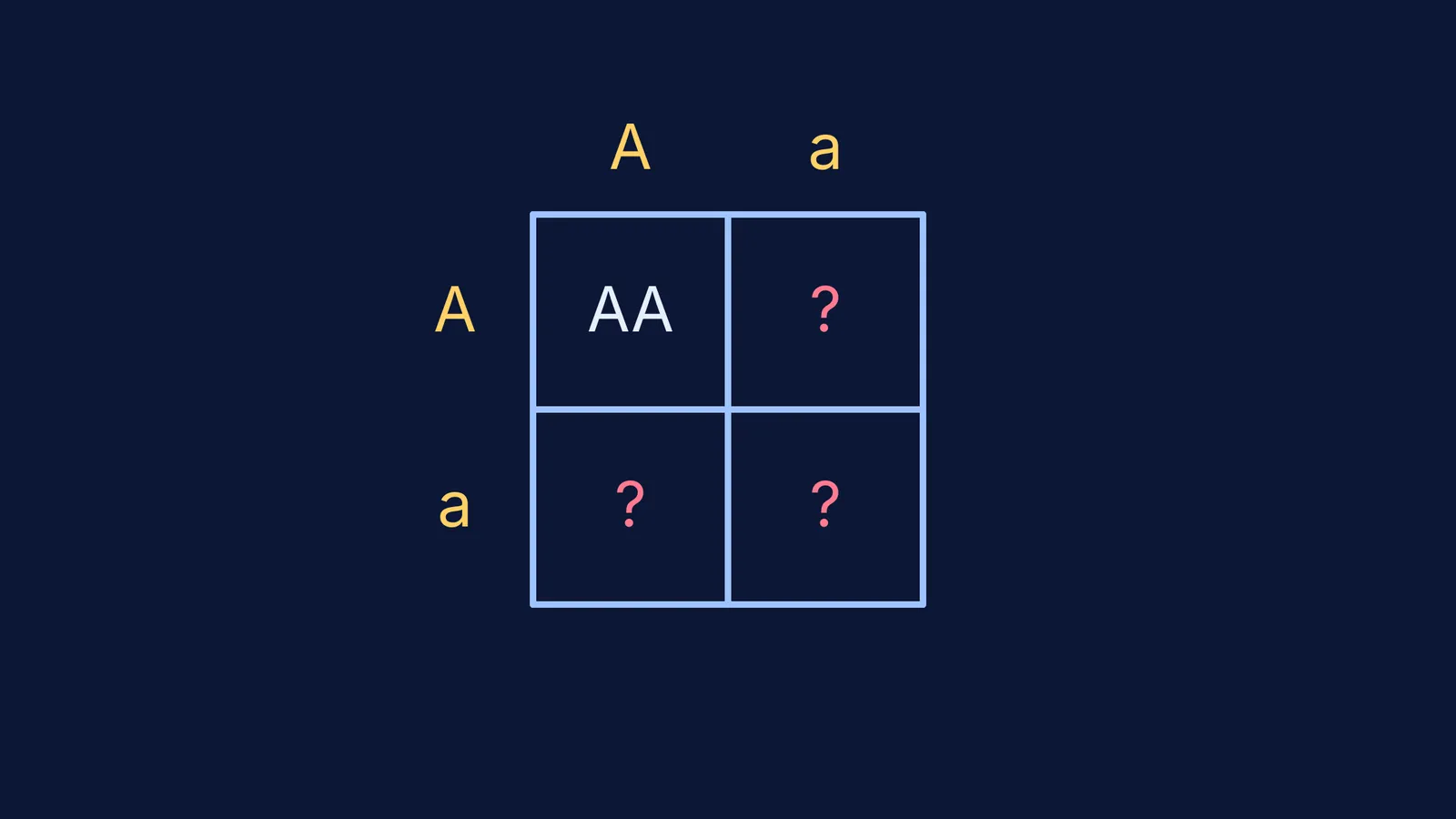
You can ask the tutor to draw the empty grid and gently guide you through filling it. This forces you to pause and remember that the letters on the outside represent the physical separation of homologous chromosomes.
What is the best prompt for an AI tutor?
To learn actively, you must give the AI a strict rule about what it should not do. Give it your genetics question, but forbid it from completing the math.
When you use the Fermi Problem Library, the step-by-step solver explains the reasoning rather than printing an answer. It might ask you: "Before we cross these plants, what are the possible gametes the heterozygous parent can produce?" You must identify the correct gametes before you are allowed to arrange them in the square. This deliberate friction prevents you from blindly copying letters.
When should you use a simulation instead?
Some genetics concepts are incredibly difficult to picture from a flat grid of letters. A Punnett square shows the probability of offspring, but it does not show the biological mechanism of independent assortment or crossing over.
If you cannot visualise why certain traits travel together or separate, step away from the word problem entirely. The Fermi Simulation Lab offers interactive simulations for the ideas that are easier to see than to read. Watching alleles physically sort into gametes makes the abstract letters on your page suddenly make sense.
Whether you are identifying an unknown genotype in a test cross or calculating the odds of a recessive trait appearing in a pedigree, the goal is never to fill boxes quickly. The goal is to deeply understand the biology behind those boxes. Let the AI draw the lines, but make sure you are the one doing the crossing.


