On this page
Ask a class why giraffes have long necks and most answers sound like this: "they stretched to reach the leaves, so their necks grew." That is Lamarck's answer, and examiners want you to reject it. Lamarck and Darwin both used the giraffe, so it is the cleanest way to compare use and disuse with variation and selection.
What did Lamarck say about the giraffe's neck?
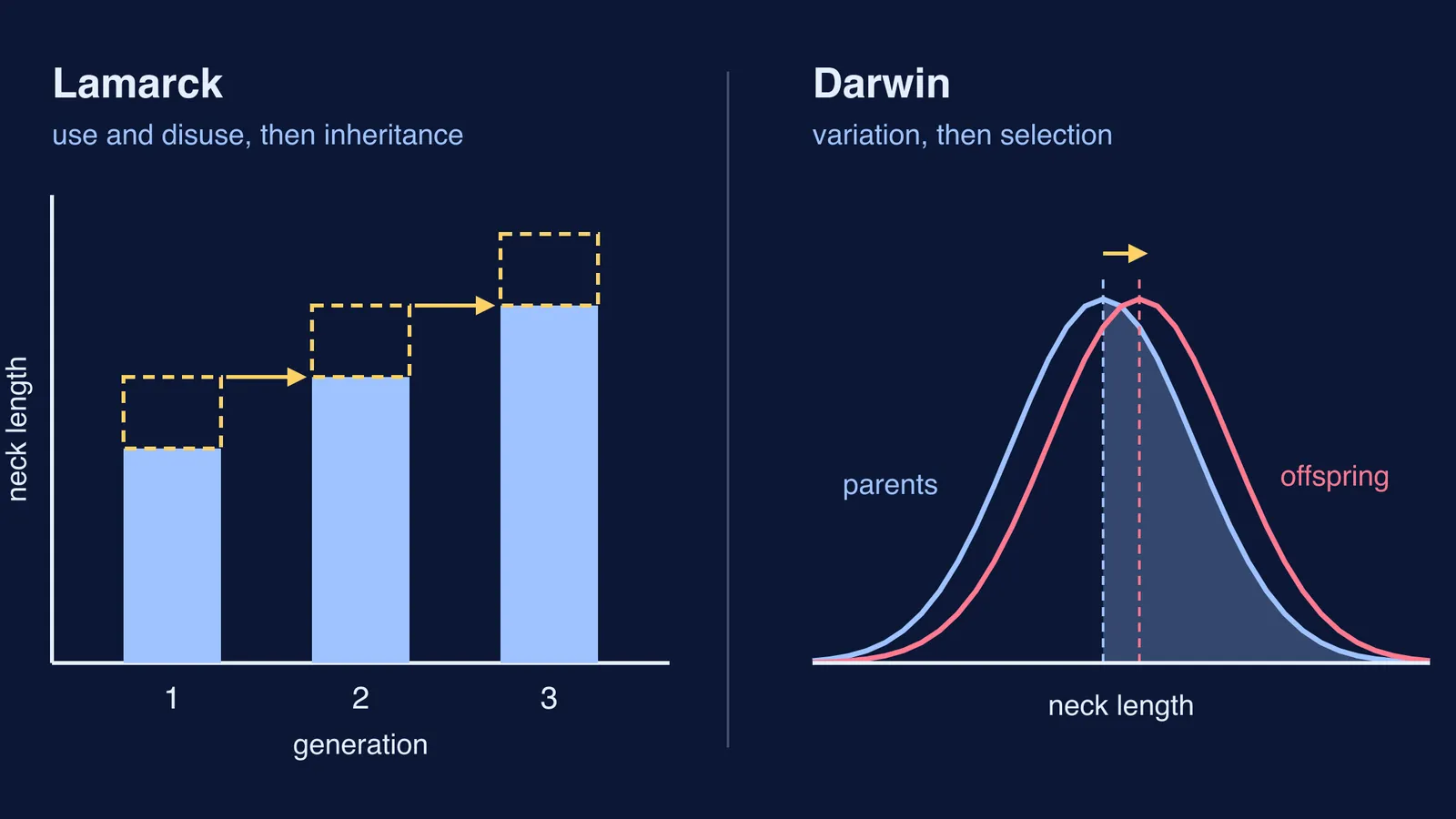
In *Zoological Philosophy* (1809), Lamarck set out two laws, here in Ian Johnston's translation of chapter 7. The first law says that frequent use of an organ "strengthens this organ, develops it, makes it larger", while constant disuse weakens it until it disappears. The second law says that whatever individuals gain or lose in this way, nature "preserves by reproduction" in their offspring.
His giraffe lives where the ground is "almost always arid and without grass", so it has to browse on trees and "constantly to try hard to reach that foliage". Kept up "for a long time in all the individuals of its race", that habit lengthened the front legs and the neck, he wrote, until the animal could lift its head to about six metres.
So in Lamarck's model the change happens inside one animal's lifetime, and the next generation starts where the parent finished.
How did Darwin explain the long neck?
Darwin starts with differences that already exist at birth. The sixth edition of *On the Origin of Species* (1872) puts it like this in chapter VII: "the individuals which were the highest browsers and were able during dearths to reach even an inch or two above the others, will often have been preserved".
In steps: neck length varies and is partly inherited; in a drought, taller animals reach food others cannot, survive and breed more; the next generation's average neck is a little longer. No single giraffe's neck has to change during its life.
Darwin did not throw out use completely, though. He also wrote that "the prolonged use of all the parts, together with inheritance, will have aided in an important manner in their co-ordination". Selection was his main cause, not his only one. For the wider picture, see our explainer on Darwin's branching descent and fitness.
Why was the inheritance of acquired traits rejected?
Nobody could show it happening, and heredity research offered a reason why. According to the Embryo Project Encyclopedia at Arizona State University, August Weismann cut off the tails of 901 mice and their offspring for five generations and described the result in an 1888 lecture: the descendants still grew normal tails.
The same entry explains Weismann's bigger idea. Only the germ-plasm in germ cells (eggs and sperm) passes from parent to offspring, so changes to body cells cannot reach the next generation; this was later called the Weismann barrier. A stretched neck is a change to muscle and bone, which are body cells. Inherited variation comes from changes in the DNA of germ cells, through mutation and recombination.
Is "long necks for high leaves" still the accepted answer?
It has some experimental support. Cameron and du Toit fenced individual *Acacia nigrescens* trees in the greater Kruger ecosystem, South Africa, in a 2007 study. After a full growing season, leaf biomass per shoot did not differ between height zones on fenced trees but did on unfenced ones, which suggests smaller browsers deplete the lower shoots. The authors called it the first experimental support for the classic idea that the giraffe's height comes from competition with other browsers.
There is a rival idea. Simmons and Scheepers argued for sexual selection in the evolution of the giraffe (1996): the idea that the neck was shaped by males fighting for mates rather than by competition for food. A 2022 study of an early Miocene relative, *Discokeryx xiezhi*, found head-neck joints suited to fierce head-butting. Both camps are Darwinian; they differ on which advantage was selected.
How do you answer Darwin vs Lamarck in an exam?
Compare them on four points:
Where the variation comes from. Lamarck: created by need and use during life. Darwin: already present at birth, and heritable.
What changes. Lamarck: each individual. Darwin: the make-up of the population.
What gets passed on. Lamarck: the acquired body change. Darwin: only inherited variation.
Why Lamarck was rejected. Body changes do not reach germ cells (Weismann).
A model three-line answer: "Lamarck: giraffes stretched their necks to reach leaves, and the longer necks were inherited. Darwin: giraffes varied in neck length; those with longer necks got more food in droughts, survived and left more offspring, so longer necks became common. Lamarck's view was rejected because acquired traits are not inherited, as Weismann's germ-plasm theory explained."
To see selection shift a population over generations, try our piece on predicting a natural selection simulation.
If the gap is further back, in variation, heredity or meiosis, the Fermi Concept Library covers every concept in biology, each with its own lesson and its place in the map, so you can trace natural selection back to the ideas it rests on.