

On this page
A natural selection simulation is easy to play with and easy to learn nothing from. The fix is to predict first: which trait will spread after you change the environment, roughly how many generations it will take, and what happens if the right mutation is not there yet.
What does a natural selection simulation actually show?
Take the free PhET Natural Selection simulation from the University of Colorado. You start with a population of bunnies. You can add mutations for fur (white or brown), ears (straight or floppy) and teeth (short or long), and set each one as dominant or recessive. You can switch the habitat between an equator setting and an arctic one, and turn on environmental factors: wolves, tough food or limited food.
Every run tests the same three ingredients:
Variation: individuals differ in a trait.
Heredity: the trait is passed to offspring.
Selection: in this environment, some versions of the trait survive and reproduce better than others.
Take away any one and the trait stops shifting in a consistent direction. Small populations also change by chance; our genetic drift simulation guide covers that.
Why must a mutation exist before selection can act?
Selection can only choose between variants that already exist. Melting snow cannot make a brown bunny appear.
The classic evidence comes from bacteria. In 1943, Salvador Luria and Max Delbrück grew many separate cultures of bacteria and then exposed them to a virus that kills them (Luria and Delbrück, Genetics, 1943). Resistant survivors varied far more between cultures than they would if the virus itself caused resistance. A 2024 teaching review explains the logic: if mutations can occur without contact with the selective agent, "then mutations will occur before plating", and the results "pointed to the occurrence of pre-plating mutations" (Zheng, Journal of Microbiology and Biology Education, 2024). It also notes a fair limit: the test cannot prove the environment never directs a mutation.
Wild animals tell the same story. The black form of the British peppered moth came from one mutation, a transposable element (a "jumping gene") inserted into a gene called cortex, dated to around 1819 (van't Hof and colleagues, Nature, 2016). Bird predation in coal-polluted woods then gave that existing variant its edge. In rock pocket mice, dark mice living on dark lava carry four mutations in the Mc1r gene in one population, while another lava population got dark through different genes (Nachman, Hoekstra and D'Agostino, PNAS, 2003).
If new mutations and reshuffled genes blur together, read mutation vs recombination.
How fast does a favoured trait spread?
Speed depends on the selection coefficient, s: how much better carriers of the favoured trait do than everyone else. Michael Majerus released 4,864 peppered moths over six years, and the analysis of his data found daily selection against dark moths of about s = 0.1 (Cook and colleagues, Biology Letters, 2012). The same paper reports a rapid fall in dark moths since 1970 and finds that bird predation on today's less sooty bark is enough to explain it, so the direction of selection flipped. Note that this s is per day, not per generation.
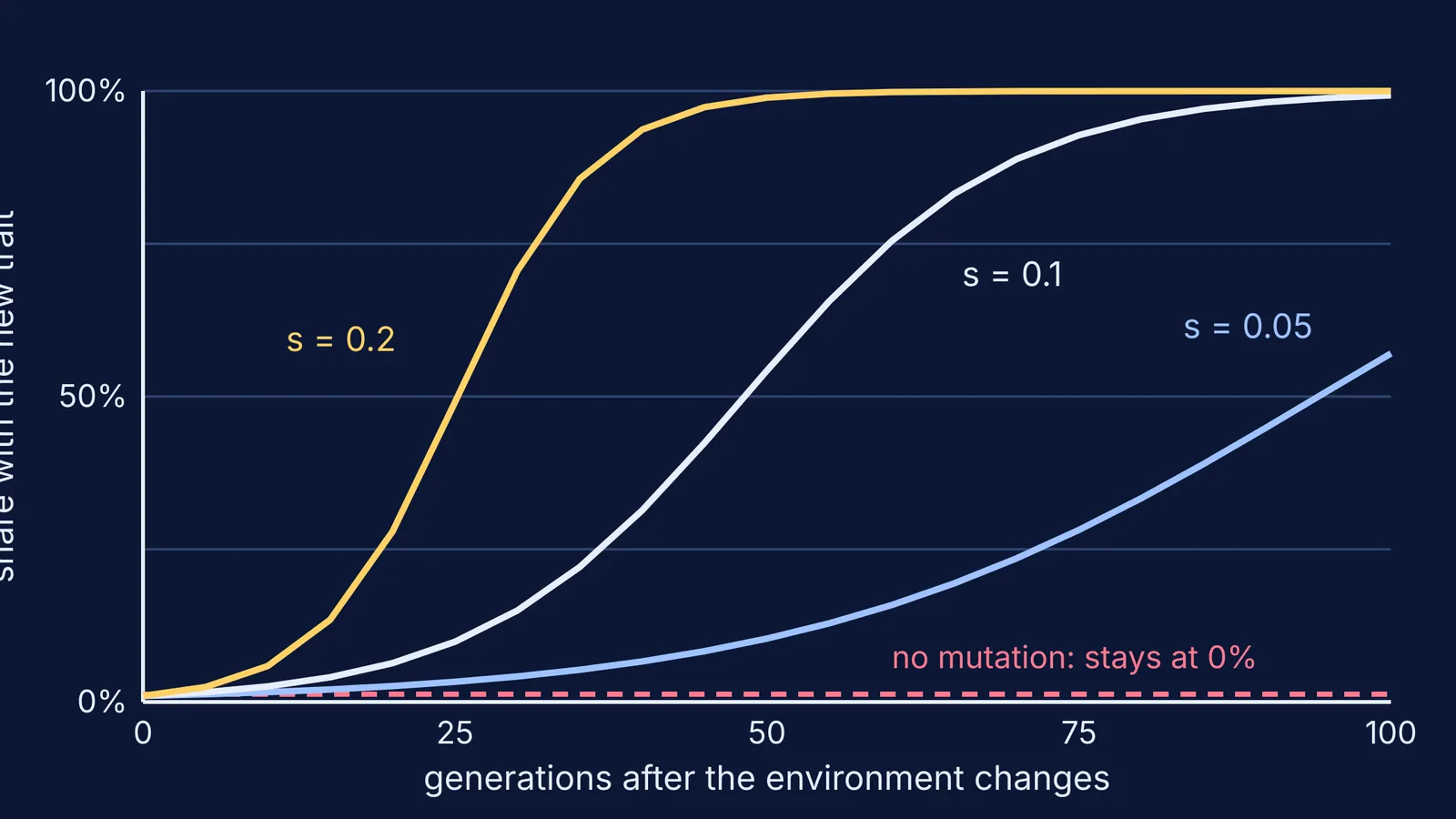
A worked example you can check by hand uses the simplest model, with s per generation: for every 1 offspring a non-carrier leaves, a carrier leaves 1 + s. Start with the new trait in 1% of the population. Our arithmetic gives:
s = 0.2: about 25 generations to reach half the population, about 37 to reach 90%.
s = 0.1: about 48 generations to half, about 71 to 90%.
s = 0.05: about 94 generations to half, about 139 to 90%.
Halving s roughly doubles the time. The curve is an S: slow while the trait is rare, fast in the middle, slow again at the top. A recessive mutation can hide in carriers that do not show it, so predict a slower start for it and then check.
Five predictions to test in the simulation
Before each run, write down the trait, the direction, roughly when it passes half, and why.
Wolves on, no fur mutation. Prediction: fur colour cannot change; there is nothing to select from.
Add brown fur, in the habitat where brown blends in. Prediction: brown rises in an S-curve.
Switch the habitat halfway. Prediction: the trend reverses, as it did for the peppered moth, as long as some white bunnies are left.
Repeat run 2 with brown set to recessive. Prediction: same direction, slower start.
Long teeth with tough food, no wolves. Prediction: long teeth spread; fur, if it varies, changes only by chance.
The same logic applies to antibiotic resistance and stopping a course early.
Where can you practise this kind of prediction?
The Fermi Simulation Lab has interactive simulations for ideas that are easier to see than to read. If evolution terms like fitness or allele frequency are still shaky, the Fermi Concept Library covers every concept in biology, each with its own lesson. Start with prediction 1 today.


