

On this page
When you fall sick with a bacterial infection, symptoms often subside well before the pathogen is completely eliminated. At that stage, many patients feel tempted to stop taking their pills. Guidance from the World Health Organization cautions that managing antimicrobial medicines requires following exact professional prescriptions rather than stopping treatment early. Yet memorising the rule does not explain the population shifts occurring inside the body.
In textbooks, natural selection is often presented as a slow, historical event. But antimicrobial resistance is natural selection occurring across days and hours. Interactive modeling lets learners observe these evolutionary dynamics directly. The Fermi Simulation Lab provides interactive simulations for the ideas that are easier to see than to read.
Why does stopping an antibiotic course early cause resistance to rebound?
A bacterial infection contains a dense population of individual cells rather than a uniform clone. As shown by Esther Lederberg and replica plating of bacteria, mutations conferring drug resistance arise spontaneously before an organism encounters an antibiotic. While the overwhelming majority are susceptible wild-type bacteria, rare single-step mutants may already possess genetic variations that increase their survival threshold.
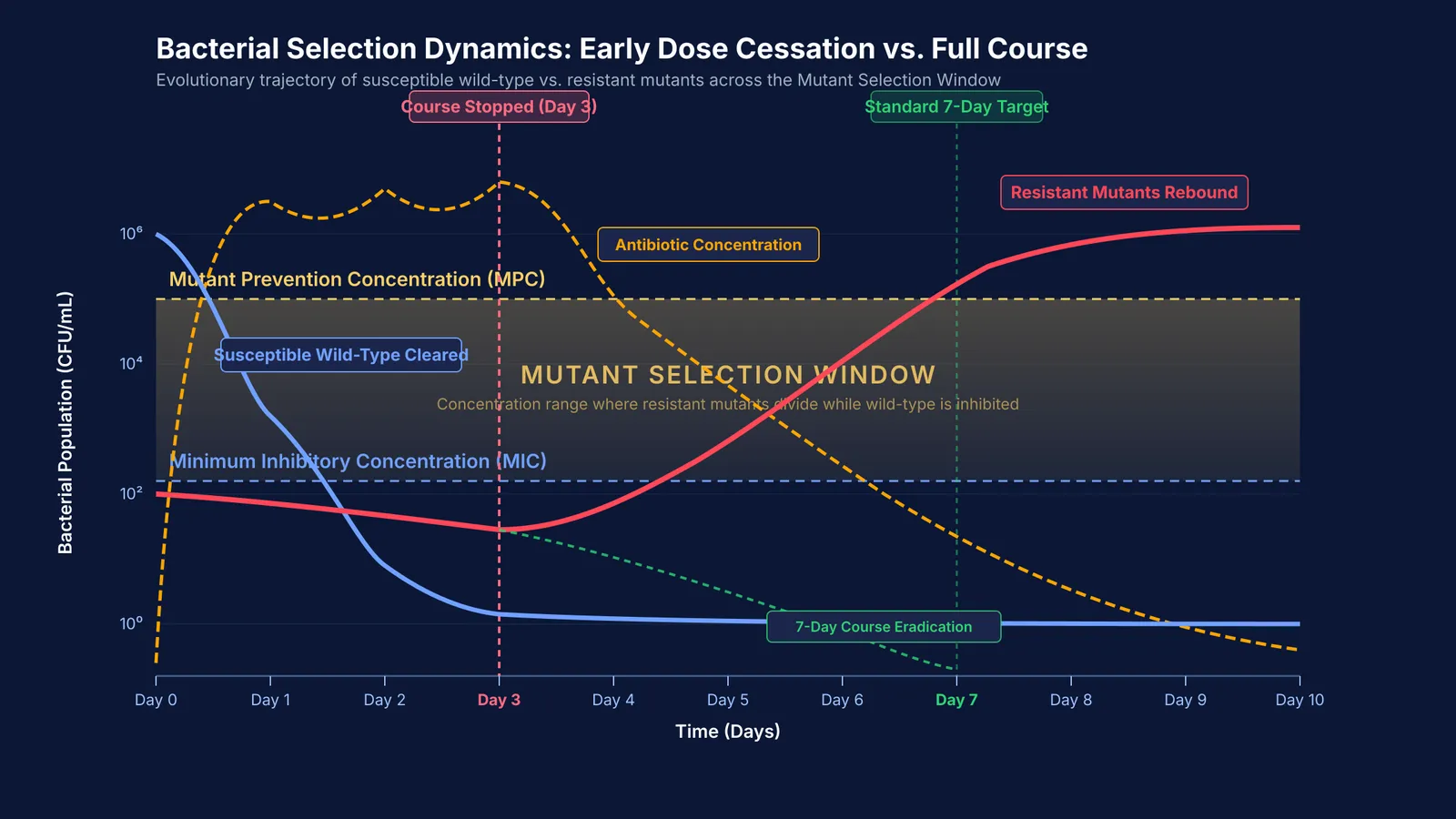
Therapeutic drug concentrations quickly eliminate the susceptible wild-type bacteria, promptly resolving clinical symptoms. If the patient stops treatment at that point, the surviving sub-population consists largely of partially resistant cells. With wild-type competitors gone, these surviving mutants experience competitive release, absorbing remaining resources and multiplying rapidly.
Michael Baym and colleagues demonstrated this process in *Science* using the giant Microbial Evolution and Growth Arena plate (DOI: 10.1126/science.aag0822). In their experiment, *Escherichia coli* adapted to survive 1,000 times the initial lethal dose in 11 days. The bacteria required intermediate concentrations as stepping stones to accumulate mutations. Stopping a course early creates that exact intermediate concentration bridge.
What is the mutant selection window between MIC and MPC?
To quantify how bacteria respond to different drug levels, researchers rely on a model developed by Dr Karl Drlica in the *Journal of Antimicrobial Chemotherapy* (DOI: 10.1093/jac/dkg269). The framework identifies two thresholds: the Minimum Inhibitory Concentration (MIC) and the Mutant Prevention Concentration (MPC).
The MIC inhibits susceptible wild-type bacteria, while the higher MPC stops the least-susceptible single-step resistant mutants. Drlica termed the concentration gap between the MIC and MPC the "Mutant Selection Window." Within this range, selective pressure peaks: wild-type cells die, while resistant mutants divide without competition.
When treatment stops prematurely, drug concentrations fall into this window and linger as the compound washes out. Conversely, prolonged exposure introduces other risks. In a 2017 analysis in the *BMJ*, Professor Martin Llewelyn and colleagues showed that unnecessarily long courses increase selective pressure on normal gut and skin flora (DOI: 10.1136/bmj.j3418). Official guidelines from the Indian Council of Medical Research therefore advocate evidence-based durations—often 5 to 7 days for common uncomplicated infections—rather than open-ended courses.
How does predicting before running a simulation change how you learn?
When students watch an educational animation passively, they often fall prey to hindsight bias. In *Probing Understanding*, educational researchers Richard White and Richard Gunstone demonstrated that learners who merely observe an outcome tend to rewrite their memories, assuming they anticipated the result all along (DOI: 10.4324/9780203761342).
White and Gunstone created the Predict-Observe-Explain (POE) cycle to challenge unexamined mental models. As noted in our discussion of simulations or static diagrams, actively committing to a prediction before altering variables forces learners to confront discrepancies between expectation and evidence. Nobel laureate Carl Wieman on moving beyond the lecture emphasized that interactive exploration builds conceptual understanding only when students actively test and adjust their thinking against experimental feedback.
How can you test antibiotic dose length in an evolution simulation?
To explore these dynamics directly, follow this five-step protocol based on the mutant selection window framework (DOI: 10.1093/jac/dkg269) in an evolutionary simulation:
Set initial populations: Initialize a population of 10⁶ wild-type cells and a sub-population of 10² cells with an elevated MIC.
Predict early-stop outcomes: Sketch the trajectory of both strains if dosing stops at Day 3. Forecast which strain will dominate by Day 10.
Simulate the Day 3 stop: Run the model and track drug decay across the Mutant Selection Window, noting when resistant cells overtake wild-type counts.
Test a 7-day course: Predict whether sustaining drug levels above the MPC for 7 days clears the resistant mutants. Run the simulation to verify clearance.
Evaluate an extended 14-day course: Simulate an extended duration to observe whether additional days offer therapeutic benefit or merely add selective pressure.
Whenever you explore biological topics where rates and concentrations shape outcomes, you can test scenarios in the Simulation Lab. Committing to a prediction before adjusting a dosing slider turns passive review into active inquiry.


