On this page
Turn an egg timer over and stand it on a sensitive balance. Some sand is always in mid-air, touching nothing. Does the balance read less? It is a good JEE-style test of one idea: a balance measures the force needed to support the whole system, and that force depends on how fast the system's momentum is changing. The answer has three parts: light for an instant at the start, heavy for an instant at the end, and almost exactly normal in between.
What does a balance actually measure?
The balance displays the normal force N it exerts on the glass. Take the glass plus all the sand as one system of mass M. From outside, only Mg and N act on it; every force between grains and glass is internal and cancels in pairs. Newton's second law for the system says:
N = Mg − (rate of change of the sand's downward momentum)
If the sand's total downward momentum is growing, the balance reads less than Mg. If it is shrinking, it reads more. If it is constant, it reads exactly Mg. This is the same bookkeeping used for the force needed to keep a conveyor belt moving as sand falls on it, applied to a closed container.
Why does sand in mid-air not make the hourglass lighter?
In steady flow, sand leaves the neck at a constant rate ṁ (kg/s) and falls a height h on to the heap. For grains that leave the neck from rest:
Fall time: t = √(2h/g).
Mass in the air at any moment: ṁt.
Landing speed: v = gt = √(2gh).
On its own, the airborne sand would make the balance read less by ṁtg. But the heap stops every grain that lands. Stopping a stream of ṁ kg per second moving at v needs a force ṁv, and the heap passes it down through the glass. Compare the two:
ṁv = ṁ(gt) = (ṁt)g
The impact force is exactly the weight of the sand in the air, so they cancel. In momentum terms, the falling stream looks the same from one moment to the next, so its momentum is constant and N = Mg.
A falling chain is different: no link is held up, every link is in free fall until it lands, which is why a falling chain presses on a table with three times the weight of the part already lying there. In the hourglass, the neck holds the sand back and releases it at a steady rate, as explained in how an hourglass keeps steady time.
What happens when the sand starts and stops?
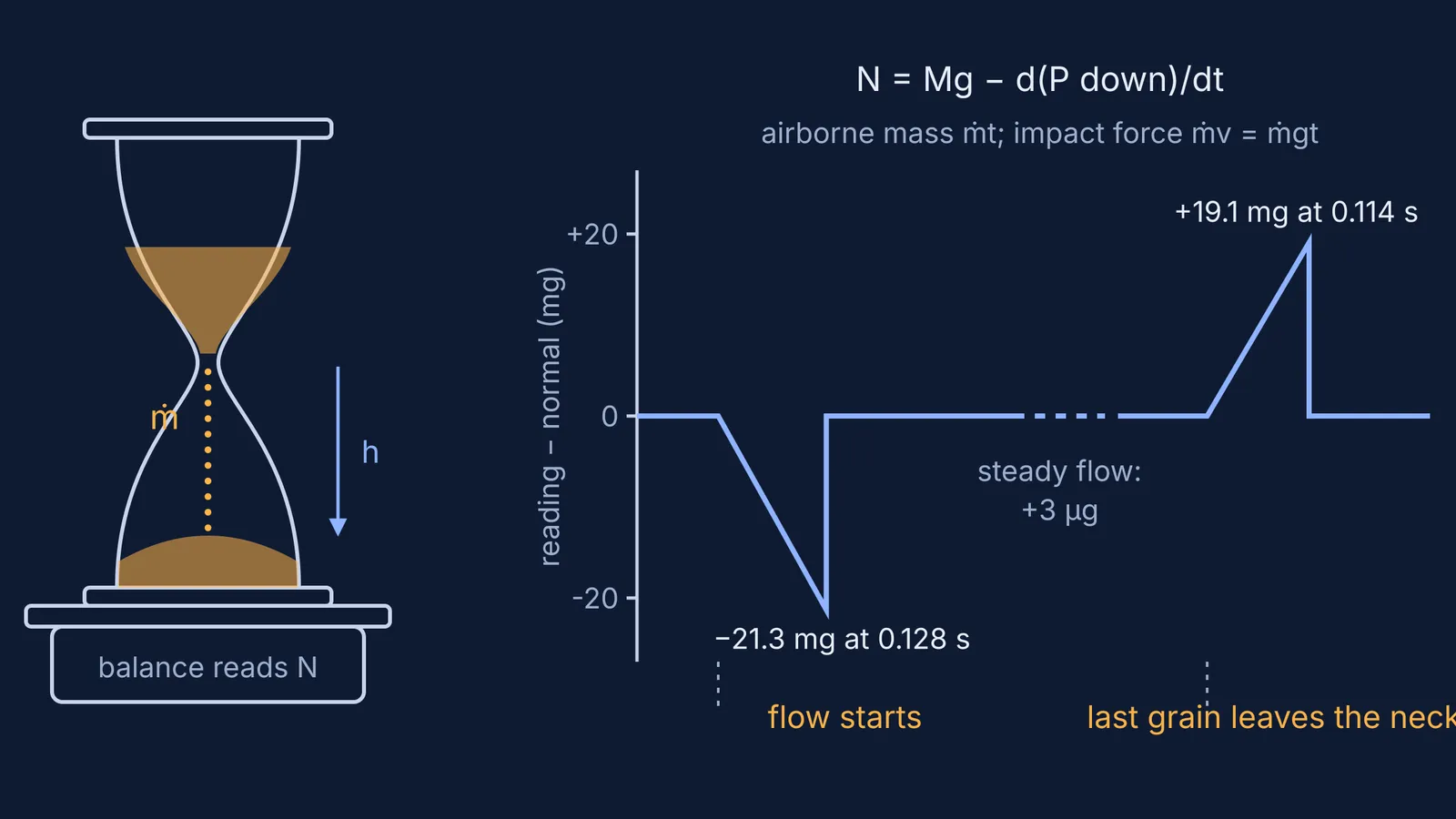
Flow starts. Sand leaves the neck but none has landed. The airborne mass grows, so the reading falls below normal. After one fall time the first grains land, the full impact force ṁv switches on, and the reading jumps back to normal.
Flow stops. The last grain leaves the neck. For one more fall time sand still lands at full rate and speed, so the impact force stays at ṁv, but the airborne mass shrinks to zero. The reading rises above normal, peaks just before the last grain lands, then drops back.
Worked example: how much does an egg timer's reading change?
Take an illustrative 3-minute egg timer with round numbers, not measured values: 30 g of sand, a fall of 8.0 cm from the neck to the floor of the empty lower bulb, bulbs that behave like cylinders 4.0 cm across, sand bulk density 1,500 kg/m³ and g = 9.8 m/s².
Flow rate. ṁ = 0.030 kg ÷ 180 s = 1.67 × 10⁻⁴ kg/s.
Fall time at the start. t = √(2 × 0.080 ÷ 9.8) = 0.128 s.
Airborne mass. ṁt = 1.67 × 10⁻⁴ × 0.128 = 2.13 × 10⁻⁵ kg = 21.3 mg. In the first 0.128 s the reading slides to 21.3 mg below normal, then snaps back.
Check the cancellation. v = √(2 × 9.8 × 0.080) = 1.25 m/s, so ṁv = 2.09 × 10⁻⁴ N, which is the weight of 21.3 mg. Units: (kg/s) × (m/s) = kg m/s² = N.
Fall at the end. The sand fills 0.030 ÷ 1,500 = 20 cm³. The bulb's cross-section is π × (2.0 cm)² = 12.6 cm², so the sand layer is 1.59 cm deep and the last fall is 8.0 − 1.59 = 6.41 cm.
Peak at the end. t = √(2 × 0.0641 ÷ 9.8) = 0.114 s, so the airborne mass is 1.67 × 10⁻⁴ × 0.114 = 19.1 mg. The reading climbs to 19.1 mg above normal over the last 0.114 s.
A kitchen scale cannot see this. A 0.1 mg laboratory balance could in principle, but a balance that averages over a second or more smooths out blips lasting a tenth of a second.
If you are preparing for JEE Main & Advanced and want more questions where the hard part is choosing the system, Fermi Test Prep offers personalised preparation with an AI tutor, live classes, adaptive mocks, mentorship and a study plan that updates based on mastery.
Is a running hourglass really slightly heavier?
Yes, by a tiny amount. K. Y. Shen and B. L. Scott showed this in "The hourglass problem" (American Journal of Physics, 1985): the sand's centre of mass moves down during the run but ever more slowly, so it has a small upward acceleration and the running glass weighs more than a still one. Becker and Pöschel (Granular Matter, 2008) summarise that result, note that how the excess changes with time depends on the glass's shape, and show how to build an hourglass whose weight stays constant.
In the cylinder model the extra comes from two places:
Top bulb. The sand surface sinks at a steady speed u = ṁ/(ρA). The moving sand's downward momentum is its mass times u, and that mass is shrinking, so the momentum falls at the rate ṁu.
Falling stream. Its momentum is ṁh: a slice of mass ṁ dt moving at v carries ṁ v dt, and v dt added over the whole fall is h. The heap rises at u, so h shrinks and this momentum falls at the rate ṁu.
Both reduce the downward momentum, so the reading is higher by ṁ²/ρ × (1/A top + 1/A bottom). For the egg timer, u = 1.67 × 10⁻⁴ ÷ (1,500 × 1.26 × 10⁻³) = 8.8 × 10⁻⁵ m/s and the extra force is 2 × (1.67 × 10⁻⁴)² ÷ (1,500 × 1.26 × 10⁻³) = 2.9 × 10⁻⁸ N, the weight of about 3 micrograms. Real bulbs taper, so this changes during the run, but it stays tiny.
What mistakes cost marks on this problem?
Saying the hourglass is lighter by the weight of the airborne sand and forgetting the impact force.
Assuming the start and end effects are equal. The end fall is shorter because the heap has risen.
Quick checklist
Balance reading: N = Mg − rate of change of the sand's downward momentum.
Airborne mass ṁt, impact force ṁv = ṁgt: equal, so steady flow reads normal.
Flow starts: light by up to ṁtg for one fall time.
Flow stops: heavy by up to ṁtg for one shorter fall time.
Sinking and rising sand surfaces add only micrograms: ṁ²/ρ × (1/A top + 1/A bottom).