On this page
An hourglass and a pendulum clock both cut time into equal slices, in opposite ways. The hourglass relies on a flow that stays nearly steady. The clock stores energy and lets it out in small, counted bursts.
Why does sand in an hourglass flow at a steady rate?
Water leaving a vessel slows as the level falls. Dry grains do not: their flow rate through an opening "does not depend on the height of the granular layer", as Mankoc and colleagues write in their study of granular flow.
The idea goes back to Hagen's 1852 paper on dry sand (English translation in Granular Matter). Hagen found that the pressure in a column of sand stops rising with depth, because the walls take up much of the weight. The neck, not the pile above it, sets the pace.
The Beverloo law gives that pace: mass flow W = Cρ√g (D − kd)^(5/2), where ρ is the bulk density of the sand, D the neck width, d the grain size, and C and k fitted constants (Mankoc et al., who also show it needs adjusting for very small openings). So doubling a wide neck multiplies the flow by 2^2.5, about 5.7 times: a one-hour glass would empty in roughly 10.6 minutes.
Real hourglasses are not perfect. Koivisto and Durian reported in Nature Communications that grains leaving a hopper surge near the end, which they trace to the flow pumping the surrounding fluid through the packing; they saw it under water and in air. Pongó and colleagues showed that soft, low-friction grains slow down as the fill drops.
How does a verge escapement work?
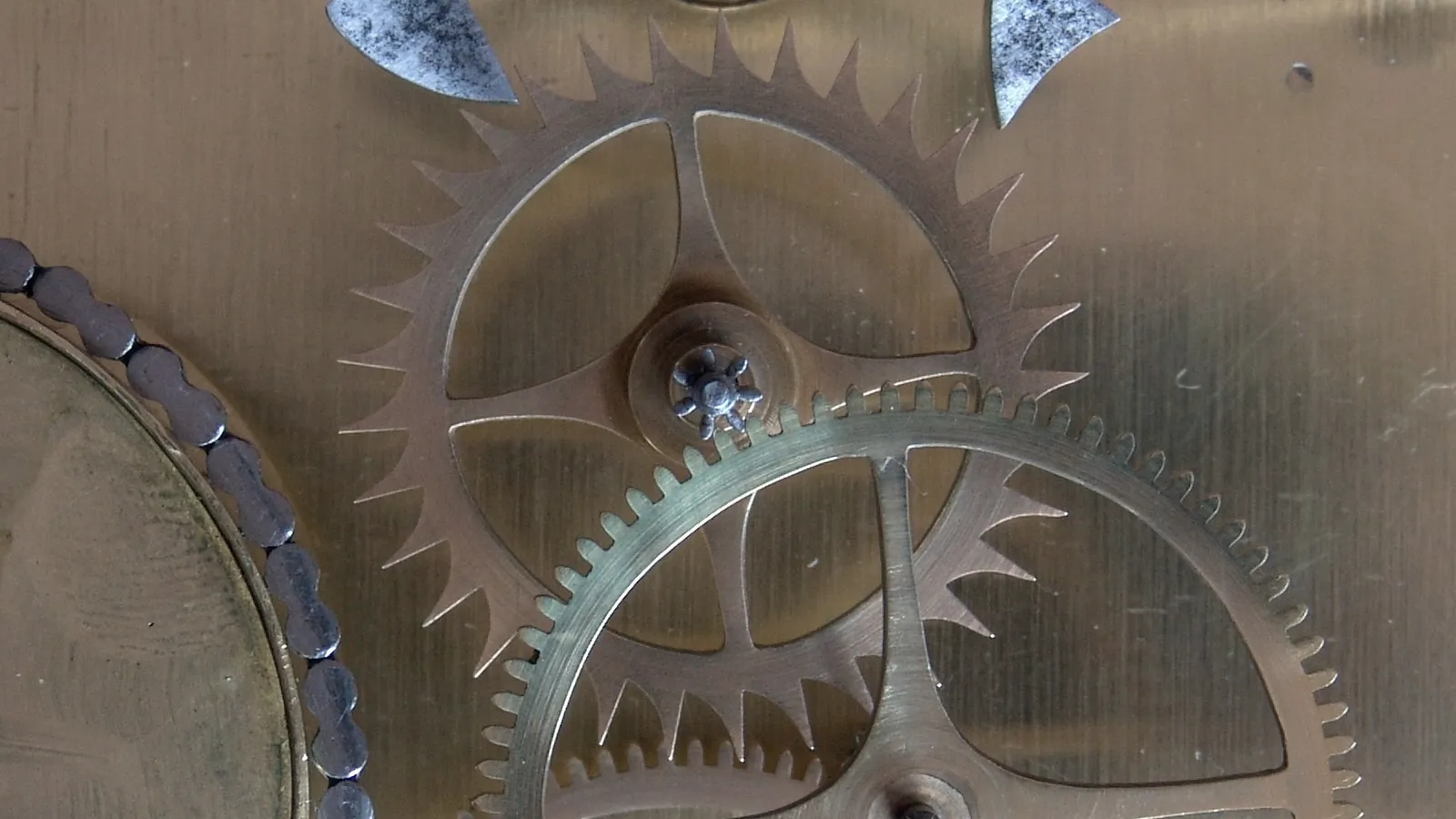
A mechanical clock needs an energy store (a falling weight or wound spring), a gear train, and an escapement that releases the energy in equal steps. Weight-driven tower clocks with a verge-and-foliot escapement appeared in Italian cities in the first half of the 14th century, according to NIST's history of timekeeping. The University of Bristol's guide to early turret clocks describes the parts:
The weight, through a train of gears, turns the crown wheel.
A vertical rod, the verge, carries two pallets set 90 degrees apart, which meet the wheel at two points across its diameter.
On the verge sits the foliot, a bar with a weight at each end.
A tooth pushes one pallet and swings the foliot one way. Then a tooth on the far side meets the other pallet, which slows the foliot, stops it and drives it back.
The weakness: the foliot has no rhythm of its own. NIST notes its period depended heavily on the driving force and on friction, and a verge dynamics analysis by Hoyng and Nieuwenhuizen finds the period gets shorter as the driving torque grows.
How does an anchor escapement work?
The fix was a regulator with its own natural period. In 1656 Christiaan Huygens made the first pendulum clock, with an error of less than 1 minute a day, later cut to under 10 seconds a day (NIST).
Early pendulum clocks kept the verge and its wide swings. The anchor escapement, developed in the 1660s and 1670s (University of Bristol), cut the swing from around 100 degrees to 4 to 6 degrees (Wikipedia, citing a 2002 IEEE Control Systems paper).
An anchor-shaped piece rocks with the pendulum, and its two pallets take turns catching and releasing a tooth of the escape wheel. Each release gives the pendulum a small push; each catch is the tick. Small swings matter because a pendulum keeps nearly constant time only for small arcs, as in Galileo's pendulum and isochronism.
How long should a clock's pendulum be?
Huygens's best clocks drifted under 10 seconds a day (NIST). Here is how little it takes to do worse. For small swings, T = 2π√(L/g). In a seconds pendulum each tick takes 1 s, so T = 2 s.
Rearrange: L = gT²/(4π²) = g/π² for T = 2 s.
With g = 9.81 m/s², L is about 0.994 m.
Since T depends on √L, ΔT/T = ½ ΔL/L.
A pendulum 1 mm too long gives ΔT/T = 0.5 × 1/994, about 0.050%.
Over 86,400 s in a day, the clock loses about 43 seconds.
With a 30-tooth escape wheel passing one tooth per 2 s period, the wheel turns once a minute and can carry a seconds hand, a common design in longcase clocks.
To see the √L relation rather than read it, the Fermi Simulation Lab has interactive simulations, and the Fermi Problem Library has a step-by-step solver that explains the reasoning.
For a timekeeper with no moving parts, see how India's Konark wheel tells time with a shadow; later, Harrison took precise clockwork to sea.