

On this page
NCERT's Class 11 physics textbook opens its simple pendulum section with a story: "It is said that Galileo measured the periods of a swinging chandelier in a church by his pulse beats" (NCERT Physics Part 2, Chapter 13). The Museo Galileo in Florence places that lamp in Pisa Cathedral in 1583 and traces the story to Galileo's biographer Vincenzo Viviani, so read it as tradition. What Galileo wrote down later leads to the formula you use in exams.
What did Galileo notice about a pendulum's swing?
Galileo's claim has a name: isochronism, the idea that a pendulum of a given length takes the same time for every swing, whatever the size of the swing. The Museo Galileo timeline records that he first stated it in a letter to Guidobaldo del Monte in November 1602: pendulums of equal length swing in equal times "regardless of their amplitude and the size of the swinging mass".
He described the test in Two New Sciences, printed in Leiden in 1638. In the 1914 English translation by Henry Crew and Alfonso de Salvio, his speaker Salviati hangs a lead ball and a cork ball, "the former more than a hundred times heavier than the latter", on equal threads "four or five cubits long". Air slows the cork's swing more, "but without altering the frequency of either". Then the bold claim: "Each vibration, whether of ninety, fifty, twenty, ten, or four degrees occupies the same time."
The same book gives the length rule too: "if one wishes to make the vibration-time of one pendulum twice that of another, he must make its suspension four times as long."
Is the period really the same for big and small swings?
Not exactly. The Museo Galileo notes that Christiaan Huygens showed in 1659 that only a pendulum swinging along a cycloid is truly isochronous. An ordinary bob on a string swings along a circle.
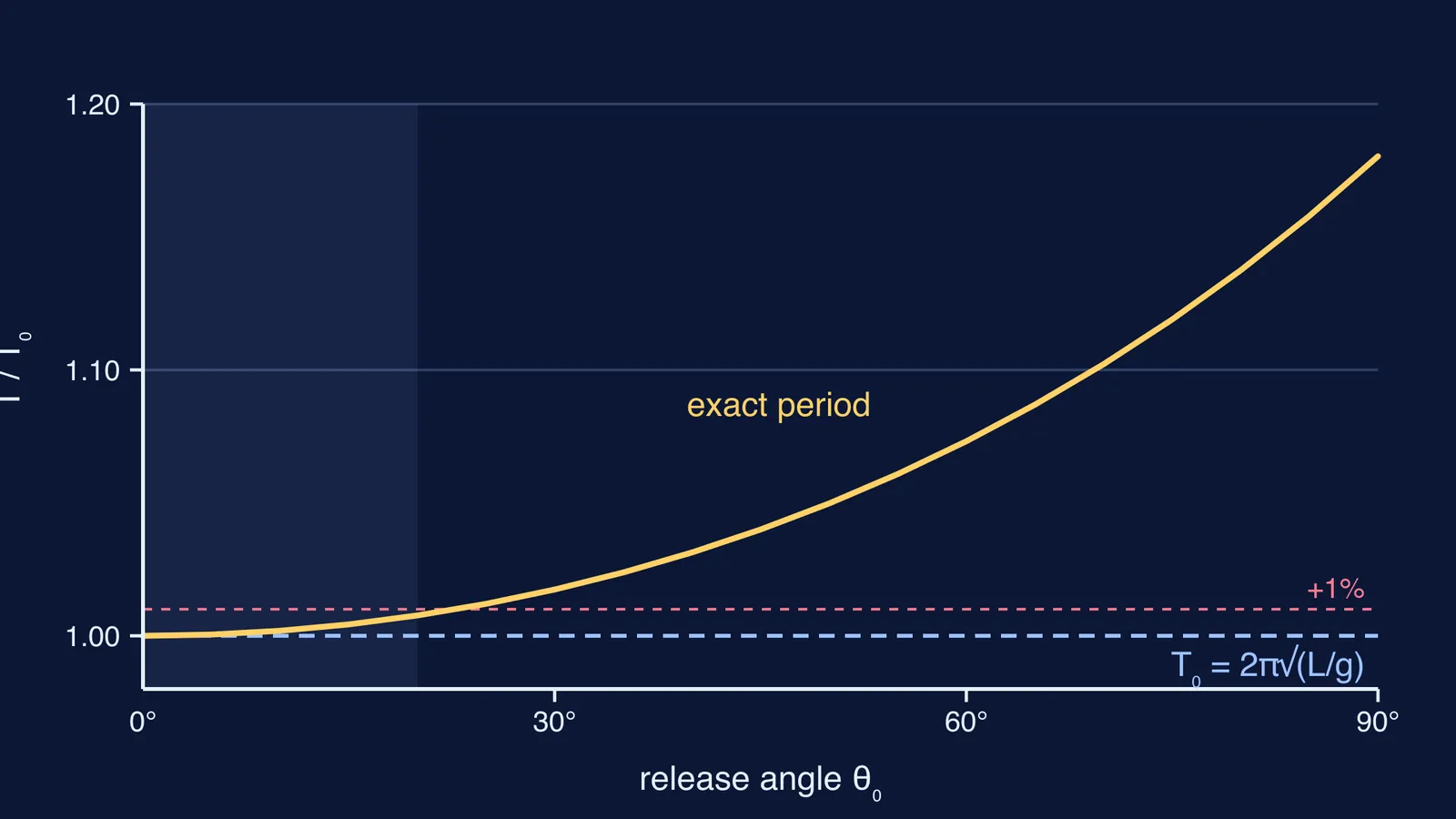
For a circular swing, the exact period is T = T₀(1 + θ₀²/16 + 11θ₀⁴/3072 + ...), where T₀ = 2π√(L/g) and θ₀ is the release angle in radians (Pendulum (mechanics)). The θ₀²/16 term is tiny for small angles, which is why Galileo's observation works so well. HyperPhysics puts it plainly: the error in the simple formula is less than one percent for amplitudes below 22 degrees. Our numbers from the exact formula:
10 degrees each side: about 0.2% longer than a tiny swing
30 degrees: about 1.7% longer
45 degrees: about 4.0% longer
90 degrees: about 18% longer
Galileo's degrees seem to be whole arcs (he says a 50-degree pull traces an arc of nearly 100 degrees), so his "ninety" means about 45 degrees each side, roughly 4% longer than a tiny swing.
How does this give T = 2π√(L/g) in Class 11?
Section 13.8 of NCERT Chapter 13 follows four steps:
The part of gravity along the arc, mg sin θ, gives a restoring torque τ = −L(mg sin θ) about the support.
With τ = Iα and I = mL² for a bob on a massless string, α = −(g/L) sin θ.
For small θ in radians, sin θ ≈ θ. NCERT's Table 13.1 shows that at 20 degrees, θ = 0.349 rad and sin θ = 0.342.
Now α = −(g/L)θ, which is simple harmonic motion, so T = 2π√(L/g).
Step 3 is Galileo's observation in algebra: once the restoring effect is proportional to displacement, the amplitude drops out of the period. The mass cancels too, which is the lead-and-cork result. And T ∝ √L is his "four times as long" rule.
To see the small-angle step fail, try our simulation test of pendulum period against amplitude. The Fermi Simulation Lab has interactive simulations for ideas like this, which are easier to see than to read.
Does swing size matter for a 1 m pendulum?
Take L = 1 m and g = 9.8 m/s², the values in NCERT's seconds-pendulum example (Example 13.8 in the same chapter), and the exact-period series.
Small-swing period: T₀ = 2π√(1/9.8) ≈ 2.007 s.
Released at 10 degrees: T ≈ 2.007 × 1.0019 ≈ 2.011 s, about 0.004 s longer per oscillation.
Released at 30 degrees: T ≈ 2.007 × 1.0174 ≈ 2.042 s. Over 50 oscillations that adds up to about 1.7 s.
So keep the amplitude small. If you are measuring g with the L–T² graph method, a big release angle makes every T slightly too long, and your g comes out slightly too small.
What should you remember for exams?
Use T = 2π√(L/g) only for small swings; NCERT's table checks the approximation up to 20 degrees.
The period does not depend on the mass of the bob.
Four times the length gives twice the period.
A larger amplitude makes the period longer, never shorter.
For how Huygens built this into a clock, read Christiaan Huygens: the pendulum clock and his wave theory of light. And if pendulum numericals keep going wrong at the method stage, the Fermi Problem Library has worked problems with a step-by-step solver that explains the reasoning rather than printing an answer.


