On this page
Two of the most-used ideas in Class 11 and 12 physics trace back to one Dutch scientist: the time period of a pendulum, and the wavefront construction you use to derive Snell's law. Christiaan Huygens worked on both, and for the same reason. He wanted to measure and explain things exactly. This post covers what he did, corrects a date confusion in many notes, and works one problem from each idea.
Who was Christiaan Huygens?
According to the MacTutor biography of Huygens from the University of St Andrews, he was born in The Hague on 14 April 1629 and died there on 8 July 1695. He studied law and mathematics at Leiden. Using lenses he ground himself, he found Saturn's first moon in 1655 and then worked out the true shape of Saturn's rings. He was elected to the Royal Society of London in 1663 and joined the new Académie Royale des Sciences in Paris in 1666.
How did Huygens make the first pendulum clock?
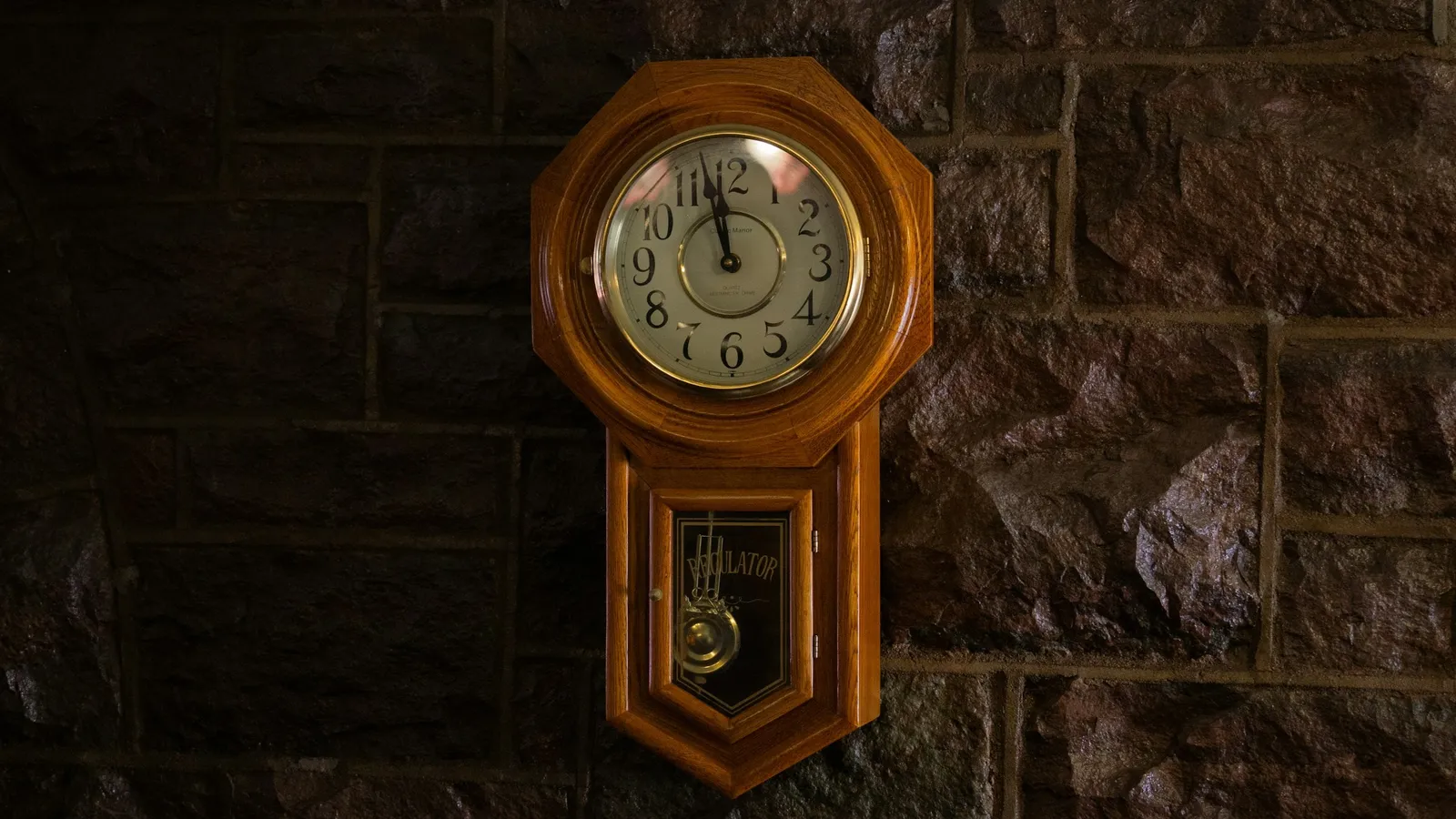
Astronomy needed accurate time. Galileo had noticed that a pendulum's swings take about the same time, but, as the Linda Hall Library notes, he did not work out how to couple a pendulum to a clock mechanism. Huygens did. He dated his invention to 25 December 1656, applied for a patent on 14 June 1657 and received it two days later. He described the mechanism in *Horologium* in 1658.
He then went deeper. MacTutor explains that a simple pendulum keeps perfect time only for small swings, so Huygens designed a cycloidal pendulum, whose period does not depend on the size of the swing. In *Horologium Oscillatorium* (1673) he proved that the cycloid has this property, solved the compound pendulum, and derived the law of centrifugal force for uniform circular motion. He hoped such clocks would solve the problem of finding longitude at sea, and his clocks had sea trials in 1662 and 1686.
Worked example: the seconds pendulum
For small swings, a simple pendulum has period T = 2π√(L/g). The JEE (Main) 2026 syllabus asks you to derive this expression.
Question. A seconds pendulum ticks once per second, so its full period is 2 s. Find its length where g = 9.81 m/s².
Rearrange: L = gT² / (4π²).
L = 9.81 × 4 ÷ (4 × 9.8696) = 9.81 ÷ 9.8696 ≈ 0.994 m.
So a pendulum just under a metre long beats seconds. Two common mistakes: taking T = 1 s (a "tick" is half a period) and using the formula for large swings, where the period grows with amplitude. That second point is exactly the problem Huygens' cycloid solved. For more on oscillations, read our post on simple harmonic motion problems.
When did Huygens propose the wave theory of light?
You will see two dates, and both are right. NCERT's Class 12 wave optics chapter says that in 1678 Huygens put forward the wave theory of light. The preface to his Treatise on Light, in Silvanus Thompson's translation, explains: he wrote it in France and communicated it in 1678 to the Royal Academy of Science, then published it with a preface dated The Hague, 8 January 1690.
What is Huygens' principle?
In the Treatise, Huygens argues that each small region of a luminous body sends out its own waves, and that each particle the light reaches passes the motion on, so that "around each particle there is made a wave of which that particle is the centre". The new wavefront is the surface that touches all these small waves.
He used this to explain reflection and refraction. Among the chapter headings of the Treatise are "That Light spreads more slowly in water and in glass than in air" and "Demonstration why Refraction obeys the known proportion of Sines". If light is slower in glass, the part of a wavefront that enters first falls behind, and the wavefront turns towards the normal. NCERT's chapter notes that this contradicts the prediction of the corpuscular model, and that Foucault showed in 1850 that light is indeed slower in water than in air.
Worked example: refraction from wavefronts
The Huygens construction gives sin i / sin r = v₁ / v₂ = n, the refractive index of the second medium relative to the first.
Question. Light in air strikes glass of refractive index 1.5 at 30°. Find the angle of refraction and the speed of light in the glass. Take c = 3.0 × 10⁸ m/s.
sin r = sin 30° ÷ 1.5 = 0.5 ÷ 1.5 ≈ 0.333.
r ≈ 19.5°.
v = c ÷ n = 3.0 × 10⁸ ÷ 1.5 = 2.0 × 10⁸ m/s.
The ray bends towards the normal because the light slows down, exactly as Huygens argued. A frequent error is to write sin i / sin r = v₂/v₁, the wrong way round. Check with common sense: slower medium, smaller angle. Both JEE (Main) and the NEET (UG) 2026 syllabus list the laws of reflection and refraction using Huygens' principle. Our post on Young's double slit problems takes the wave model further.
What can a student take from Huygens' way of working?
In the preface to the Treatise, Huygens explains how he argues. In geometry, propositions are proved from fixed principles. In this subject, he says, the principles are checked by the conclusions drawn from them, and "it is always possible to attain thereby to a degree of probability which very often is scarcely less than complete proof" when the conclusions match what experiments show.
Test an idea by what it predicts. A model is worth keeping when its consequences match observation, as his construction matched the law of sines.
Fix the weak point, not just the main idea. The simple pendulum was good enough for most clocks. Huygens went after the small-swing assumption anyway.
Draw the construction. Huygens' principle is a drawing. Sketch the wavelets before you write the equation.
Wavefronts bending at a boundary are easier to grasp in motion. The Fermi Simulation Lab has interactive simulations for ideas easier to see than read.
Try it now: find the angle of refraction for the same glass when light enters at 45°.