

On this page
If you learned T = 2π√(L/g) in Class 11, you also got the fine print: it holds for small swings. That fine print is worth testing yourself, because it is one of the few approximations in school physics you can watch fail on a screen in ten minutes.
Does a pendulum's period depend on amplitude?
Yes, but only a little until the swing gets wide. The textbook formula comes from replacing sin θ with θ in the equation of motion, which turns the swing into simple harmonic motion with no amplitude in its period (HyperPhysics, Georgia State University).
The exact period of a simple pendulum released from rest at angle θ₀ is T = (2T₀/π)K(k), where k = sin(θ₀/2) and K is the complete elliptic integral of the first kind (Pendulum (mechanics), Wikipedia). Written as a series, the same page gives T = T₀(1 + θ₀²/16 + 11θ₀⁴/3072 + ...), with θ₀ in radians.
HyperPhysics states that the error of the simple formula is less than 1% for amplitudes under 22 degrees (HyperPhysics). Putting 15 degrees into the series above gives an error of about 0.43%, which is why 15 degrees makes a comfortable working limit.
Why does the small-angle rule break down?
The pull back towards the centre is mg sin θ, not mg θ; the simple formula only works because sin θ ≈ θ for small angles (HyperPhysics). At 10 degrees, sin θ is 0.1736 and θ is 0.1745 radians, a gap of about 0.5%. At 90 degrees, sin θ is 1 while θ is 1.571, so the real restoring force is about 36% weaker than the approximation assumes. A weaker pull means a slower return, so a wide swing takes longer.
If you want to see where sin θ ≈ θ comes from, our guide to small-angle and binomial approximations for JEE physics works through it.
What should you predict at 10, 30, 60 and 90 degrees?
Write your guesses down before you open any simulation. Then compare them with ours, for a 1.00 m pendulum with g = 9.81 m/s², so T₀ = 2.006 s. We computed each value from the exact elliptic-integral formula on Wikipedia's pendulum page and checked it against the series.
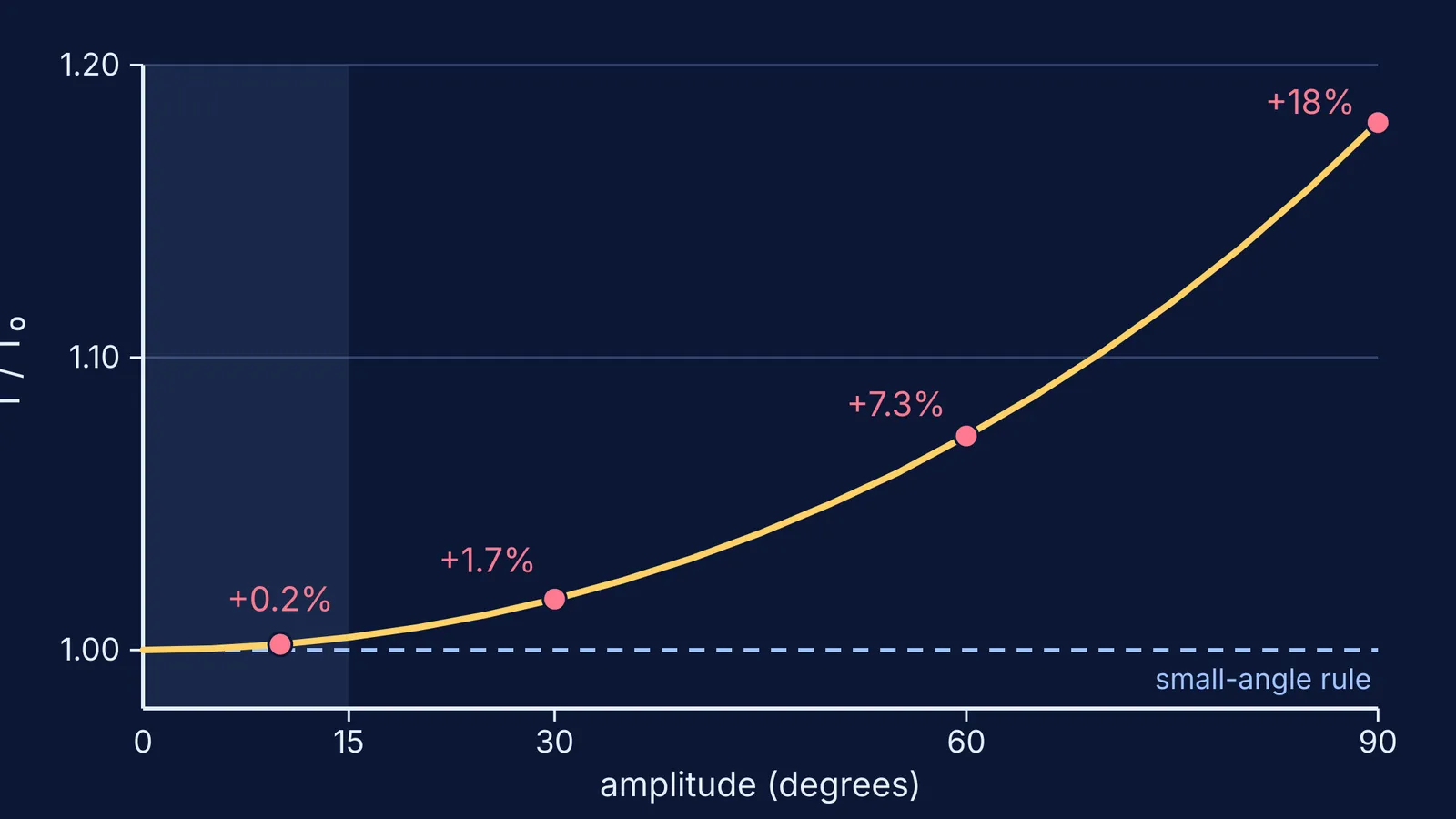
10 degrees: T/T₀ = 1.0019, so T ≈ 2.010 s (0.19% longer)
30 degrees: T/T₀ = 1.0174, so T ≈ 2.041 s (1.7% longer)
60 degrees: T/T₀ = 1.0732, so T ≈ 2.153 s (7.3% longer)
90 degrees: T/T₀ = 1.1803, so T ≈ 2.368 s (18% longer)
The same page works through a 1 m pendulum at 10 degrees, using g = 9.80665 m/s², and gets 2.0102 s exact against 2.0064 s from the simple formula, a difference of under 0.2% that agrees with the first line.
How do you test it in a simulation?
PhET's free Pendulum Lab suits this test. Its simulation file steps the full equation with sin θ, not the small-angle version, and it includes a stopwatch and a period timer, so it shows the effect instead of hiding it.
Set the length to 1.00 m, gravity to Earth and friction to zero.
Drag the bob to 10 degrees, release it and read the period timer. Do this three times and take the average.
Repeat at 30, 60 and 90 degrees.
Divide each period by 2.006 s to get T/T₀. Your 10-degree reading also works as a stand-in, since it is within 0.2% of T₀.
Plot T/T₀ against amplitude. You should see a nearly flat start that curves upward after about 30 degrees.
Write one sentence explaining the curve using sin θ.
At 10 degrees the gap from the simple formula is about 0.004 s per swing, far too small to catch by hand on one swing. Use the period timer, or time 10 swings and divide by 10. At 60 and 90 degrees even a hand stopwatch will show the difference.
If you would like to run this alongside other oscillation ideas, the Fermi Simulation Lab has interactive simulations for ideas that are easier to see than to read. Fermi's AI tutor can run the simulation with you and check your understanding as it goes.
What does this mean for exams and lab work?
In problems, a simple pendulum usually means small oscillations, and the question often says so. Use T₀ = 2π√(L/g) unless you are told otherwise.
In a real lab, keep the amplitude under about 15 degrees, where the series period formula gives an error below 0.5%. Our walkthrough of measuring g with a simple pendulum uses exactly this setup.
Proving a motion is SHM uses the same approximation; see how to prove SHM and find the period.
Open the simulation, write down your four predictions, and see how close you get.


