On this page
Check each part on its own before you look at the options. Here are 8 original items, easy to hard.
What do these questions cover?
Units 4 and 5 of NTA's Syllabus for JEE (Main) - 2027 list the fundamental principle of counting, permutations and combinations, the meaning of P(n, r) and C(n, r), and the binomial theorem for a positive integral index with its general and middle term. Every question stays inside that list and NCERT Class 11 Mathematics Chapter 6, Permutations and Combinations and Chapter 7, Binomial Theorem (Reprint 2026-27). Building the chapter from scratch? Start with how to prepare the binomial theorem for JEE Main.
Can you solve these statement questions?
Options for Q1 to Q4: (1) Both correct (2) Both incorrect (3) I correct, II incorrect (4) I incorrect, II correct
Q1 (easy). Statement I: The letters of BANANA can be arranged in 60 ways. Statement II: P(5, 2) = 10.
Answer: (3). I correct: 6!/(3! × 2!) = 720/12 = 60. II incorrect: P(5, 2) = 5 × 4 = 20; the value 10 is C(5, 2).
Trap: (1), reading P as C.
Q2 (medium). Statement I: There are 5040 four-digit numbers with all digits different. Statement II: A decagon has 35 diagonals.
Answer: (4). I incorrect: the first digit cannot be 0, so the count is 9 × 9 × 8 × 7 = 4536. P(10, 4) = 5040 also counts 0123. II correct: C(10, 2) − 10 = 45 − 10 = 35.
Trap: (1), forgetting the leading zero.
Q3 (medium). Statement I: The term independent of x in (x + 1/x)^10 is 252. Statement II: The middle term of (x + 2)^8 is 1120x⁴.
Answer: (1). I correct: T(r+1) = C(10, r) x^(10 − 2r), so r = 5 and the term is C(10, 5) = 252. II correct: with 9 terms, the middle one is T5 = C(8, 4) x⁴ 2⁴ = 70 × 16 x⁴ = 1120x⁴.
Trap: (3). Dropping the 2⁴ gives 70x⁴ and makes II look false.
Q4 (hard). Statement I: The sum of the coefficients of (1 − 2x)^7 is 1. Statement II: In (1 + x)^9 the greatest binomial coefficient occurs in exactly one term.
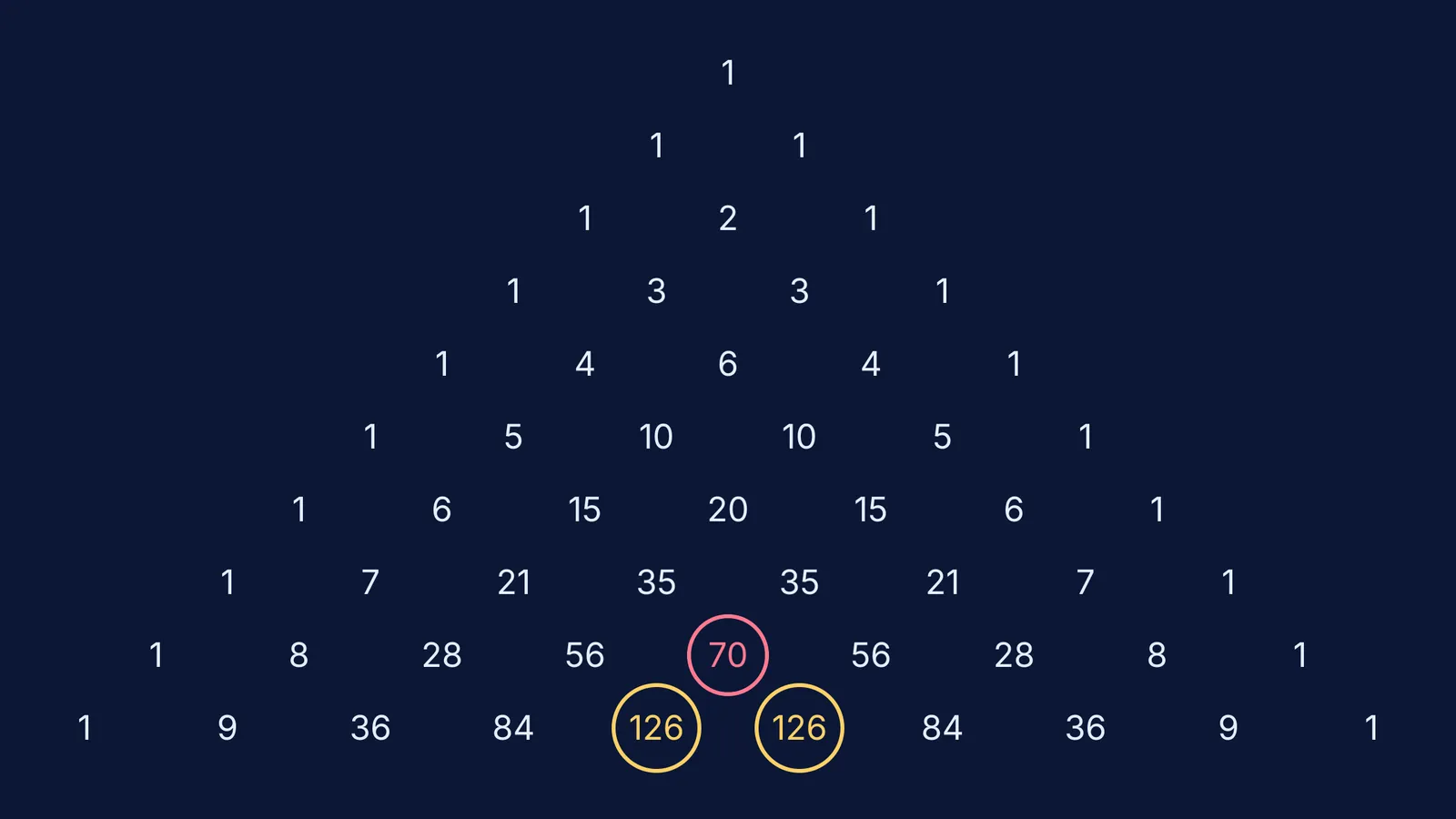
Answer: (2). I incorrect: put x = 1 to get (1 − 2)^7 = −1. II incorrect: n = 9 is odd, so there are two middle terms, T5 and T6, and C(9, 4) = C(9, 5) = 126.
Trap: (4). The rule that one middle term carries the greatest coefficient holds only for even n.
Can you solve these match-the-list questions?
Q5 (easy). Match each count.
List-I: A. Arrangements of all the letters of MATHS. B. Ways to choose 2 of 6 students for a committee. C. Ways to choose a captain and a vice-captain from 6 students. D. Ways to seat 5 people around a round table.
List-II: I. 15 II. 24 III. 30 IV. 120
(1) A-IV, B-III, C-I, D-II (2) A-IV, B-I, C-III, D-II (3) A-II, B-I, C-III, D-IV (4) A-IV, B-I, C-II, D-III
Answer: (2). A: 5 distinct letters, 5! = 120. B: C(6, 2) = 15. C: order matters, P(6, 2) = 30. D: fix one person, then (5 − 1)! = 24.
Trap: (1), swapping B and C. A committee has no order; a captain and a vice-captain do.
Q6 (medium). For the expansion of (2x + 1/x)^6, match each quantity.
List-I: A. Number of terms. B. Term independent of x. C. Coefficient of x². D. Sum of all the coefficients.
List-II: I. 240 II. 7 III. 729 IV. 160
(1) A-II, B-I, C-IV, D-III (2) A-IV, B-II, C-I, D-III (3) A-II, B-IV, C-I, D-III (4) A-II, B-IV, C-III, D-I
Answer: (3). The general term is C(6, r) 2^(6 − r) x^(6 − 2r). A: 6 + 1 = 7. B: r = 3 gives 20 × 8 = 160. C: r = 2 gives 15 × 16 = 240. D: put x = 1 to get 3⁶ = 729.
Trap: (1), swapping B and C. Solve 6 − 2r for each power instead of guessing r.
Q7 (medium). For the letters of PENCIL, match each count.
List-I: A. All arrangements. B. Arrangements with E and I together. C. Arrangements beginning with P. D. Arrangements with E somewhere before I.
List-II: I. 360 II. 720 III. 120 IV. 240
(1) A-II, B-IV, C-III, D-I (2) A-II, B-III, C-IV, D-I (3) A-I, B-IV, C-III, D-II (4) A-II, B-I, C-III, D-IV
Answer: (1). A: 6! = 720. B: glue E and I into one block, then 5! × 2 = 240. C: fix P, then 5! = 120. D: by symmetry, 720/2 = 360.
Trap: (2), giving B 120. The glued block still has 2 internal orders, EI and IE.
Q8 (hard). Match each item with its value.
List-I: A. Ways to share 10 identical sweets among 3 children so that each gets at least one. B. Non-negative integer solutions of x + y + z = 10. C. Ways to choose at least one book from 6 different books. D. C(7, 0) + C(7, 2) + C(7, 4) + C(7, 6).
List-II: I. 63 II. 36 III. 64 IV. 66
(1) A-IV, B-II, C-I, D-III (2) A-II, B-IV, C-III, D-I (3) A-IV, B-II, C-III, D-I (4) A-II, B-IV, C-I, D-III
Answer: (4). A: give each child 1, then share 7 freely: C(9, 2) = 36. B: C(12, 2) = 66. C: each book is in or out, minus the empty choice: 2⁶ − 1 = 63. D: these are the coefficients C(7, r) with even r, which add to half of 2⁷, so 1 + 21 + 35 + 7 = 64.
Trap: (1), swapping A and B. Ask whether zero is allowed before you choose the formula.
How do you attack these formats quickly?
Judge each statement alone, on paper, before reading the four options.
For every count, ask first: does order matter, and are repeats or zero allowed?
For a binomial item, write the general term once and read every part off it.
Settle the easier statement first; if it is false, two options go.
In a match grid, fix the surest pair and strike every code that disagrees.
If one slip keeps recurring, such as P versus C, the Fermi Problem Library has a step-by-step solver that explains the reasoning. For the rest of your JEE preparation, Fermi Test Prep covers JEE Main and Advanced.
Next, try 8 permutations and combinations numerical value questions and binomial theorem practice questions with full solutions.